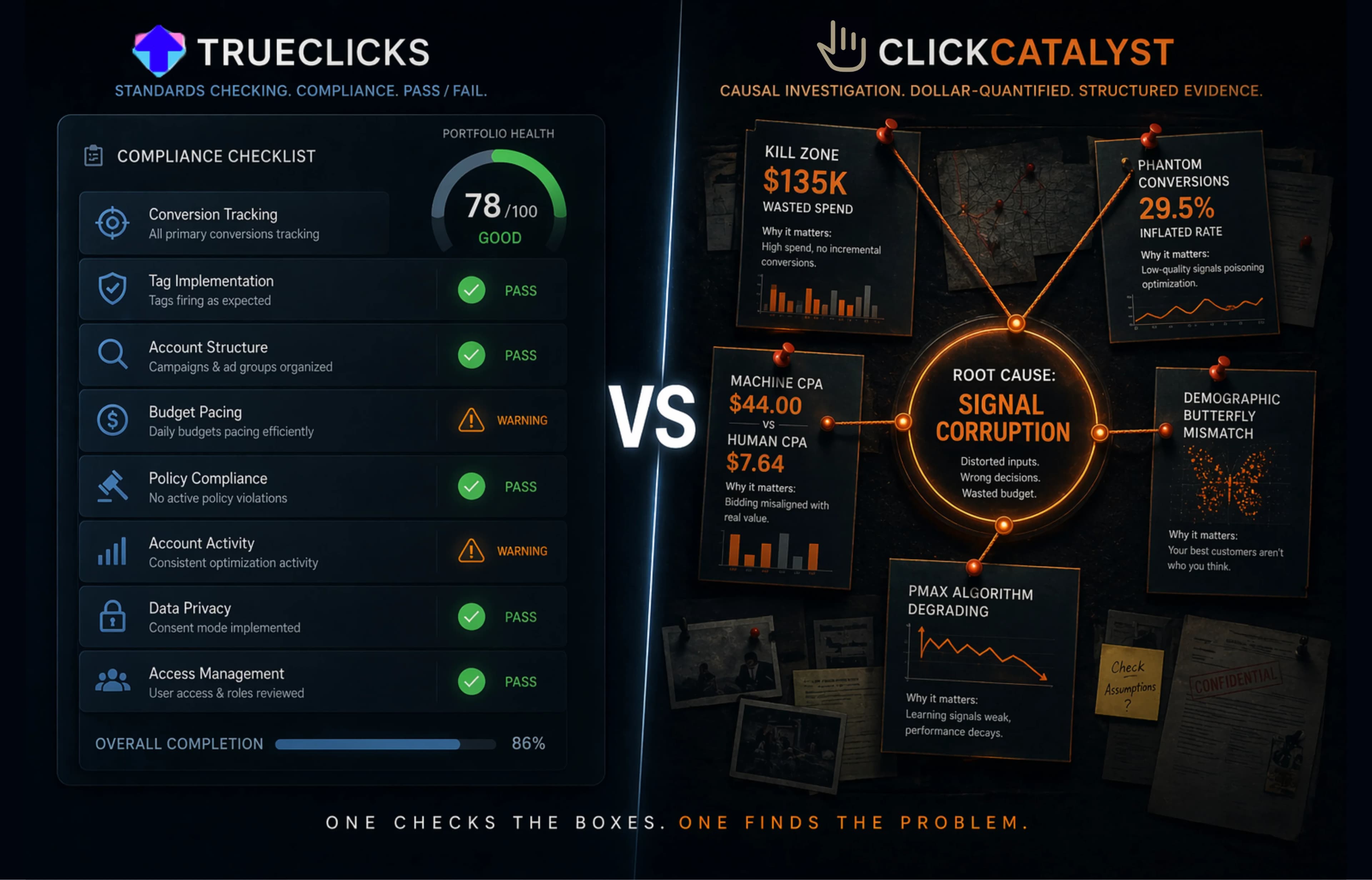
TrueClicks and ClickCatalyst sit in a specific corner of the Google Ads tool market that most broad comparison articles don't reach. They're not bid management platforms. They're not keyword research tools. They're not general PPC optimisation platforms with dashboards for every channel. Both are built around a shared premise: Google Ads accounts have structural problems the standard interface doesn't surface clearly, and finding those problems requires a dedicated audit layer.
That shared premise is why they appear in the same conversation. But what each tool means by "audit," how deeply it investigates, what it validates before drawing conclusions, and what a performance marketing agency can actually produce from the output — that's where this comparison becomes worth making carefully.
Full disclosure: I'm the founder of ClickCatalyst. I built it because compliance-based audit tools, including ones like TrueClicks, tell you whether an account is configured correctly — but not why it's generating wasted ad spend, or whether the data it's reporting can even be trusted. This comparison is objective. Where TrueClicks wins, I say so directly.
What TrueClicks Is Built Around
TrueClicks is a Google Ads auditing and compliance platform built specifically for PPC agencies managing large account portfolios. Its approach centres on automated compliance checking: it runs accounts against a comprehensive library of best-practice rules across multiple dimensions — campaign structure, keyword quality, ad copy, negative keywords, bidding settings, tracking configuration, and more — producing a scored health assessment showing where the account meets established standards and where it doesn't.
Automated best-practice compliance checking. TrueClicks covers a wide range of structural, technical, and settings-related checkpoints simultaneously. For agencies onboarding new clients, this provides a rapid baseline assessment across many dimensions at once — faster than manual investigation and comprehensive enough to catch the most common structural issues.
Account health scoring over time. The audit produces scores that can be tracked, giving agencies a metric for demonstrating improvement to clients and identifying which accounts in a portfolio need the most attention.
Automated portfolio monitoring. TrueClicks runs continuous monitoring across connected accounts, alerting to health score changes and new issues without requiring manual review triggers. For agencies managing large portfolios, this passive surveillance reduces the overhead of staying current.
Cross-account portfolio view. The dashboard gives a bird's-eye view of health scores and pending issues across all accounts simultaneously, useful for triage and prioritisation at the agency level.
These are meaningful capabilities for a specific workflow: systematic best-practice compliance maintenance, onboarding audits, and portfolio health monitoring. TrueClicks does this job well and has a defined audience of Google Ads agencies who have built their review process around it.
Where ClickCatalyst Is a Fundamentally Different Kind of Tool
Describing ClickCatalyst as a Google Ads auditing and compliance platform undersells it in the same way describing a diagnostic MRI as "a health check" undersells that versus a routine checkup.
TrueClicks checks accounts against best practices. ClickCatalyst investigates why accounts are underperforming — at which layer of the system the problem exists, what the budget leakage costs in exact dollar terms, what the causal chain looks like, and crucially, whether the data being used to make that diagnosis is actually trustworthy in the first place.
The distinction is between compliance auditing (does this account meet established standards?) and causal investigation (what is actually making this account lose money right now, and how much?).
Level Zero: System Readiness Before Any Diagnosis
Before ClickCatalyst draws a single diagnostic conclusion, it validates the foundation that conclusion would be built on. Level Zero — the System Readiness layer — contains four tools:
- Campaign Wizard — connection health, data pipeline status, historical data availability, and campaign intelligence from prior account performance to inform new campaign setup
- Conversion Setup — conversion tracking verification and configuration health
- Integrity Monitor — data reliability checks and tracking mismatch detection (currently evolving)
- Setup & Pulse — overall account readiness
The explicit framing: "Everything here must be green before insights mean anything."
TrueClicks checks whether conversion tracking exists and is configured. ClickCatalyst verifies whether the data flowing through it is actually reliable before any other layer of analysis begins. That's a different starting point with different implications for everything downstream.
Conversion Signal Integrity at Depth
This is the most significant gap in this comparison. In 2026, following Google's aggressive push toward broad match defaults, automated bidding, and AI-driven campaign types like Performance Max, Smart Bidding now controls bid decisions across the majority of the industry's ad spend. The quality of the conversion signal is therefore the most important variable in any account.
ClickCatalyst calculates attribution drift — the percentage gap between conversions Google Ads reports and those GA4 independently confirms — at the campaign level, with severity classification.
One finding from a real ClickCatalyst audit: a PMax campaign reporting 54 Ads conversions with only 20 GA4 conversions confirmed — a 64.8% drift rate classified as CRITICAL_BLIND. The system also calculates training data noise across the whole account (one account: 29.5% of the algorithm's training signal modelled rather than directly observed), and runs a Machine vs Human CPA comparison (one account: $44.09 machine CPA versus $7.64 human CPA — a 477% gap on equivalent non-brand demand). An account training its bid strategy on 30% phantom conversions is actively getting worse with every click, silently, in ways that don't show up in standard reporting until performance has already significantly declined.
TrueClicks doesn't diagnose this layer. ClickCatalyst was specifically built to find it.
Semantic Word Hierarchy and Causal Waste Structure
ClickCatalyst's Pattern Finder N-Gram Analysis builds a semantic word hierarchy — a tree structure showing primary waste words, their co-occurring words, the spend and conversion data at each node, and the causal pattern of how inefficient ad spend clusters form.
One finding from a real ClickCatalyst audit: the insight bar surfaced "89 waste words detected, burning $683.8K." The word "WATER" appeared as primary node at $202K wasted ad spend and 0.0x ROAS, expandable to co-occurring nodes for "BOTTLE" ($140K, 255 occurrences), "CLEAR" ($98.5K, 178 occurrences), "200ML" ($20.6K), "MINERAL" ($18K) — each with individual spend, count, ROAS, and Block buttons adding negatives directly from the tree without leaving the diagnostic view.
TrueClicks identifies that negative keywords should be added. ClickCatalyst shows the semantic architecture of why budget leakage accumulated, what it cost in exact dollars, and removes it in context.
Kill Zone Detection and Quantified Temporal Waste
The Context Engine's Time & Day Patterns analysis identifies specific hourly windows where spend is high and conversions are consistently near-zero, calculates the wasted ad spend in exact dollar terms, and provides an interactive 168-slot ad schedule painter where you click-drag to mark hours active or paused — colour-coded from the account's own ROAS data — then apply the schedule directly to the campaign with a single button.
One finding from a real ClickCatalyst audit: "Kill Zone detected: 0:00–1:00 — $135.8K wasted."
This isn't a scheduling feature. It's a temporal budget leakage diagnostic with execution embedded. TrueClicks can flag that ad scheduling isn't configured. ClickCatalyst shows which specific hours are generating which specific dollar amounts of wasted ad spend and applies the fix from the same screen.
Demographic and Audience Budget Leakage
The Context Engine's Audience & Demographics analysis includes the Demographic Butterfly — a mirrored pyramid visualisation showing spend by demographic segment on the left and revenue on the right, with ROAS colour-coding at every segment. The mismatch between where budget flows and where revenue comes from is visible immediately, without cross-referencing multiple reports manually.
The Audience Cohort Control Panel shows every audience segment with ROAS, CVR, spend, and a one-click Exclude button. TrueClicks monitors whether audience segments are configured. ClickCatalyst identifies which ones are generating inefficient ad spend and removes them in context.
Algorithm Lifecycle Diagnostics
ClickCatalyst's Growth Engine classifies each campaign by algorithm maturity stage — Calibration (learning phase), Exploitation (operating on strong signals, ready for scaling decisions), or Degradation (signal quality declining, performance deterioration incoming) — and quantifies how much total spend sits in each stage.
A portfolio where significant spend is locked in Degradation stage is heading toward visible underperformance in four to eight weeks. This forward-looking diagnostic doesn't exist in TrueClicks. Compliance tools check current status. They don't assess the trajectory of the optimisation engine running underneath current status.
PMax Observability
ClickCatalyst's PMax Audit PDF provides something genuinely unique in the current market: deep observability into Performance Max. PMax is intentionally opaque — Google provides minimal visibility into asset group performance, search term matching, and conversion attribution within PMax.
The PMax Audit surfaces asset group spend concentration and critical over-dependence flags, attribution drift between Ads and GA4, zombie products burning spend with zero sales silently corrupting the audience signal, diminishing returns analysis (whether marginal ROAS has already fallen below average ROAS, meaning every additional dollar reduces account-level efficiency), and algorithm maturity staging per campaign.
One finding from a real ClickCatalyst audit: a PMax campaign with 28.6% attribution drift, a single asset group absorbing $12.4K flagged CRITICAL_CONCENTRATION, and 9 zombie products with $1.2K in zero-sale spend corrupting the bidding signal.
TrueClicks checks whether PMax campaigns have the recommended structural settings. ClickCatalyst opens the black box.
White-Label Client Audit Deliverables
TrueClicks produces health score dashboards and audit outputs designed for internal agency use and metric-based client reporting. ClickCatalyst generates 18+ white-label PDF audit reports — branded with the agency name, structured as multi-chapter diagnostic narratives with opening verdicts, chapter-level diagnostic findings, quantified dollar costs, data visualisations, and prioritised action plans — ready to present to a client who doesn't know what an N-gram is.
The Margin Erosion Audit, to take one example, can surface a finding that no health score dashboard ever will: your account has a positive ROAS, a positive-looking dashboard, and a net loss of $3.8K per month after product costs — because the ROAS target was set below break-even and the algorithm hit it perfectly. That finding, documented in a 16-page branded report, is what changes a client relationship from "our agency manages our ads" to "our agency found something Google wasn't going to tell us."
The first is a vendor. The second is a strategic partner.
Where TrueClicks Has Genuine Advantages
Comprehensive best-practice coverage breadth. TrueClicks's rules library is wide and covers many account dimensions simultaneously in a single automated pass. For agencies needing rapid baseline assessments across many accounts — especially during client onboarding — the automated multi-dimensional compliance audit is fast and thorough at the structural and settings level.
Low-overhead passive portfolio surveillance. The automated alerting system runs continuously across connected accounts without manual review triggers, surfacing health score changes and new issues passively. For agencies managing large portfolios, this passive monitoring reduces the cognitive load of staying current.
Defined methodology for Google Ads best practices. TrueClicks has built a well-documented, consistently applied set of best-practice rules that agencies can reference when explaining findings to clients. The methodology is transparent and the standards are established.
Pricing and Economic Comparison
Both tools are positioned for agency use with comparable pricing tiers for mid-size agencies.
ClickCatalyst Pro is $103/month (annual) covering up to 10 Google Ads and GA4 connections with 3 branded PDF audit reports monthly. Business is $208/month (annual) covering up to 50 connections with unlimited white-label PDFs and custom pricing available for larger portfolios. The Founding Agency Program offers 50% off year one for the first 100 agencies.
For agencies whose retainer model includes monthly audit deliverables, ClickCatalyst's PDF output creates a direct path to cost recovery. Unlimited white-label audit PDFs at the Business tier, used as monthly client deliverables, can offset the tool's cost against retainer justification alone — independent of the diagnostic value the dashboards provide.
The Decision
Choose TrueClicks if: Your primary need is systematic best-practice compliance monitoring across a portfolio, you want automated alerts that surface health issues passively without manual review, and your client reporting needs centre on health scores and metric dashboards rather than narrative diagnostic deliverables.
Choose ClickCatalyst if: You need to find why an account is generating budget leakage at the causal level — not just which metrics are off — you need to validate the integrity of your conversion data before any diagnosis means anything, you want PMax observability that surfaces what the native interface deliberately obscures, you need contextual budget leakage diagnostics across time, geography, device, audience, and algorithm lifecycle dimensions that compliance-based audits don't reach, and you need professional client-facing audit documents that communicate diagnostic findings in plain language and justify what you charge.
The clearest way to frame this: TrueClicks asks "Is this account configured correctly?" ClickCatalyst asks "What is structurally causing this account to lose money, what is it costing, and why?"
Both are legitimate questions. In an era where Google's AI is making more autonomous decisions than ever before, an account can be perfectly configured against every best practice and still have corrupted conversion signals, a degrading algorithm, $135K burning in Kill Zone hours, and a Demographic Butterfly showing budget flowing into demographic segments that never convert.
A compliance audit won't find those problems. A causal investigation will.
Finding them — and telling that story to a client in a document they can read and act on — is what ClickCatalyst was built for.
If you're also comparing Optmyzr or Adalysis, see our detailed comparisons: ClickCatalyst vs Optmyzr and ClickCatalyst vs Adalysis.