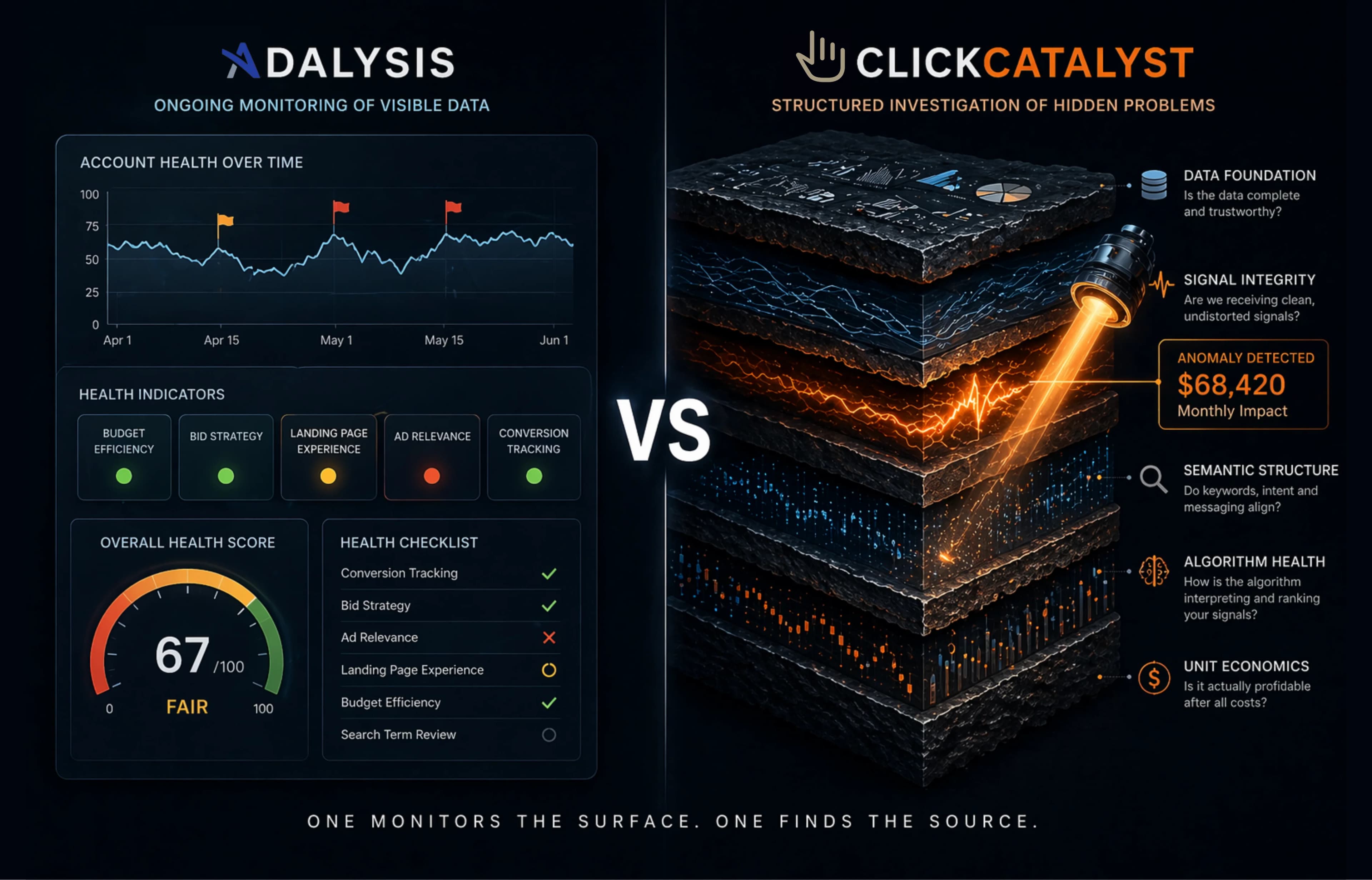
If you've been searching seriously for a Google Ads account audit platform, you've likely landed on both Adalysis and ClickCatalyst. They're two of the relatively few tools in the market genuinely focused on audit depth rather than automation breadth — neither is primarily a bid management platform, neither is a bulk editor, and both are specifically trying to surface problems the standard Google Ads interface doesn't show you clearly.
That shared focus is why they appear in the same conversation. But the way each tool approaches the audit — which layers of the account it examines, how deep it goes, and critically what a performance marketing agency can produce from the output — is where this comparison becomes genuinely important.
Full disclosure: I'm the founder of ClickCatalyst. I built it after years of running Google Ads accounts where tools like Adalysis helped me maintain Search campaign hygiene but didn't answer the deeper question of why accounts structurally underperformed. This comparison is honest about where Adalysis wins — because for certain workflows, it genuinely does.
What Adalysis Was Built to Do
Adalysis was designed specifically for Search Ads management and has developed a well-regarded set of capabilities for the ongoing work of keeping accounts structurally clean and creatively tested.
Responsive Search Ad (RSA) testing and statistical significance. Adalysis manages A/B tests across large RSA inventories at scale — tracking statistical significance, surfacing tests that have reached a decision point, and managing the process of pausing losers across campaigns and ad groups. For accounts with a genuine commitment to systematic creative testing at volume, this is a meaningful and well-implemented capability. With Google having retired Expanded Text Ads, RSA testing management has become a core operational need for any serious Google Ads specialist.
Account health monitoring. Adalysis runs regular automated health checks flagging structural issues: ad groups without ads, keywords without impressions, campaigns approaching budget caps, duplicate keywords, and similar maintenance gaps. The monitoring is designed to catch hygiene issues before they compound into performance problems.
Quality Score analysis. Adalysis provides QS breakdowns at the keyword level — ad relevance, expected CTR, landing page experience — with historical trending. Understanding QS movement over time helps diagnose CPA inflation and identify which keywords need creative or landing page attention.
Search term and negative keyword management. Adalysis surfaces wasting search terms, identifies conflicts between keywords across campaigns, and provides bulk tools for negative keyword additions. N-gram analysis allows segmentation of search terms by word-level patterns for identifying inefficient ad spend themes.
These are real capabilities, well-implemented. The question isn't whether Adalysis does these things well. It's whether these are the layers of the account where your most significant problems actually exist.
Where ClickCatalyst Goes Beyond Adalysis
Level Zero: Data Foundation Validation
ClickCatalyst begins with something Adalysis doesn't address at all: verifying that the data feeding the diagnostic is trustworthy before the diagnostic begins. Level Zero — System Readiness — contains four tools:
- Campaign Wizard — connection health, data pipeline status, and campaign intelligence from historical performance to inform new campaign setup
- Conversion Setup — conversion tracking configuration and signal verification
- Integrity Monitor — data reliability and tracking mismatch detection (currently evolving)
- Setup & Pulse — overall account readiness check
The explicit framing: "Everything here must be green before insights mean anything."
This matters enormously in 2026, following Google's aggressive push toward broad match defaults, automated bidding, and AI-driven campaign types like Performance Max. With Smart Bidding now controlling bid decisions across the majority of the industry's ad spend, the quality of the conversion signal is the most important variable in the account. Adalysis analyses what your conversion data shows. ClickCatalyst first asks whether that data is accurate.
Conversion Signal Integrity
This is the most significant gap in the comparison. ClickCatalyst's Conversion Quality analysis and AI Max Signal & Strategy Audit surface attribution drift — the percentage gap between conversions Google Ads reports and those GA4 independently confirms — at the campaign level, with severity classification.
One finding from a real ClickCatalyst audit: a PMax campaign reporting 54 Ads conversions with only 20 GA4 conversions confirmed — a 64.8% drift rate classified as CRITICAL_BLIND. The tool calculates overall training data noise (one account: 29.5% of the algorithm's training signal was modelled rather than directly observed), and runs a Machine vs Human CPA comparison — one account: $44.09 machine CPA versus $7.64 human CPA, a 477% gap on equivalent non-brand demand at the same time.
An account with 30% modelled conversions is asking Smart Bidding to optimise against data that is 30% estimated. Adalysis doesn't diagnose this layer. It optimises within it.
Semantic Word Hierarchy N-Gram Analysis
ClickCatalyst's Pattern Finder goes beyond search term frequency tables to build a semantic word hierarchy — a tree structure showing primary waste words, their co-occurring words, spend and conversion data at each node, and the causal relationship between word combinations.
One finding from a real ClickCatalyst audit: the word "WATER" as a primary node at $202K in wasted ad spend at 0.0x ROAS, with expandable co-occurrence nodes for "BOTTLE" ($140K, 255 occurrences), "CLEAR" ($98.5K, 178 occurrences), "200ML" ($20.6K, 47 occurrences) — each with individual spend, count, ROAS, and Block buttons that add negatives directly from the tree view. This is the causal architecture of how budget leakage compounds semantically. Very few platforms in the current market offer this level of granular semantic waste mapping.
Algorithm Lifecycle Diagnostics
ClickCatalyst's Growth Engine tracks algorithm maturity across three stages — Calibration (learning phase), Exploitation (operating on strong signals), and Degradation (declining signal quality) — and quantifies what percentage of total spend sits in each stage.
A portfolio where significant spend is locked in Degradation stage is heading toward a performance problem that current metrics don't yet show. This forward-looking diagnostic doesn't exist in Adalysis. It monitors current performance. It doesn't assess the health of the optimisation engine running underneath current performance.
Contextual Targeting Budget Leakage Analysis
The Context Engine covers four targeting dimensions systematically that Adalysis doesn't analyse at depth:
Time and Day: Kill Zone detection with dollar-quantified wasted ad spend — one finding from a real ClickCatalyst audit: "Kill Zone detected: 0:00–1:00 — $135.8K wasted" — and an interactive 168-slot ad schedule painter where you click-drag to mark active and paused hours with colour coding from actual ROAS data, then apply the schedule directly to the campaign.
Geo and Device: Geographic performance map ranked by ROAS, device ROAS breakdown, and Mobile App Waste detection with a one-click "Exclude All Mobile Apps" button. One finding from a real ClickCatalyst audit: $89.5K in mobile app spend at 0.00x ROAS, eliminated with a single click.
Audience and Demographics: The Demographic Butterfly visualisation showing the mismatch between where spend flows and where revenue comes from, the Acquisition Leakage funnel filterable by demographic segment, and the Audience Cohort Control Panel with one-click Exclude buttons.
Tech and UX: The Browser Matrix identifying high-traffic low-conversion browser combinations indicating UX issues, The Fold Analysis by screen resolution, and the Bug Hunter showing granular device model-level performance anomalies.
Unit Economics and True Business Profitability
ClickCatalyst's Analyst level runs a Profit Simulator with an adjustable target profit margin slider calculating maximum tolerable CAC in real time, tracks the LTV:CAC ratio, and shows daily profit contribution trends. The Quality Matrix maps campaigns by acquisition cost versus customer loyalty score — identifying Holy Grail campaigns (low CAC, high loyalty) versus Churn & Burn campaigns (low CAC, near-zero loyalty) versus The Waste (high CAC, low loyalty).
This is the layer that connects Google Ads performance to actual business economics. Adalysis doesn't reach this layer.
PMax Observability
ClickCatalyst's PMax Audit PDF surfaces asset group spend concentration and critical over-dependence flags, attribution drift between Ads and GA4, zombie products burning budget with zero sales corrupting audience signals, diminishing returns analysis showing whether marginal ROAS has already fallen below average ROAS, and algorithm maturity staging.
One finding from a real ClickCatalyst audit: a PMax campaign showing 28.6% attribution drift, a single asset group absorbing $12.4K flagged as CRITICAL_CONCENTRATION, and 9 zombie products with $1.2K in zero-sale spend silently corrupting the bidding signal.
White-Label Client Deliverables
In my experience working with mid-size agencies, this is where the practical comparison diverges most completely — and it's the difference that determines whether a client relationship survives a bad quarter.
Adalysis produces health score dashboards and audit outputs designed primarily for internal use by Google Ads specialists. ClickCatalyst generates 18+ white-label PDF audit reports branded with the agency name, structured as multi-chapter diagnostic narratives, ready to hand to a client who has never heard of an N-gram analysis. The Efficiency & Waste Audit opens with: "67.6% of total spend — $9K — generated zero conversions. 'bulk candy wholesale' consumed $39.4K with zero conversions — your single largest search term bleed. 4 of 5 audit areas are critical — structural intervention required this week."
That sentence is understood by any business owner. It doesn't require PPC literacy. It communicates that money is being wasted, what it is costing, and that something specific can be done about it today. That's what justifies a retainer. That's what builds client trust through a difficult performance period.
Where Adalysis Has the Edge
RSA testing workflow at volume. For performance marketing agencies with a genuine systematic A/B testing programme across large RSA inventories — hundreds of ad groups, thousands of assets — Adalysis's testing management tools are more mature and specifically designed for that workflow. If RSA testing cadence and statistical significance tracking at scale is your primary bottleneck, Adalysis handles it with more dedicated tooling.
Passive health monitoring across a portfolio. Adalysis's automated alert system for structural health issues runs passively and flags problems without requiring manual review triggers. For agencies managing many accounts where something is always due for a check, this low-overhead monitoring is operationally useful.
Search-specific maturity. Adalysis has been refined for the specific workflow of ongoing Search campaign management over many years. Its negative keyword tools, QS tracking, and ad health monitoring have the polish of a mature PPC optimisation platform in a well-defined lane.
The Client Deliverable Economic Argument
The PDF deliverable difference has a direct revenue implication worth stating plainly. An Adalysis report shows a client their account health scores and performance metrics — useful for internal analysis and communication with clients who read data fluently.
A ClickCatalyst PDF audit tells a client: here is the specific problem, here is what it is costing you this month in exact dollars, here is why it exists, here is the causal chain that produced it, and here is the prioritised list of actions in order of estimated financial recovery.
The Margin Erosion Audit, for example, can surface a finding like: your account has positive ROAS but negative true profit — you're losing $3.8K per month after costs while the dashboard shows everything is working. That finding, presented in a 16-page branded document with charts and an action plan, is the kind of deliverable that a client remembers six months later when a competitor calls them.
If three branded audit PDFs per month — included in ClickCatalyst's Pro plan at $103/month — allow an agency to retain one client longer or justify one retainer increase, the tool's cost is covered many times over.
Pricing
Adalysis pricing is account-connection based, with plans scaling from small single-account users to enterprise agency portfolios, broadly in the same mid-market range as ClickCatalyst for comparable connection counts.
ClickCatalyst Pro is $103/month (annual) covering up to 10 Google Ads and GA4 connections with 3 branded PDF audit reports monthly, auto-clean search terms, and waste recovery workflows. Business is $208/month (annual) covering up to 50 connections with unlimited white-label PDFs and custom pricing available for larger portfolios. The Founding Agency Program offers 50% off year one for the first 100 agencies.
The Decision
Choose Adalysis if: Your primary need is rigorous RSA testing management across high volumes of Search campaigns, you want mature automated health monitoring running passively across your portfolio, and your client communication needs are primarily metric-based rather than diagnostic-narrative.
Choose ClickCatalyst if: You need to find why an account is generating inefficient ad spend rather than just track which metrics are off, you need to validate that your conversion data is trustworthy before any optimisation analysis means anything, you want PMax observability beyond what the native interface shows, you need contextual budget leakage diagnostics across time, geo, device, audience, and algorithm lifecycle dimensions, and you need professional client-facing audit deliverables that communicate findings in plain language.
Adalysis audits what Google shows you. ClickCatalyst finds what Google doesn't show you, validates the data foundation before it starts, and produces the document that makes a client understand why the problem existed and what fixing it is worth.
That's a different audit. For a different purpose. Choose accordingly.
If Optmyzr or TrueClicks are also on your shortlist, see our detailed comparisons: ClickCatalyst vs Optmyzr and ClickCatalyst vs TrueClicks.