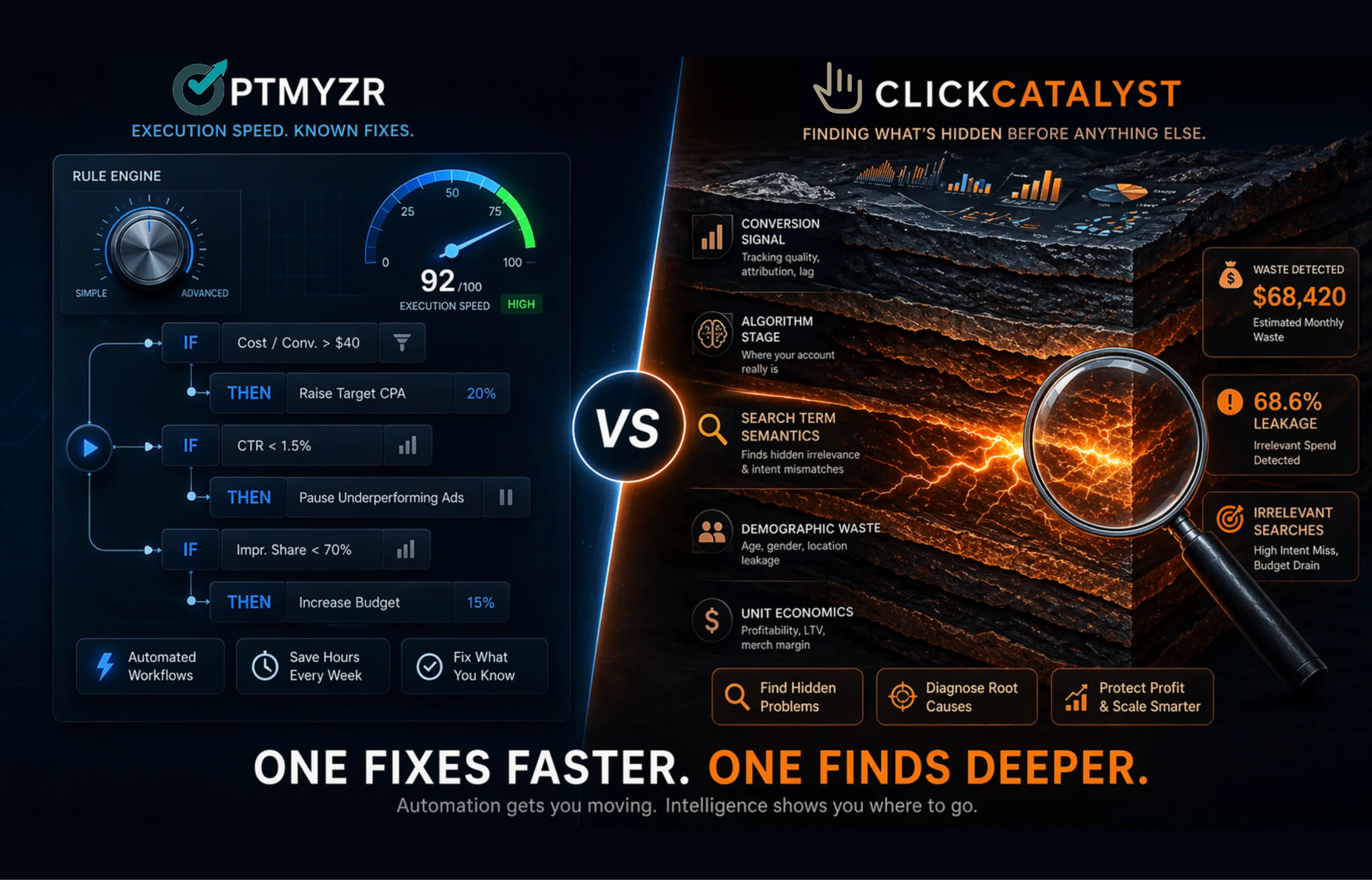
There's a moment every Google Ads specialist knows well. You're looking at a campaign with rising CPA inflation and declining ROAS. Something is structurally broken — budget leakage is building — but the platform isn't telling you what, and your current Google Ads management software is surfacing the same numbers Google already showed you, just formatted differently.
That's the gap both Optmyzr and ClickCatalyst are trying to close. But they're closing it in fundamentally different ways. And if you're evaluating both right now, understanding that difference will determine whether you choose the right PPC optimisation platform for the problem you actually have.
Full disclosure: I'm the founder of ClickCatalyst. I built it because I spent years managing Google Ads accounts and using tools like Optmyzr in my own work — and while Optmyzr is genuinely good at what it does, it didn't solve the diagnostic problem I kept running into: not knowing why an account was underperforming at the structural level. This comparison reflects that experience honestly, including where Optmyzr wins.
This isn't a feature checklist. It's an honest breakdown of what each tool is philosophically built to do, where each one genuinely wins, and which one belongs in your ad tech stack based on your role, your agency size, and what your accounts need most right now.
The Philosophical Difference First
Before comparing features, you need to understand what each tool believes about the primary job of a Google Ads specialist.
Optmyzr's belief: You already know what good looks like and need tools to implement optimisations faster, at scale, with less manual effort. The problem it solves is execution speed and operational efficiency.
ClickCatalyst's belief: Most wasted ad spend is structurally invisible — not because managers lack skill, but because Google's interface isn't designed to show you where the real problems are, and most platforms don't look deep enough to find them. The problem it solves is diagnostic clarity: finding the root cause of CPA inflation and budget leakage before applying any fix.
Neither belief is wrong. They describe different problems that real performance marketing agency owners face at different moments. An agency managing 40 client accounts daily needs execution speed. A Google Ads specialist trying to understand why a previously healthy account started declining six weeks ago needs diagnostic depth. The mistake is assuming one PPC optimisation platform does both jobs equally well.
What Optmyzr Is Actually Built For
Optmyzr was founded in 2013 by former Google employees and has spent over a decade refining a specific workflow: connect your accounts, surface recommendations, approve and apply them through bulk bid adjustments, rule-based automation, and custom Google Ads scripts.
Its core strengths are real and well-documented.
The Rule Engine is the product's centrepiece. You build if/then logic that triggers automated actions — pause a keyword when CPA exceeds a threshold, increase bids when conversion rate crosses a target, send a Slack alert when budget pacing goes off track. For agencies running 20+ accounts, this is genuinely transformative. Tasks that previously required daily manual checks become automated guardrails that run without your involvement.
One-click optimisations are designed for speed. Bid adjustments, keyword additions, negative keyword suggestions, RSA headline refreshes — these surface as batched recommendations you can approve or dismiss quickly. The workflow is: see the recommendation, understand why it was flagged, act. Repeat across accounts.
Multi-platform support means Optmyzr handles Google, Microsoft, Amazon, and Meta from a single interface with consolidated reporting across platforms. For performance marketing agencies billing across channels, the unified portfolio view is operationally significant.
The Blueprints feature lets you build account health checklists that run automatically across your portfolio, flagging any account that doesn't meet your defined standards. For agencies with a repeatable methodology, this is a quality control mechanism that scales.
What Optmyzr assumes throughout all of this: you already understand why something is underperforming. Its recommendations tell you what to change. They don't walk you through the causal chain of why the problem exists and which layer of the account is responsible for it.
What ClickCatalyst Is Actually Built For
ClickCatalyst is built around a different starting point: most wasted ad spend isn't visible in the standard interface, and most Google Ads management software doesn't show you the structured diagnostic picture needed to find it.
The product operates through the ClickHub interface, organised across an eight-level diagnostic framework covering three phases — What's Happening, Why It's Happening, and What Happens Next. Critically, before any of those phases begins, there is Level Zero: System Readiness — the foundation that most tools skip entirely.
Level Zero contains four tools:
- Campaign Wizard — connection health, data pipeline status, historical data availability, and importantly, the ability to start new campaigns informed by insights from previous campaign performance
- Conversion Setup — conversion tracking configuration and signal verification
- Integrity Monitor — data reliability and tracking mismatch detection (currently evolving)
- Setup & Pulse — overall connection health and account readiness
The framing is explicit: "Everything here must be green before insights mean anything."
This matters because ClickCatalyst's entire diagnostic architecture is built on a premise Optmyzr doesn't address: the data feeding your optimisations might be wrong. If conversion signals are corrupted, if there's a GA4-to-Ads mismatch, if your tag is misfiring — any recommendation built on that data is built on a false foundation. ClickCatalyst validates the foundation before diagnosing what's built on it.
The distinction that matters practically: in Optmyzr, you see a recommendation. In ClickCatalyst, you see the evidence chain that produced it — the data source, the causal mechanism, the dollar cost of the problem — and you can apply the fix from the same screen where you understood it.
Where ClickCatalyst Goes Deeper Than Optmyzr
N-Gram Analysis with Semantic Word Hierarchy
ClickCatalyst's Pattern Finder N-Gram Analysis decomposes every search term in the account down to individual word-level performance. Not just "here are your top wasting keywords" — a full semantic tree structure showing every significant word, its co-occurring words, their combined spend, conversion volume, and ROAS, with a Block button at every node that adds the word as a negative directly from the tree.
One finding from a real ClickCatalyst audit: the insight bar surfaced "89 waste words detected, burning $683.8K." Clicking into the N-Gram tree showed the word "WATER" at $202K spend and 0.0x ROAS, with co-occurring nodes for "BOTTLE" ($140K), "CLEAR" ($98.5K), "200ML" ($20.6K) — each expandable with their own co-occurrence data. This is causal semantic structure, not a flat list of underperforming keywords. Very few platforms in the current market offer this level of granular semantic waste mapping.
Conversion Signal Integrity
This is where the gap between the two platforms is most significant. ClickCatalyst's Conversion Quality analysis and AI Max Signal & Strategy Audit surface attribution drift — the percentage gap between conversions reported in Google Ads and those confirmed in GA4 — at the campaign level.
One finding from a real ClickCatalyst audit: a PMax campaign reporting 54 conversions in Ads with only 20 confirmed in GA4 — a 64.8% drift rate classified as CRITICAL_BLIND. The tool also calculates training data noise (one account: 29.5% of the algorithm's training signal was modelled rather than directly observed), and runs a Machine vs Human CPA comparison — one account showed $44.09 machine CPA versus $7.64 human CPA, a 477% gap on the same account at the same time.
Optmyzr builds recommendations on the conversion data you have. If that data is 30% phantom, Optmyzr's recommendations are built on a corrupted foundation. ClickCatalyst finds that before anything else.
Kill Zone Detection
The Context Engine's Time & Day Patterns analysis identifies specific hourly windows where spend is consistently high and conversions are consistently zero, calculates the waste in dollar terms — one finding from a real ClickCatalyst audit: "Kill Zone detected: 0:00–1:00 — $135.8K wasted" — and provides an interactive ad schedule painter where you click-drag across a 168-slot grid to mark hours as active or paused, colour-coded by actual ROAS data, then apply the schedule to the campaign with a single button.
This isn't a scheduling tool. It's a budget leakage detection tool with a scheduling interface attached. The distinction is whether you're building a schedule from instinct or from data showing exactly which hours are generating inefficient ad spend.
Demographic Butterfly
The Context Engine's Audience & Demographics tab visualises spend and revenue by age group and gender simultaneously in a mirrored pyramid — spend on the left, revenue on the right, ROAS colour-coded at each segment. Mismatches between where budget flows and where revenue comes from are immediately visible without any manual cross-referencing.
Algorithm Lifecycle Diagnostics
ClickCatalyst's Growth Engine tracks where each campaign sits in its algorithm lifecycle: Calibration (learning phase), Exploitation (performing on strong signals), or Degradation (signal quality declining). It quantifies how much of total spend sits in each stage.
A campaign can have historically good performance metrics while its algorithm is actively degrading — meaning current spending decisions are based on declining signal quality that won't show up as visible performance problems for another four to eight weeks. That forward-looking diagnostic doesn't exist in Optmyzr.
Unit Economics and True Profitability
ClickCatalyst's Analyst level runs a Profit Simulator with an adjustable target profit margin slider calculating maximum tolerable CAC in real time, tracks the LTV:CAC ratio, and shows daily profit contribution trends. The Quality Matrix shows which campaigns acquire customers who return versus customers who churn. This connects Google Ads performance to actual business economics — the question most clients actually care about, which is not "is my ROAS good?" but "am I actually making money after costs?"
PMax Observability
ClickCatalyst's PMax Audit PDF does something no other Google Ads management software does at depth: it opens the Performance Max black box. PMax is the least transparent campaign type Google has ever shipped. The PMax Audit surfaces asset group spend concentration, attribution drift between Ads and GA4, zombie products burning budget with zero sales, diminishing returns analysis, and algorithm maturity staging per campaign.
One finding from a real ClickCatalyst audit: a PMax campaign showing 28.6% attribution drift, a single asset group absorbing $12.4K flagged as CRITICAL_CONCENTRATION, and 9 zombie products with $1.2K in zero-sale spend silently corrupting the bidding signal. This level of PMax observability exists nowhere else in the current market.
White-Label Audit PDFs
ClickCatalyst generates 18+ professional multi-chapter PDF audit reports branded with the agency name — Efficiency & Waste Audit, AI Max Signal & Strategy Audit, PMax Black Box & Algorithm Audit, Search Query Bleed Audit, Tracking Mismatch Audit, Margin Erosion Audit, and more. Each is 15–19 pages with structured narrative: opening verdict with action count and severity, chapter-by-chapter diagnostic sections, data visualisations, and a methodology appendix.
Optmyzr has reporting templates and PDF exports. They are not the same category of output. An Optmyzr report shows performance metrics. A ClickCatalyst PDF audit tells a diagnostic story with a named problem, a quantified financial cost, a causal explanation, and a ranked remediation plan. One is data. The other is a deliverable.
Where Optmyzr Wins
This comparison would be incomplete without acknowledging where Optmyzr is genuinely better.
Multi-platform breadth. If your agency manages Microsoft Ads, Amazon Ads, and Meta alongside Google Ads, Optmyzr handles all of them from a single interface. ClickCatalyst is currently Google Ads and GA4 focused, with expansion to other ad platforms on the long-term roadmap. For multi-channel performance marketing agencies today, Optmyzr's cross-platform support is a real operational advantage.
Rule Engine depth and maturity. Optmyzr's rule-based automation with 50+ pre-built templates, custom if/then logic, and custom Google Ads scripts without coding is more mature as a pure automation layer. If your primary bottleneck is automating routine bulk bid adjustments, budget pacing, and keyword management across a large account portfolio, Optmyzr handles this at scale in a way ClickCatalyst's current automation doesn't match.
Platform tenure and integrations. Optmyzr has been in the market since 2013, manages over $5 billion in ad spend according to their own published figures, and has deep integrations built over years. The Slack alerts, Blueprint health checks, and Portfolio Dashboard are production-tested features with years of refinement behind them.
The Workflow Difference That Actually Matters
Here's the practical scenario that clarifies everything: a client account's ROAS has declined 30% over six weeks. You need to find out why and present a recovery plan.
In Optmyzr: You check performance dashboards, review campaign-level metrics, look at any rule alerts that fired, check auction insights, and review pending recommendations. You'll find what metrics changed. Finding why requires you to already have a hypothesis.
In ClickCatalyst: You start at Level Zero — confirm connection health, verify conversion signal integrity, check for attribution drift distorting the picture. Move to Exploratory Data Analysis and use scatter plots with Profitability and Efficiency lenses to identify which campaigns broke the relationship between spend and revenue. Move to the Search Hygiene Cockpit to check for new wasting search terms or cannibalization. Check the Pattern Finder N-Gram tree for semantic clusters that changed behaviour. Go to the Context Engine for new Kill Zone hours or demographic segments driving inefficient ad spend. Check the Growth Engine's algorithm maturity view for campaigns that moved into Degradation stage. The insight bar on each dashboard surfaces the most important finding without requiring you to know which question to ask first.
At the end of this process, generate an Efficiency & Waste Audit PDF and an AI Max Signal Audit PDF — branded for your client, narrating the complete diagnostic story with a prioritised action list.
One workflow finds what changed. The other finds why it changed and validates that the data showing the change is actually trustworthy.
Pricing Reality
Optmyzr starts at $249/month (monthly billing) for up to $10,000 in ad spend managed, scaling to $499/month for up to $50,000 in spend. The pricing is tied to ad spend, meaning costs compound as client budgets grow.
ClickCatalyst Pro is $103/month (annual billing) for up to 10 Google Ads and GA4 connections — covering agencies managing 5–10 clients regardless of individual ad spend levels. Business is $208/month (annual) for up to 50 connections, with custom pricing available for larger portfolios. There is currently a Founding Agency Program offering 50% off year one, locked in at signup.
An agency managing 8 clients each spending $25,000/month would pay Optmyzr substantially more than ClickCatalyst for equivalent coverage, because Optmyzr's model scales with spend while ClickCatalyst's scales with connection count.
Which One You Actually Need
Choose Optmyzr if: You're managing accounts across multiple platforms, your primary bottleneck is execution speed on optimisations you already know need to happen, you need mature rule-based automation running without your involvement, and multi-platform consolidated reporting is operationally important.
Choose ClickCatalyst if: Your accounts are Google Ads focused, you need to find the root cause of budget leakage and CPA inflation rather than just apply known fixes faster, you need to validate whether your conversion data is trustworthy before any Smart Bidding decision means anything, you want PMax observability beyond what the native interface shows, and you need professional client-facing audit deliverables that justify retainer fees.
The honest answer for many established agencies: these tools are not direct substitutes. An agency running 30+ accounts might use Optmyzr for day-to-day execution automation and ClickCatalyst for monthly diagnostic audits and client reporting. They solve adjacent problems at different layers of the same workflow.
But if you're choosing one right now: what's your biggest unsolved problem?
Is it that you know what to fix and need to fix it faster across more accounts? Optmyzr.
Is it that you don't know what's broken at the structural level, your data integrity is unverified, and you need a Google Ads management platform that finds the root cause and gives you a client-ready document to present it? ClickCatalyst.
The account is the same. The budget leakage costing you money is different. Choose the PPC optimisation platform that closes your specific gap.
If you're also evaluating Adalysis or TrueClicks as part of your agency tool stack review, see our detailed comparisons: ClickCatalyst vs Adalysis and ClickCatalyst vs TrueClicks.