The Architect's Guide to Google Ads Bidding: Balancing Algorithmic Scale with Manual Governance
On March 15, 2025, Google deprecated Enhanced CPC. The hybrid middle ground between manual control and full automation was removed from the platform. Operators who had been using eCPC as a safety net now faced a binary choice: manual CPC or full algorithmic commitment through Smart Bidding.
That deprecation ended an era of ambiguity. It forced every Google Ads account into a clear position on the most consequential strategic question in modern paid search: how much do you trust the algorithm, and under what conditions?
The honest answer is that the algorithm is exceptional at solving a narrow mathematical problem and catastrophic at defining what problem should be solved. It will optimize for whatever objective you set with terrifying efficiency. If the objective is wrong, the efficiency makes the damage worse. If the objective is right, the efficiency produces results that manual bidding cannot match at scale.
Your job is not to choose between human judgment and machine execution. It is to architect the signal environment that lets each do what it does well.
For the conversion signal foundation that makes any bidding strategy viable, The $1,127 Algorithmic Tax covers why the data you feed the bidding system determines the customers it finds.
Manual CPC vs. Smart Bidding: What the Technical Divide Actually Means
The choice between manual and automated bidding is not a question of control versus laziness. It is a question of data density and what each approach can actually optimize for given the information available.
| Manual CPC | Smart Bidding (tCPA / tROAS) | |
|---|---|---|
| Control level | Granular, keyword and ad group level | Strategic, targets and goals |
| Bidding frequency | Static, updated manually | Real-time, auction by auction |
| Data requirements | Minimal, useful for initial discovery | High, 30 to 50 conversions per month |
| Signal depth | Basic: device, location, schedule | Advanced: browser, OS, intent, search history |
The mathematical advantage of Smart Bidding is probabilistic depth. At every auction, the algorithm solves for:
Bid = P(Conversion | Signals) × Target CPA
Where P(Conversion | Signals) is the probability that a specific user, on a specific device, at a specific location, with a specific recent search history, will convert if shown your ad right now. A human manager cannot evaluate those signals simultaneously at auction speed. The algorithm does it in milliseconds for every impression.
But that probability calculation is only as accurate as the conversion data it was trained on. If your conversion events are form fills from users who never become customers, the algorithm has learned to find users who submit forms. If your conversion data reflects actual revenue events, it has learned to find users who buy. The sophistication of the execution is irrelevant if the objective is wrong.
This is why the decision architecture for bidding strategy begins with conversion signal quality, not bid strategy selection.
Why Automation Fails: Three Specific Failure Modes
Premature deployment of Smart Bidding produces predictable failures. Understanding the mechanism of each one tells you exactly what precondition it requires before you transition.
Signal Misalignment
The most common structural failure is setting low-intent actions as Primary conversion events. Page views, session duration, add-to-cart events, and unverified form fills all share the same problem: they are measurable, they are frequent, and they are not reliable proxies for revenue.
When the algorithm optimizes for these events, it finds users who complete them efficiently. That means high conversion volume, low cost per conversion, and stagnant revenue. The dashboard looks excellent. The business is not growing. The fix is moving shallow conversions to Secondary status and making a qualified downstream action the Primary conversion: a CRM-verified lead, an offline sale import, a completed purchase with revenue value attached.
Data Pollution from Click Fraud
Without a validation layer, bot traffic and spam leads are recorded as successful conversion events. The algorithm perceives those fraudulent interactions as high-value signals and increases bids to find similar users. This creates a feedback loop: more fraud attracts higher bids, higher bids attract more fraud. Implement reCAPTCHA on lead forms, use honeypot fields on high-traffic pages, and if fraud is significant, integrate a third-party click fraud detection layer before deploying Smart Bidding.
The CPC Surge from Uncapped Maximize Conversions
Maximize Conversions prioritizes full budget utilization. Without a Target CPA or portfolio-level Max CPC cap, the algorithm will chase conversions at any price to spend the allocated budget by end of day. In competitive auctions, this can triple CPCs without proportional improvement in conversion value. The algorithm hit its objective: it spent the budget and generated conversions. The fact that those conversions cost three times more than they should is not a failure from the algorithm's perspective. It is a success. Set a Target CPA from the beginning to give the algorithm a cost constraint, not just a volume objective.

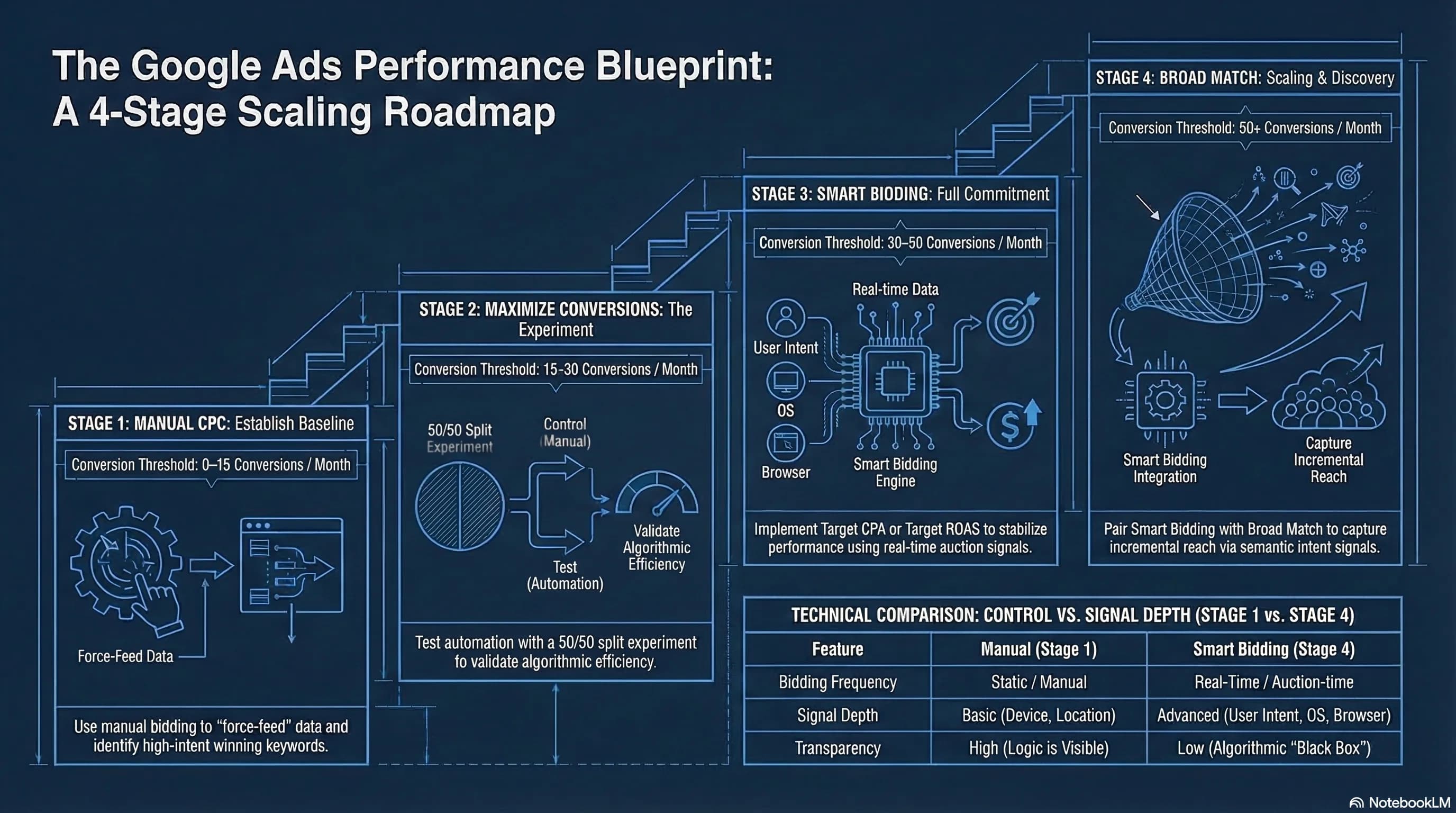
The 4-Stage Migration Roadmap
Smart Bidding does not work on day one. It works after the algorithm has accumulated enough high-quality conversion data to build a reliable predictive model. The migration roadmap stages the transition to give the algorithm what it needs at each point without exposing the account to the failure modes above.
Stage 1: Cold Launch with Manual CPC
Duration: First 30 days of a new campaign or new account.
Manual CPC in the cold launch phase is not an admission that automation is unnecessary. It is a data collection exercise. You are force-feeding the account with real impression, click, and conversion data across a range of keyword types and audiences before asking the algorithm to build predictions from that data.
During this stage, identify your actual winning keywords, establish a baseline CPA from real performance data, and verify that your conversion tracking is firing correctly on meaningful events. The data you collect here is the foundation the algorithm will train on. If conversion tracking is misconfigured during Stage 1, everything that follows is built on bad data.
Stage 2: Validation with Maximize Conversions
Trigger: 15 to 30 conversions per month per campaign.
Transition to Maximize Conversions and run a 50/50 experiment: half your traffic continues on Manual CPC, half transitions to Maximize Conversions. Let the experiment run for at least 14 days and a minimum of 100 conversions per variant before reading the results.
This stage validates whether the algorithm's predictions are accurate enough to outperform your manual bids. If the experiment shows Maximize Conversions underperforming, your conversion data is likely still insufficient or contaminated. Fix the data problem before proceeding.
For high-ticket B2B campaigns with long sales cycles and inherently low conversion volume, this stage requires proxy conversions. Use mid-funnel events, webinar sign-ups, whitepaper downloads, demo requests, or case study views as supplementary conversion signals to give the algorithm enough data points to calibrate. These carry lower proxy values and are set as Secondary conversions, but they provide the signal volume that low-touch B2B campaigns cannot generate from closed deals alone.
Stage 3: Commitment with Target CPA or Target ROAS
Trigger: 30 to 50 consistent conversions per month per campaign.
Set your initial Target CPA at 10 to 20% above your historical average CPA from Stage 2. This headroom prevents the algorithm from starving the campaign of traffic while it attempts to optimize toward the new target. An overly aggressive initial Target CPA will trigger bid suppression as the algorithm avoids auctions it predicts will exceed the target, which reduces volume before the system has had time to find its efficiency ceiling.
Adjust targets in increments of 10 to 15% maximum. Changes exceeding this threshold are treated by the algorithm as structural shifts and trigger a new 7 to 14 day learning phase with associated performance volatility. Patience at this stage pays compounding dividends. An account that has been stable on Target CPA for 90 days outperforms an account that has been adjusted weekly.
Stage 4: Semantic Expansion with Broad Match
Trigger: Smart Bidding has stabilized, campaign performance is consistent, conversion volume is sufficient.
Broad Match integration is the final stage, not the first. It functions as an intent-based discovery layer that identifies new query patterns the algorithm predicts will convert based on its existing model. Without the foundation of stable Smart Bidding and high-quality conversion data, Broad Match produces the budget drift and semantic expansion problems covered in Match Type Forensics.
With that foundation in place, Broad Match becomes a genuine growth lever: reaching queries you did not know to include, at bids calibrated to their individual conversion probability.
Portfolio Bid Strategies: Governance at Scale
Portfolio bid strategies apply a single Smart Bidding strategy across multiple campaigns simultaneously, treating them as a unified data pool rather than independent systems. This is the primary governance lever for accounts managing multiple campaigns with varying volume levels.
The Budget-to-CPA Ratio
Your daily budget must be at minimum 2 to 5 times your Target CPA. If your Target CPA is $50 and your daily budget is $60, the algorithm cannot function. It will bid tentatively throughout the day to avoid overshooting the goal, cap out, and stop delivery entirely once it estimates it has reached the daily limit. The result is under-delivery and artificially constrained performance. At $250 per day against a $50 CPA target, the algorithm has room to explore and optimize.
The Low-Volume Solution
For niche B2B campaigns or highly segmented campaigns that cannot individually reach the 50-conversion threshold, portfolio strategies aggregate their data into a single learning stream. Three campaigns each generating 15 conversions per month individually will each remain in an under-optimized state indefinitely. Pooled into a portfolio strategy, their combined 45 conversions approach the threshold for reliable optimization.
The Max CPC Cap
Portfolio strategies support a hard maximum CPC ceiling. This safeguard is non-negotiable in competitive auctions where outlier bids can spike dramatically in response to competitor changes or unusual auction dynamics. Without a cap, a single unusually competitive auction can consume a meaningful portion of your daily budget on one click. Set the cap at the highest CPC you can justify given your conversion rate and revenue per customer. The algorithm will not exceed it regardless of what the auction demands.
Three Non-Negotiable Audit Checks
Run these on any account before concluding the bidding strategy is the problem. In most cases, the bidding strategy is functioning correctly. The data it is operating on is not.
Search Term Triage for Signal Pollution
Review the Search Terms report specifically for branded queries matching to non-brand keywords through close variants. When this happens, the algorithm develops a false positive bias: it learns that generic keywords produce high-intent branded traffic, which inflates their perceived efficiency. When you tighten the account or reduce branded query coverage, the generic keyword performance collapses because the signal was never real. Separate branded and non-branded queries into dedicated campaigns and measure them independently.
Campaign Unblending
High-intent bottom-of-funnel terms and broad generic terms should never share a campaign. Mixed in the same campaign, the algorithm attempts to hit a single CPA target across two economically distinct audience profiles. Bottom-of-funnel terms convert at high rates and justify high CPCs. Generic terms convert at low rates and require low CPCs to remain efficient. Blending them forces the algorithm to compromise on both. Separate them and set appropriate targets for each economic profile.
The 20% Stability Rule
Limit all budget and target adjustments to 10 to 20% increments. Any adjustment exceeding this is classified by the algorithm as a structural change, triggering a new learning phase. An account that is adjusted weekly is perpetually in learning phase volatility, never accumulating the stable performance data that would allow the algorithm to reach its efficiency ceiling. Set a policy: no bid strategy change more than 20%, no budget change more than 20%, minimum 14-day intervals between significant adjustments.
The Signal Architect's Framework
The competitive advantage in Google Ads bidding is no longer in the algorithm itself. Every advertiser has access to the same Smart Bidding infrastructure. The differentiation is in the data environment provided to the algorithm.
An account with high-quality conversion signals, a clean data environment, appropriate campaign separation, and a stable bidding history will outperform an account with identical spend and worse data quality. Not because it has a better algorithm. Because it is giving the same algorithm better instructions.
This reframes the role of the Google Ads operator. The task is not setting bids. It is architecting the signal environment: conversion event definitions that reflect actual revenue, campaign structures that allow precise target-setting, data hygiene practices that prevent fraud and noise from contaminating the learning model, and stability disciplines that allow the algorithm to reach its performance ceiling without interruption.
The algorithm handles execution. The operator handles governance. Neither works without the other.
For the operational discipline that maintains signal quality over time, The Pruning Protocol covers the weekly and monthly cadence that keeps the data environment the algorithm trains on clean and accurate.
Frequently Asked Questions
What happened to Enhanced CPC in Google Ads? Google deprecated Enhanced CPC on March 15, 2025. It was a hybrid bidding strategy that adjusted manual bids by up to 30% based on automated signals. Its removal ended the middle ground between manual CPC and full Smart Bidding. Accounts still running eCPC were automatically migrated. Operators now choose between manual CPC for full human control or Smart Bidding for algorithmic optimization, with no hybrid option available.
How many conversions does Google Ads Smart Bidding need to work properly? The functional thresholds are 30 conversions per month per campaign for Target CPA and 50 conversions per month for Target ROAS. Below these thresholds, the algorithm lacks sufficient data to build reliable conversion probability predictions. It enters an extended learning phase that can run 30 days or longer, during which 30 to 50% of budget may go to uncertain, exploratory auctions. For low-volume accounts, portfolio bid strategies that aggregate conversion data across multiple campaigns can reach these thresholds faster than single-campaign deployment.
What is a portfolio bid strategy in Google Ads and when should I use it? A portfolio bid strategy applies a single Smart Bidding strategy across multiple campaigns, treating their combined conversion data as a unified learning stream. Use it when individual campaigns cannot reach the 30 to 50 monthly conversion threshold on their own. Niche B2B campaigns, highly segmented product campaigns, and geographic splits of the same product are all candidates. Pooling their data allows the algorithm to optimize on aggregate performance rather than making predictions from each campaign's limited individual dataset.
Should I start a new Google Ads campaign with Smart Bidding or Manual CPC? Start new campaigns with Manual CPC for the first 30 days. This cold launch phase establishes a real performance baseline and confirms that conversion tracking is functioning correctly before the algorithm begins making predictions from that data. Launching with Smart Bidding on day one means the algorithm starts predicting from zero data, which produces the extended learning phase volatility and budget waste that the staged migration roadmap is designed to prevent.
What is the 20% stability rule for Google Ads bidding? The 20% stability rule limits bid strategy changes, budget adjustments, and Target CPA or ROAS modifications to increments of 10 to 20% maximum, with at least 14 days between significant changes. Changes exceeding this threshold trigger a new 7 to 14 day learning phase with associated performance volatility. Operators who adjust frequently are perpetually resetting the algorithm's learning process and never allowing it to reach stable optimization. The rule creates the stability the algorithm needs to compound its learning into reliable performance.
What is the difference between Target CPA and Maximize Conversions in Google Ads? Maximize Conversions prioritizes spending your full daily budget and generating as many conversions as possible, without a cost constraint. It will pay whatever the auction requires to generate conversions. Target CPA adds a cost constraint: optimize for conversions at or below a specific cost per conversion. Maximize Conversions is appropriate during the validation stage when you want to understand what the algorithm can achieve without restrictions. Target CPA is appropriate for scaled campaigns where cost efficiency matters as much as conversion volume.
Sources
- Google Ads Help — About Smart Bidding
- Google Ads Help — About Target CPA Bidding
- Google Ads Help — Create a Portfolio Bid Strategy
- Google Ads Help — About Cross-Account Bid Strategies
- Google Ads Help — About Conversion Value Rules
- Search Engine Land — Beyond Keywords: Mastering AI-Driven Campaigns
- Search Engine Land — PPC Budgeting: When to Adjust, Scale, and Optimize with Data
- Store Growers — Target CPA Bidding in Google Ads (2026)
- WordStream — The Future of Google Ads Keywords: 6 Experts Weigh In