Match Type Forensics: Why Your Search Intent Is Drifting and How to Regain Control
The most expensive Google Ads problems are not the ones that show up in your dashboard. They are the ones that hide in the gap between what you intended to buy and what the algorithm actually purchased on your behalf.
After auditing hundreds of accounts, the pattern I see most consistently is not aggressive bidding or poor landing pages. It is budget drift: a silent, compounding discrepancy where human commercial intent is systematically sacrificed to satisfy the appetite of an automated system optimizing for volume. The advertiser thinks they are buying flight searches. The algorithm is spending their budget on hotel deals. The conversion data tells a story of failure that the keyword report never explains.
This happens because match types in 2026 are no longer what their names imply. Understanding what they actually do, and building the governance architecture to keep them inside useful boundaries, is the core skill of modern Google Ads management.
For context on how this connects to the broader signal architecture problem, The $1,127 Algorithmic Tax covers how match type drift contributes to data poisoning at the conversion level and what it costs accounts over time.
How Match Types Actually Work in 2026
The mental model most advertisers carry from five years ago is wrong and it is costing them money.
Exact Match no longer means exact. It includes synonyms, close variants, and what Google describes as intent-based matches. A query does not need to contain your exact keyword to trigger an exact match ad. It needs to be interpreted by the algorithm as expressing the same intent. The system makes that judgment autonomously.
Phrase Match now functions as the successor to Modified Broad Match, which Google deprecated. It maintains some word-order discipline while absorbing semantic flexibility. You get more control than broad match and more reach than the old exact match, but the boundaries are softer than the name implies.
Broad Match is an audience expansion signal, not a keyword targeting parameter. It processes real-time contextual signals for every auction: device, browser, operating system, location, search history, and the full context of the user's recent search behavior. Two users searching the same query may see different ads triggered by different broad match keywords because the algorithm evaluated their individual context differently.
The practical consequence: managing broad match with manual bidding is a 2016-era approach that no longer reflects how the system operates. Smart Bidding must act as the selective filter. Broad match provides the reach. Smart Bidding provides the judgment to bid aggressively on auctions likely to convert and abstain from those that are not. Remove either component and the system either over-restricts or over-spends.
The Forensic Evidence: What Budget Drift Actually Looks Like
Abstract explanations matter less than documented examples. The following cases are drawn from real account audits and show the economic cost of match type drift when it goes unmanaged.
An airline account bidding on transit intent keywords like "[city] airport to [city] flights" was seeing CTRs of 43 to 50% on those terms. Normal for high-intent navigational queries. The same broad match logic was simultaneously matching those bids to "hotel deals" queries, where CTR dropped to 2 to 4%. The algorithm was buying hotel intent traffic with flight advertising budget because both queries fell within the semantic neighborhood of travel.
A niche insurance operator bidding on "low cost vehicle insurance" was matching to "cheap vehicles." The funnel collapsed from service research to asset research. The user was not looking to insure a vehicle. They were looking to buy one.
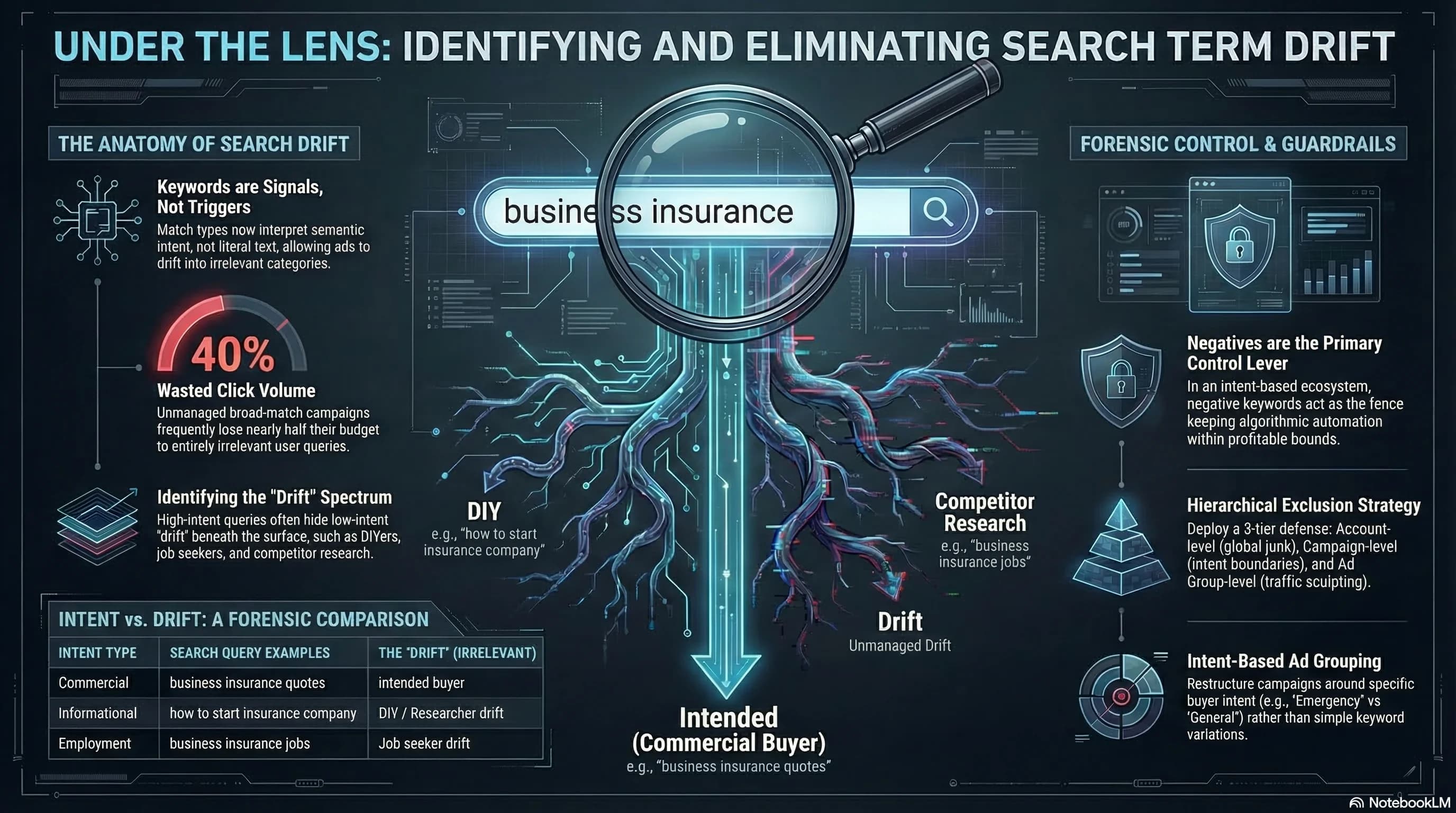
A B2B services account bidding on "business insurance" was matching to "how to start an insurance company." Commercial service intent drifted into DIY educational intent. The user was not a buyer. They were a researcher.
| Advertiser Keyword | Actual Query Matched | Forensic Diagnosis |
|---|---|---|
| airplane to [city] | [city] hotel deals | Transit intent matched to accommodation |
| low cost vehicle insurance | cheap vehicles | Service intent matched to asset research |
| business insurance | how to start an insurance company | B2B service matched to DIY education |
| [city] airport flights | [city] show tickets | Travel intent matched to entertainment |
In each case, the keyword report showed normal performance. The spend was categorized under the original keyword. The drift was only visible in the Search Term Report. Which is exactly why the Search Term Report audit, covered in detail in The Search Term Report Audit, is a non-negotiable weekly discipline rather than an occasional review.

The Intent-First Architecture: Building Defined Traffic Corridors
The antidote to budget drift is not eliminating broad match. It is structuring your campaigns so that each match type serves a specific, defined function with appropriate bid weighting.
Advanced operators build what I call defined corridors of traffic: a tiered bidding structure that exerts a priority claim on high-intent queries while still using broad match for discovery, not delivery.
Exact Match as Priority Claim
Exact match campaigns carry your highest bids. Their function is to act as a shield, ensuring that your core high-value queries are captured by the most precise match type available rather than being swallowed by the more expensive, exploratory dynamics of broad match auctions. When a query matches your exact match keyword, your exact match campaign should win that auction. The bid structure enforces this.
Phrase Match as Controlled Expansion
Phrase match campaigns run at moderate bids. Their function is to capture relevant variations of your core intent and surface new query patterns worth evaluating for exact match inclusion. They are the discovery layer for your keyword strategy, not your primary conversion driver.
Broad Match as Signal Exploration
Broad match campaigns run at your lowest bids and are restricted to a mining role: identifying emerging search behaviors and audience signals you did not know existed. They are never your primary campaign for a high-value query category. They are the research instrument that informs your exact match expansion.
This architecture means that when broad match drifts into adjacent intent territory, it does so at low bid levels with limited budget exposure. The drift is contained. The discovery is preserved.
When to Expand Broad Match and When to Restrict It
Broad match is a multiplier of strength. It amplifies what is already working. It does not fix what is broken.
Expansion is appropriate only when three technical conditions are met simultaneously.
Data density. The campaign must generate at minimum 30 conversions per month to provide the algorithm's predictive model with sufficient signal to make reliable judgments about which broad match queries are worth bidding on. Below this threshold, the algorithm is guessing.
Tracking hygiene. Optimization must target meaningful conversion actions that reflect actual business outcomes: qualified leads, offline sales, revenue events. Accounts optimizing for page views, button clicks, or unverified form fills will train the broad match system to find traffic that completes those shallow actions, which does not correlate with commercial value.
Active monitoring. Weekly Search Term Report reviews are mandatory during any broad match scale-up phase. New query patterns enter the account continuously. Without a weekly review cycle, toxic patterns compound for months before they are caught.
Restrict broad match or avoid it entirely when budgets are tight and cannot absorb exploration costs without degrading overall account performance, when conversion tracking is unreliable or recently changed, or when a campaign blends incompatible objectives such as brand defense and new customer acquisition in the same campaign structure.
The Negative Keyword Shield: Infrastructure, Not Cleanup
Negative keywords are infrastructure. They are not the cleanup you do after waste accumulates. They are the boundaries you define before the algorithm starts exploring.
The distinction matters because it changes when you build them. Infrastructure goes in before launch. Cleanup happens after damage. Accounts that treat negatives as cleanup are always paying for the delay between when drift begins and when it is caught.
Negative Phrase Match is the primary tool for defining intent boundaries. It blocks specific intent patterns, free, jobs, how to, training, without the over-restriction of Negative Broad, which requires all words in the negative to be present in the query. A negative phrase match for "how to" blocks every query containing that phrase regardless of what surrounds it, which is almost always the right behavior for an informational intent exclusion.
One technical update from 2025 that changes the maintenance calculus: Google has begun applying automatic misspelling coverage to negative keywords. Previously, negating "insurance" would not block "insuranc" or "insurence." With misspelling coverage, common misspellings of your negatives are now blocked automatically. This reduces the manual work required to maintain comprehensive coverage, but it does not eliminate the need for manual oversight. Brand safety decisions should never rely on automated coverage alone.
The core negative keyword behavior that remains unchanged and that destroys many negation strategies: negatives do not use close variant matching. If you negate "flower," your ads still show for "flowers." Every plural must still be negated explicitly.
The 5-Step Match Type Audit
Run this audit on any account where budget drift is suspected. These are not theoretical checks. Each one has a specific diagnostic output that tells you exactly where the account needs intervention.
Step 1: Cross-Campaign Query Audit
Filter the Search Terms Report for queries that are triggering in more than one campaign simultaneously. Internal cannibalization inflates your own CPCs because your campaigns are bidding against each other in the same auction. Identify every instance of this, determine which campaign should own each query, and add the query as a negative in every campaign that should not own it.
Step 2: Search Partner Network Audit
For lead generation accounts, the Search Partner Network is a primary source of low-quality traffic. Audit it separately by segmenting performance by network in your campaign report. If Search Partner CPA is significantly above your target or if conversion rate is materially lower than Search, test disabling Search Partners at the campaign level. This is especially important for accounts in regulated industries where partner sites may generate legally non-compliant leads.
Step 3: Location Forensics
Pull a geographic performance report and filter for regions where you either have no service coverage or where legal constraints prevent you from transacting. One insurance account in my audit was spending budget in two states where they had no license to write policies. Every dollar spent there was legally non-recoverable waste. Add non-serviceable locations as negative location targets. Review this quarterly as campaigns expand.
Step 4: Brand and Non-Brand Segmentation
Branded and non-branded campaigns must be separate. When they are combined, branded traffic masks the underperformance of acquisition spend. Branded searches convert at high rates and low CPAs because the user is already looking for you. Blending them with acquisition campaigns produces an average performance metric that looks acceptable but conceals a non-branded campaign that would fail on its own metrics. Separate them, measure them independently, and set appropriate targets for each.
Step 5: Query to Ad to Landing Page Alignment
Pull your highest-spend query segments and trace the path from query to ad headline to landing page. The content of the landing page should be a direct continuation of the promise in the ad, which should be a direct response to the intent of the query. Any break in this chain is a conversion rate problem that bidding changes cannot solve. A perfectly targeted query landing on a generic homepage will not convert regardless of how well the campaign is structured.
The Governance Shift: From Bid Management to Signal Architecture
The role of the Google Ads operator has changed fundamentally. In 2016, control meant manual bid adjustments at the keyword level. In 2026, control means governance of three things: targets (CPA and ROAS settings that define the optimization objective), budget allocation (which campaigns receive enough capital to learn effectively), and conversion definitions (what signals the algorithm is instructed to optimize toward).
Manual bid management on individual keywords in an account running Smart Bidding is not just unnecessary. It actively interferes with the algorithm's optimization process. Every manual override introduces variance that disrupts the statistical model the algorithm is building.
The operator's job is to define the system's objective precisely, provide the signal quality that makes accurate optimization possible, and enforce the guardrails that prevent the system from pursuing its objective through means that serve Google's revenue targets rather than yours.
That last distinction is the one most accounts get wrong. The algorithm is exceptionally good at finding the most efficient path to whatever objective you set. If your objective is form fills, it will find form fills at scale. If your objective is qualified revenue, it will find qualified revenue, but only if you have defined qualified revenue as the conversion event, provided enough examples of it to train the model, and removed the low-quality signal noise that would otherwise corrupt the optimization.
Intent corridors, match type architecture, negative keyword governance, conversion signal quality: these are not separate tactics. They are the components of a single system designed to ensure that the algorithm's efficiency works for your business rather than against it.
For the full picture of how signal quality, budget architecture, and conversion tracking work together at the account level, Inside the PMax Black Box covers how these principles apply specifically to Performance Max campaign governance.
Frequently Asked Questions
What is broad match drift in Google Ads and why does it happen? Broad match drift is the process by which your broad match campaigns gradually expand into query territory that has no commercial relevance to your offer. It happens because broad match in 2026 is an audience expansion signal rather than a keyword matching parameter. The algorithm processes contextual data for each auction and decides what queries fall within the semantic neighborhood of your keywords. Without active negative keyword governance and Smart Bidding with quality conversion signals, the algorithm will drift toward whatever queries are cheapest to win, which are typically informational and research-intent queries with low purchase probability.
Is exact match truly exact in Google Ads anymore? No. Exact match now includes close variants and intent-based matches. A query does not need to contain your exact keyword to trigger an exact match ad. Google's algorithm evaluates whether the query expresses the same intent as your keyword and may serve the ad if it determines the intent is equivalent. This extends your reach beyond the literal keyword but reduces the precision that exact match historically provided. The practical response is to use exact match as your priority bid layer for core high-value queries while monitoring the Search Term Report for variant queries that do not align with your commercial intent.
When should I use broad match versus phrase match versus exact match? Use exact match at your highest bid for core high-value commercial queries where precision matters most. Use phrase match at moderate bids for controlled expansion and new query pattern discovery. Use broad match at your lowest bids as a signal exploration layer when your account has at least 30 monthly conversions, reliable conversion tracking, and a weekly Search Term Report review process in place. Never use broad match as your primary delivery mechanism for high-value queries. Use it to discover new patterns, then graduate those patterns to phrase or exact match once they demonstrate conversion value.
What is keyword cannibalization in Google Ads and how do I stop it? Keyword cannibalization happens when multiple campaigns compete in the same auction for the same query, bidding your CPCs up against yourself. It is most common between broad match and exact match campaigns targeting related terms, and between branded and non-branded campaigns that have not been properly segmented. Stop it by running a cross-campaign query audit in the Search Term Report, identifying queries appearing in multiple campaigns simultaneously, and adding those queries as negatives in every campaign that should not own them.
Why should I separate branded and non-branded campaigns? Branded traffic converts at high rates and low CPAs because users searching your brand name are already familiar with your product and are actively looking for you. Mixing branded and non-branded traffic in the same campaign produces blended performance metrics that make the campaign appear to be performing well when the non-branded acquisition component may be failing on its own terms. Separating them lets you set appropriate CPA and ROAS targets for each behavior type, evaluate acquisition performance honestly, and allocate budget based on actual efficiency rather than blended averages.
How do negative keywords interact with Smart Bidding? Negative keywords define the query space the algorithm is allowed to explore. Smart Bidding operates within that space, evaluating conversion probability for each auction and bidding accordingly. Negative keywords are not redundant in a Smart Bidding environment. Smart Bidding may correctly evaluate a junk query as low-probability and bid minimally, but it will not exclude the query entirely unless you add a negative. Without negatives, those queries still consume impressions, generate CTR signal, and influence Quality Score calculations even when bids are suppressed. Negatives remove them from the account's signal environment entirely.
Sources
- Google Ads Help — About Keyword Matching Options
- Google Ads Help — About the Broad Match Keywords Campaign Setting
- Google Ads Help — About Account-Level Negative Keywords
- Google Ads — How to Use Broad Match and AI-Powered Advertising
- Search Engine Land — How to Use Broad Match Without Losing Control
- Search Engine Land — Top 10 Google Ads Mistakes to Avoid in 2026
- Store Growers — Keyword Match Types in Google Ads: How to Use Them in 2026
- WordStream — The Future of Google Ads Keywords: 6 Experts Weigh In
- Semrush — What Are Keyword Match Types? Examples and Best Practices