Beyond the Pixel: First-Party Audience Architecture for Advanced Google Ads Operators
Third-party cookies are gone. The targeting infrastructure that most Google Ads accounts were built on for the last decade no longer exists in the way it did. Generic interest-based audiences pulled from third-party data networks are now algorithmically thin: low signal density, poor match rates, and progressively worse performance as the data ages.
The accounts that are outperforming in 2026 are not the ones with the biggest budgets. They are the ones with the best data. Specifically, first-party data from their own CRM, website behavior, and transaction history, fed into Google's machine learning systems in a format that trains the algorithm to find more users who look like their most valuable customers.
The performance differential is not marginal. Current benchmarks show a 13x CTR gap between retargeted ads built on first-party signals versus standard display placements. When AI-powered dynamic retargeting is fed high-quality first-party signals, conversion rates lift by up to 187%. The gap between accounts with mature first-party data architecture and accounts relying on third-party approximations widens every quarter.
This article covers the architecture. Customer Match setup, segmentation strategy, exclusion logic, lifecycle sequencing, and the server-side tracking infrastructure that ensures your signals actually reach the algorithm in an increasingly privacy-constrained environment.
For the conversion signal quality foundation that makes audience architecture effective, The $1,127 Algorithmic Tax covers why the events you define as conversions determine which audience profiles the algorithm learns to find.
Why Generic Audiences Are Algorithmic Starvation
Google's bidding models are greedy. They will prioritize volume over margin unless you supply high-quality signals that constrain them toward quality. A campaign running on generic interest audiences gives the algorithm a wide, low-density signal environment. It finds reach. It does not find your best customers.
The transition to first-party signals changes this relationship fundamentally. When you upload your top-LTV customer list and instruct the algorithm to find similar users, you are not adjusting a targeting parameter. You are providing the algorithm with a specific definition of what a valuable conversion looks like in terms of real user characteristics: device patterns, search behavior, location history, purchase recency. The algorithm uses that definition to identify and bid aggressively on users who match the profile before they have shown explicit purchase intent.
This is the compounding advantage of data maturity. An account with a well-maintained, segmented first-party data infrastructure trains a progressively better model over time. An account running on generic audiences trains the same mediocre model indefinitely.
The 20 to 50% CAC increase that most accounts have experienced since the collapse of third-party tracking is not an inevitability. It is the cost of not having replaced cookie-based targeting with first-party signal architecture. The accounts that made that transition in 2023 and 2024 are now running at lower CAC than pre-cookie-collapse levels because their data quality has compounded.
Customer Match: The Technical Foundation
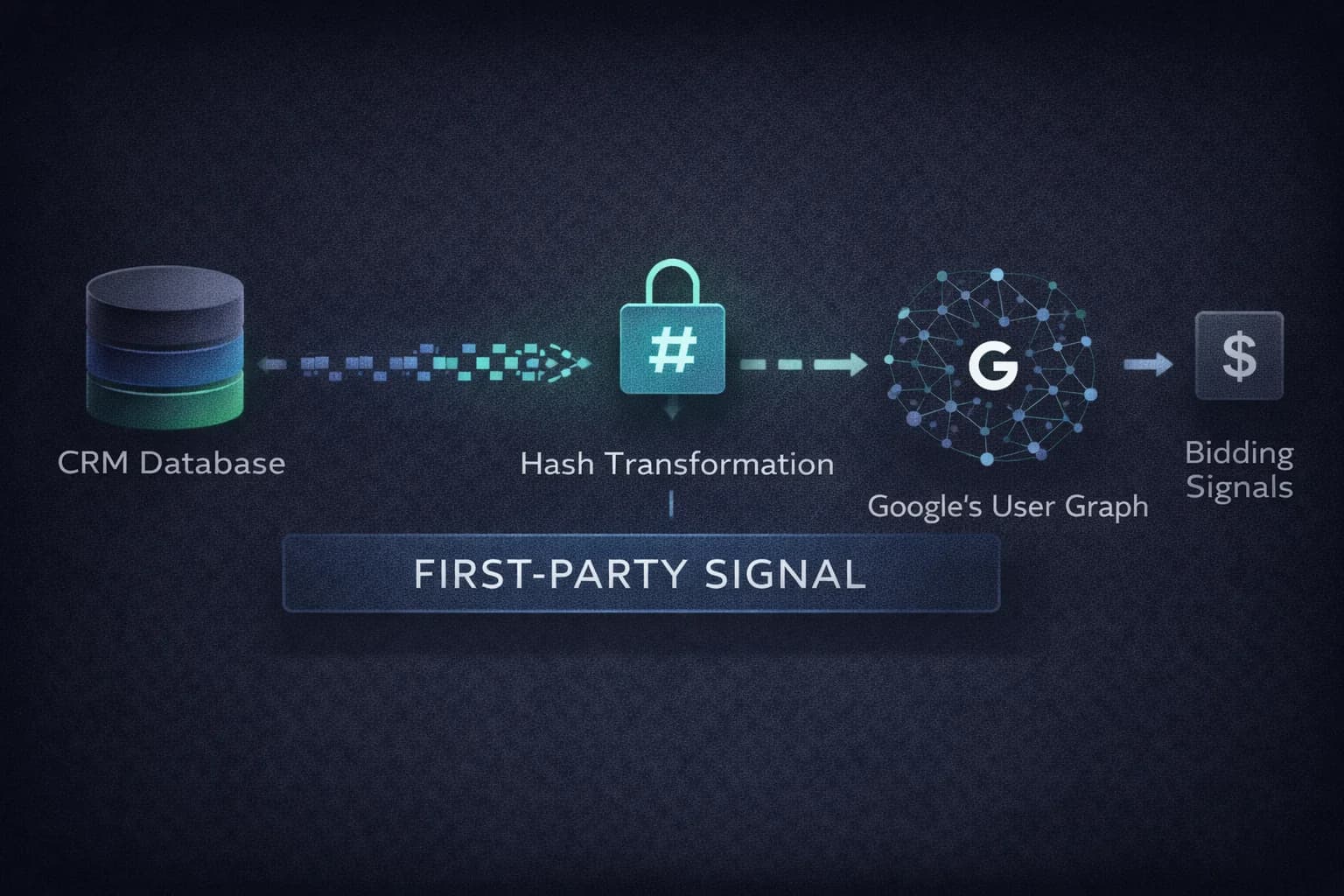
Customer Match is the mechanism that activates your CRM data inside Google Ads. You upload hashed versions of your customer identifiers (email addresses, phone numbers, physical addresses). Google matches those hashes against its database of authenticated signed-in users. The result is a privacy-safe connection between your offline customer records and Google's online user graph.
The hashing uses SHA256 encryption, a one-way transformation that cannot be reversed to recover the original PII. The matching happens on Google's infrastructure, not yours. You never transmit raw customer data.
Three prerequisites determine match rate quality and whether your Customer Match lists are actually useful:
Data standardization. Before hashing, scrub and format your CRM data to ISO standards. Phone numbers should include country codes. Addresses should follow consistent formatting. Email addresses should be lowercase with no trailing spaces. Inconsistent formatting is the primary reason Customer Match lists underperform. A match requires an exact hash match, and a hash of a differently formatted version of the same email will not match.
Automated list refresh. Static lists are a liability. A list uploaded once and never updated contains churned customers, inactive emails, and outdated profiles. The algorithm trains on that stale data. Use API integrations or direct Google Sheets syncing to refresh your Customer Match lists every 24 to 48 hours. New customers should enter your prospecting exclusion lists immediately. Recent high-intent visitors should enter your remarketing lists in real time.
Hashing integrity. SHA256 hashing must occur server-side or client-side before data transmission. Never transmit raw PII. Verify the hashing is producing consistent outputs before uploading to Google.
Two signal types deploy alongside Customer Match:
Enhanced Conversions for Web sends hashed first-party data at the point of online conversion, improving measurement accuracy for cross-device journeys and browser-restricted environments. When a user converts on mobile but was originally acquired via desktop, Enhanced Conversions connects the journey that cookie-based tracking loses.
Enhanced Conversions for Leads is the B2B operator's critical tool. It allows you to import CRM milestones back into Google Ads as offline conversion events: SQL status, demo completed, proposal sent, closed-won. The algorithm now optimizes toward users whose behavior patterns predict downstream pipeline value rather than users who submit forms.
High-LTV Segmentation: Teaching the Algorithm to Hunt for Quality
Uploading one undifferentiated customer list is the most common Customer Match mistake. The algorithm treats everyone in the list as equivalent. Your one-time buyers who churned and your highest-LTV repeat customers who drive 80% of your revenue are in the same seed pool.
Segment before you upload.
| Segment | Targeting Logic | Strategic Goal |
|---|---|---|
| Top 5% VIPs | Highest LTV and multi-purchase frequency | Seed for lookalike expansion to find high-margin new users |
| Recent High-Intent Abandoners | Cart or checkout abandoners, 1 to 7 day window | Recovery with high-frequency urgent messaging |
| Dormant and Lapsed Users | Past customers, no interaction in 31 to 90 days | Reactivation with margin-protected win-back offers |
| Active Customers | Current customers within purchase cycle | Upsell and cross-sell based on purchase history |
| Non-Converters | High-engagement visitors who have not purchased | Consideration stage nurture with social proof and testimonials |
The Top 5% VIP segment is your most valuable data asset. These are the customers whose behavioral characteristics define what a high-value conversion looks like for your specific business. Use this segment as the seed for Similar Audience expansion. The algorithm matches against this profile to find users who have not yet encountered your brand but exhibit the behavioral patterns associated with becoming a high-LTV customer.
Do not seed lookalike expansion from your full customer list. You will dilute the quality signal with the profiles of low-margin, high-churn customers. Seed from your top performers only.

Precision Exclusions: The Margin Protection Layer
Exclusions are not cleanup. They are the primary mechanism for protecting acquisition margins from algorithmic cannibalization.
Google's bidding models will bid on any user likely to convert, regardless of whether that conversion represents incremental revenue or revenue you had already earned. A user in your checkout flow who will complete the purchase regardless of whether they see an ad is still a high-probability conversion target from the algorithm's perspective. If you are not excluding that user from your acquisition campaigns, you are paying acquisition costs for organic conversions.
Three exclusion rules are mandatory for any account with meaningful organic conversion volume:
Exclude 30-day converters from prospecting campaigns. Users who have purchased within 30 days should not receive acquisition ads. They have already converted. The acquisition budget should reach users who have not yet bought. Apply your recent purchasers list as a negative audience to every prospecting campaign.
Exclude non-business email domains from B2B lead generation. Filtering out @gmail, @yahoo, @hotmail, and similar personal email domains from B2B lead generation campaigns eliminates a significant source of low-quality leads. These submissions rarely convert to sales conversations and consume sales team bandwidth on contacts with no buying authority. Apply the exclusion at the campaign level.
Exclude active support ticket holders from promotional campaigns. A customer currently experiencing a service issue who receives a promotional ad is a brand safety risk. Their likelihood of responding positively to advertising while their unresolved issue is front of mind is low. The impression cost and potential negative brand association both outweigh any conversion probability. Sync active support cases from your CRM to an exclusion list updated daily.
The mechanism for implementing all three is the same: upload the relevant CRM segment as a Customer Match list and apply it as a negative audience at the campaign level with a minimum 1-day observation window.
Lifecycle Architecture: Sequential Messaging by Funnel Stage
Audience architecture is not just about who to reach. It is about what to show them based on where they are in their relationship with your brand.
Prospecting (Top of Funnel)
Lookalike expansion from your VIP seed list. The objective at this stage is not conversion. It is qualified introduction to users who have no prior awareness of your brand but exhibit the behavioral profile associated with becoming a high-LTV customer. Messaging should focus on problem recognition and differentiated positioning, not offers. Users at this stage have not expressed purchase intent. An offer-first message is premature and wastes creative on the wrong psychological moment.
Consideration (Middle of Funnel)
Users who have visited your site, engaged with your content, or shown behavioral indicators of active research. Sequential messaging reduces friction by building trust progressively. Show an explainer ad first (utility: here is what we do and how it works), followed by a testimonial or case study (trust: here is what happened for someone in your situation), followed by a specific offer with urgency (action: here is the reason to decide now). The sequence mirrors the natural decision-making progression. Compressing it into a single offer-first ad forces the algorithm to find users who skip the trust-building phase, which typically means lower-quality conversions.
Retention and Reactivation (Bottom of Funnel)
For active customers, trigger upsell campaigns based on CRM purchase history. A customer who buys a consumable product with a predictable replenishment cycle should receive a restock promotion timed to their likely depletion date, not a generic remarketing ad. Timing here is a revenue lever. AI-sequenced retargeting using a 15-minute trigger following cart abandonment, followed by a 6-hour follow-up, is recovering 41% of abandoned sales that would otherwise be permanently lost.
For dormant customers inactive for 31 to 90 days, the messaging objective shifts from conversion to reactivation. Win-back offers should be margin-protected: the discount or incentive should not exceed the cost of acquiring a new customer, because that is effectively what you are doing. A customer who churned represents a higher probability conversion than a cold prospect, but not an unlimited budget reactivation target.
Technical Integrity: Server-Side Tracking and Signal Quality
The audience architecture described above is only as effective as the signal quality reaching the algorithm. Browser-based tracking misses 30 to 60% of conversion events in privacy-constrained environments. iOS tracking restrictions, ad blockers, and browser privacy settings all degrade cookie-based measurement.
Server-side tracking closes this gap. By moving conversion tracking from the user's browser to your own cloud server, signals reach Google's algorithm regardless of browser privacy settings. A user who converts with an ad blocker active still generates a server-side signal that feeds your bidding model and your audience lists.
The practical implementation uses either Google Tag Manager Server-Side or a dedicated server-side tagging solution. Server-side tracking has been shown to improve data accuracy for product view events by 91.8% compared to browser-side tracking in high-privacy-constraint environments.
The signal quality rule that governs everything: your Target ROAS or Target CPA bidding is only as accurate as the conversion data it trains on. If browser-side signal loss is causing you to undercount conversions by 30%, your bidding model believes your campaigns are 30% less efficient than they actually are. It responds by reducing bids, which reduces impression share, which reduces conversion volume further. Server-side tracking breaks this negative feedback loop.
The technical stack for maximum signal integrity: Enhanced Conversions for Web for online events, Enhanced Conversions for Leads for B2B offline CRM milestones, server-side conversion API for browser-restricted environments, and Customer Match list syncing via API with 24 to 48-hour refresh cadence.
Retargeting Windows: The 2026 Benchmarks
Retargeting efficiency varies significantly by time window. The recency of the user's interaction determines both their conversion probability and the appropriate message.
Current 2026 benchmarks show retargeting delivering a 58% lower CPA than traditional search ads, the widest efficiency gap on record. Within that, the windows have distinct economics:
1 to 7 days: Cart and checkout abandoners. Highest intent, highest conversion rate, highest urgency. These users reached a decision point and did not complete it. The 15-minute trigger followed by a 6-hour follow-up sequence captures the majority of recoverable abandonment. After 7 days, conversion probability drops significantly.
8 to 14 days: Product and category viewers. Balanced cost and engagement. These users expressed interest without explicit purchase intent. Social proof, testimonials, and use case specificity work here. The user is in the comparison phase. Your messaging should answer why your solution is the right choice, not remind them you exist.
31 to 90 days: Reactivation window. Past customers and dormant leads. The message is win-back or reengagement, not new customer acquisition. Offers should be framed around returning, not discovering. The user already knows you. The question is whether the timing and incentive are right to bring them back.
Beyond 90 days, conversion probability for most categories drops below the cost of the impression. Exclude these users from retargeting campaigns and let them re-enter prospecting flows as new targets.
The Data Maturity Competitive Moat
The fundamental shift in Google Ads competition is not in the auction mechanics or the bidding algorithms. Those are commodities. Every advertiser has access to the same Smart Bidding infrastructure.
The differentiation is in the data that instructs the algorithm. An account with a well-maintained, segmented first-party data infrastructure, server-side tracking ensuring complete signal coverage, and a lifecycle audience architecture that sequences messaging by funnel stage will train a progressively better model than an account running on generic targeting with browser-side tracking and undifferentiated remarketing lists.
That advantage compounds. Better data trains a better model. A better model finds better customers. Better customers generate better conversion data. Better conversion data trains an even better model.
The accounts with the most accurate, cleanest, and most strategically segmented first-party signals will consistently out-bid and out-convert competitors spending more on worse data. Data maturity is the competitive moat that budget cannot overcome.
For the account architecture that determines how these audience signals flow through your campaign structure, Beyond the Default covers how brand separation, margin-tiered segmentation, and campaign consolidation affect the efficiency with which your first-party signals translate into algorithmic performance.
Frequently Asked Questions
What is Customer Match in Google Ads and how does it work? Customer Match allows you to upload hashed versions of your CRM data (email addresses, phone numbers, physical addresses) to Google Ads. Google matches those hashes against its database of authenticated signed-in users to create a privacy-safe audience segment. You can use this segment for targeting, exclusion, and as a seed for lookalike expansion. The hashing uses SHA256 encryption, a one-way transformation that cannot be reversed to expose the original PII. Match rates depend on data quality: standardized, deduplicated CRM data with consistent formatting produces significantly higher match rates than raw, unprocessed exports.
Why is first-party data more valuable than third-party audiences in Google Ads? First-party data reflects your actual customers' behavior, purchase history, and value to your business. Third-party audiences are inferred interest categories assembled from external data providers, which do not know which of those users have ever purchased from you, what they paid, or whether they are likely to buy again. First-party data gives the algorithm a specific definition of what a valuable conversion looks like based on real examples from your business. Third-party data gives it a probabilistic guess based on category affiliation. The signal quality difference produces the 13x CTR gap and up to 187% conversion rate lift documented in current benchmarks.
What is Enhanced Conversions for Leads and when should I use it? Enhanced Conversions for Leads allows B2B advertisers to import CRM milestones back into Google Ads as offline conversion events. When a lead that originally clicked your ad reaches SQL status, completes a demo, or closes as a won deal, you import that event with the original GCLID. The algorithm learns which traffic profiles produce qualified pipeline, not just form submissions. Use it whenever your sales cycle has a meaningful gap between the initial conversion event and actual revenue, which describes virtually every B2B account. Without it, the algorithm optimizes for lead volume regardless of lead quality.
How do I use audience exclusions to protect acquisition margins? Upload your recent purchasers, active customers, and support ticket holders as Customer Match lists and apply them as negative audiences to your prospecting campaigns. This prevents the algorithm from spending acquisition budget on users who will convert regardless of advertising. The three mandatory exclusions are: 30-day converters from all prospecting campaigns, non-business email domains from B2B lead generation, and active support cases from all promotional campaigns. Each exclusion is applied as a negative audience at the campaign level with a 1-day or longer observation window.
What is the right retargeting window for Google Ads in 2026? Window selection depends on the user's interaction type. Cart and checkout abandoners should be re-engaged within 1 to 7 days with high-frequency urgency messaging. Product and category viewers warrant an 8 to 14-day window with social proof and comparison content. Past customers and dormant leads fit a 31 to 90-day reactivation window with win-back offers. Beyond 90 days, conversion probability for most categories falls below impression cost. Segment your remarketing lists by interaction type and recency rather than using a single undifferentiated remarketing audience.
Why does server-side tracking improve Google Ads performance? Browser-side tracking misses 30 to 60% of conversion events in privacy-constrained environments due to iOS tracking restrictions, ad blockers, and browser privacy settings. When the algorithm undercounts conversions, it believes your campaigns are less efficient than they actually are. It responds by reducing bids, which reduces impression share, which reduces conversion volume further. Server-side tracking moves the conversion signal from the user's browser to your cloud server, bypassing browser restrictions. The algorithm receives complete signal data and bids accurately. Server-side tracking has been shown to improve data accuracy for product view events by 91.8% compared to browser-side implementation.
Sources
- Google Ads Help — Customer Match Best Practices
- Google Ads Help — About Customer Lifecycle Goals
- Google for Developers — Get Started with Customer Match via Google Ads API
- Lever Digital — The Complete Guide to Enhanced Conversions in Google Ads (2026 Edition)
- Seer Interactive — Unlocking the Power of Customer Match: Guide to Maximizing Google Ads
- Lunio — Audience Exclusions: 11 Targeting Tips for Google Ads and Meta
- Newswire Jet — 9 Key Retargeting Statistics Every Marketer Must Know in 2025
- Stape — CDP vs CRM: What's the Real Difference and When to Use Both