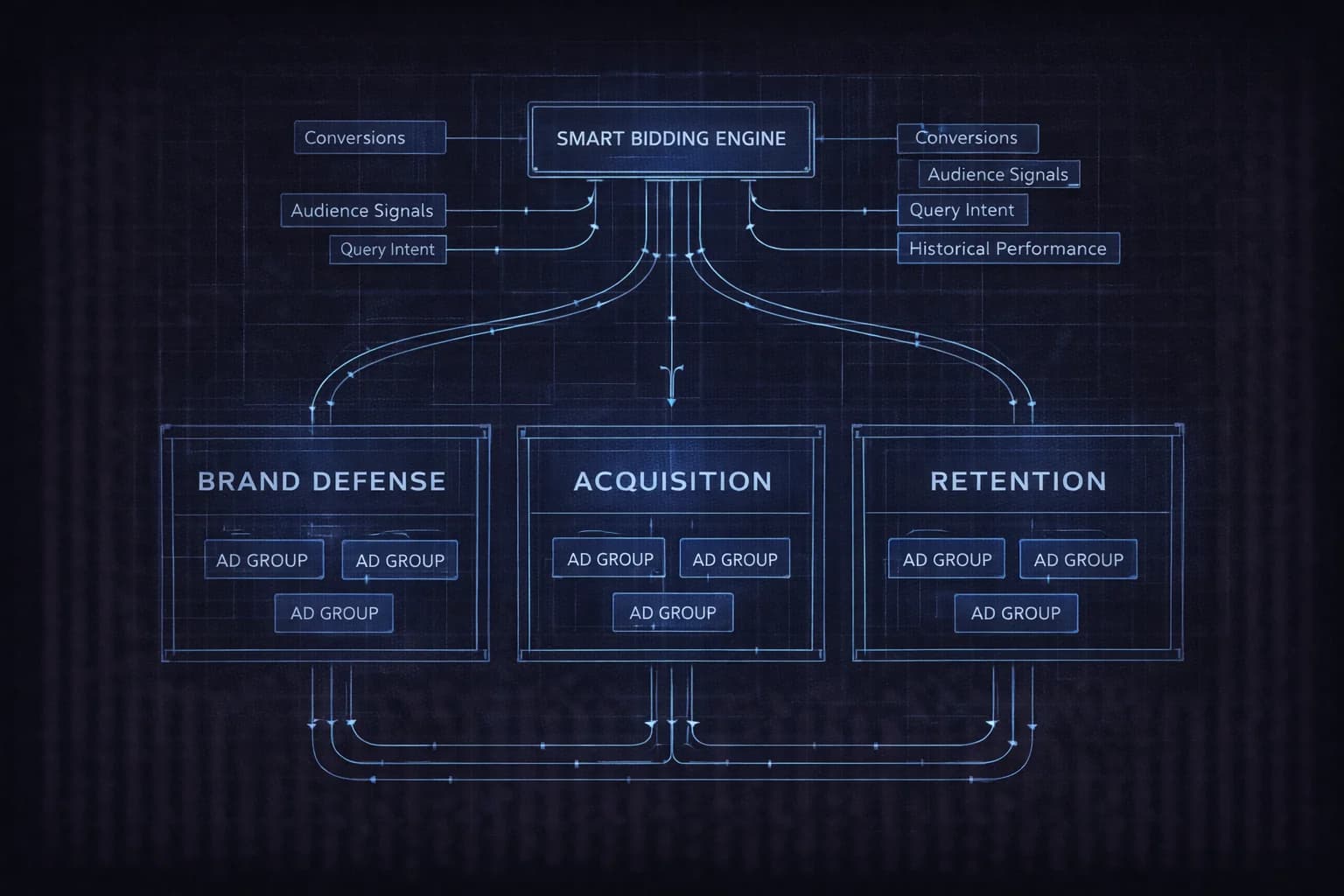
Beyond the Default: Architecting Google Ads for Signal Liquidity and Unit Economics
Most Google Ads accounts are not poorly managed. They are poorly structured. The management decisions are reasonable given the architecture. The architecture is the problem.
Auditing hundreds of accounts reveals a consistent pattern: structural fragmentation built for a manual bidding environment that no longer exists. Single keyword ad groups, granular campaign segmentation, dozens of isolated data streams each too thin to be useful. This was the right approach when human bid managers needed maximum visibility and control. It is the wrong approach when an AI-driven optimization engine needs high-volume data flow to make reliable predictions.
Poor structure in 2026 does not just impede performance. It actively starves the learning phase. A campaign with 50 keywords spread across 50 ad groups, each generating a handful of impressions per week, cannot reach the data density required for Smart Bidding to function. The algorithm is not failing. It is working with insufficient material.
The shift required is from keyword obsession to system orchestration. The objective is Signal Liquidity: the continuous flow of high-volume, high-quality conversion data that allows machine learning to make predictive decisions aligned with your actual profit objectives. Properly structured accounts achieve up to 35% higher CTR and 20% lower CPC by maximizing signal liquidity. The structural decisions are the leverage, not the bid adjustments made on top of them.
For the conversion signal quality that makes any account structure meaningful, The $1,127 Algorithmic Tax covers why structural improvements are capped by data quality at the conversion level.
The Blended Data Trap: Why Brand and Non-Brand Must Be Separated
The most common and most expensive architectural failure is blending branded and non-branded traffic in the same campaigns.
Branded queries represent existing intent. A user searching your brand name already knows you exist and has some degree of purchase consideration. These searches convert at 15 to 25% rates with ROAS around 1,300%. They cost relatively little because the user's intent is already formed.
Non-branded queries represent incremental growth. A user searching a category or problem term is in the awareness or consideration phase. These convert at 2 to 5% rates with ROAS around 68%. They cost more because you are competing for attention against every other solution in the space.
| Metric | Branded Traffic | Non-Branded Traffic |
|---|---|---|
| Conversion Rate | 15% to 25% | 2% to 5% |
| Average ROAS | ~1,300% | ~68% |
| Consumer Intent | Decision and Action (BoFu) | Awareness and Consideration (ToFu/MoFu) |
| Primary Goal | Brand Defense | New Customer Acquisition |
When these two traffic types share a campaign, branded performance masks acquisition performance. The blended conversion rate looks acceptable. The blended ROAS looks strong. The account appears to be scaling successfully. When you examine non-branded performance in isolation, you often find a campaign that would fail any reasonable ROI threshold.
This creates what I call ghost performance: metrics that look real in the dashboard but disappear the moment you try to scale. You increase acquisition budget based on blended ROAS data. Non-branded CPAs are actually 10 to 15 times higher than the blended average suggested. The scale attempt fails. You cannot diagnose why because the data architecture prevented you from seeing the real numbers.
The technical fix is two-part. First, separate branded and non-branded campaigns structurally. Set distinct CPA and ROAS targets for each because their economics are fundamentally different. Second, add brand exclusion lists to every Performance Max and generic search campaign. Without explicit exclusions, PMax will systematically capture branded queries because they are easy conversions, inflate its reported ROAS with traffic that did not require advertising to convert, and consume acquisition budget that should be funding incremental growth.
Engineering Profit: Custom Labels and Unit Economics
Default Google Ads setups optimize for conversion volume. They do not know the difference between a $20 margin product and a $200 margin product. Left to its own objective, the algorithm will allocate budget efficiently toward whatever converts most easily, which often means high-volume, low-margin inventory at scale.
The structural mechanism that aligns spend with actual profitability is Merchant Center Custom Labels. Labels 0 through 4 allow you to tag products or campaigns with attributes the algorithm cannot derive on its own: margin tier, inventory status, strategic priority, seasonality weight.
Before implementing labels, calculate your Maximum Viable CPA for each segment:
Max Viable CPA = (LTV × Profit Margin) / Target ROAS
This formula defines the ceiling on what you can pay to acquire a customer in each segment while maintaining profitability. A product with a $500 LTV, 40% margin, and 3.0 Target ROAS can support a Max Viable CPA of $66.67. A product with a $100 LTV, 15% margin, and the same ROAS target supports only $5. Running both under the same campaign with the same CPA target means one segment is being under-bid and the other is being over-bid simultaneously.
The 5-step implementation workflow:
Step 1: Define your segmentation attributes. Margin tier is the primary axis. Add seasonality and sales velocity as secondary attributes if they meaningfully affect the economics.
Step 2: Extract margin data from your ERP or e-commerce backend. This data does not live in Google Ads. You need to pull it from your source of truth and bring it into the feed.
Step 3: Assign labels using feed management rules. Automate the assignment with if-then logic: if margin exceeds 50%, assign Label 0 as "High-Margin." If margin falls below 20%, assign Label 1 as "Low-Margin." This keeps labels current as margins change without manual maintenance.
Step 4: Subdivide campaigns by label. High-Margin products get their own campaign with an aggressive CPA target. Low-Margin products get a conservative target or a dedicated efficiency campaign. You are not treating the product catalog as a single economic unit anymore.
Step 5: Allocate budget proportionally. Fund high-margin segments aggressively. Maintain minimal or defensive budgets on low-margin segments. Budget follows profit, not volume.

From SKAGs to Hagakure: The Ad Group Evolution
Single Keyword Ad Groups were the right structure for a manual bidding environment. Every keyword in its own ad group gave managers maximum visibility into individual keyword performance and allowed precise control over which ad showed for each query. That granularity was valuable when humans were making every bid decision.
In a Smart Bidding environment, that same granularity is the problem. A campaign with 100 keywords across 100 ad groups generates 100 small data streams. Each stream is too thin to reach statistical significance independently. The algorithm cannot identify winning patterns because the data is fragmented across too many containers.
The Hagakure method, developed to address this exact problem, restructures ad groups around landing page destinations rather than individual keywords. One landing page, one ad group, all the keywords and broad match patterns that point to that landing page consolidated into a single data stream.
| SKAG (Manual Era) | Hagakure (Automation Era) | |
|---|---|---|
| Structure | 1 keyword per ad group | 1 landing page per ad group |
| Match types | Primarily exact match | Broad match with Smart Bidding |
| Data flow | Fragmented into silos | Consolidated signal stream |
| Primary goal | Ad relevance control | Conversion value and data volume |
The threshold for Hagakure to function is a minimum of 3,000 impressions per week per URL. Below this level, even consolidated data is insufficient for reliable algorithmic optimization. If a specific landing page destination cannot reach this impression volume, combine it with a related destination rather than running it as an under-resourced standalone ad group.
The practical transition for accounts currently running SKAGs is to audit which landing page destinations have sufficient combined keyword volume to sustain 3,000 weekly impressions, merge the corresponding ad groups, and let the consolidated signal stream accumulate for at least 30 days before evaluating performance changes.
Value-Based Bidding: Telling the Algorithm What Matters
Target CPA treats all conversions as equal. A lead worth $5,000 to your pipeline and a lead worth $50 both get the same bid. The algorithm optimizes for cost per lead, not revenue per lead.
Value-Based Bidding corrects this by assigning monetary weights to different conversion events and instructing the algorithm to optimize for conversion value rather than conversion volume. The result is a 14% median increase in conversion value across accounts that make this transition properly.
The implementation requires two things the standard setup lacks. First, explicit value assignments for each conversion event: a contact form submission might carry a proxy value of $50, a demo request $200, an offline closed deal $5,000. Second, a data pipeline that imports actual revenue values back into Google Ads as deals close in your CRM.
Without the closed-loop data pipeline, VBB operates on proxy values that approximate but do not reflect real revenue. With it, the algorithm learns from actual deal values and progressively improves its prediction of which user profiles produce the most valuable customers.
For Customer Lifecycle goals, implement one of three modes depending on your current growth objective:
New Customer Only bids exclusively for users who have never purchased. Use this when you are in aggressive acquisition mode and retention can be handled through owned channels.
New Customer Value assigns a higher bid multiplier to new prospects than to returning customers. Use this when you want the algorithm to prioritize acquisition while still capturing repeat purchase opportunities.
Retention and Re-engagement focuses on lapsed customers using Customer Match lists to identify them specifically. Use this when reactivation economics are better than acquisition economics in your category.
Each mode requires Customer Match lists that are current, accurate, and uploaded with sufficient volume for the algorithm to use them effectively as seed profiles. Static lists from last year will produce increasingly inaccurate results as customer behavior diverges from the historical data.
Data Governance: Naming Conventions That Scale
Advanced account structure becomes useless when it is unreadable. Naming conventions are not an administrative preference. They are the operational infrastructure that makes reporting, automation, and analysis possible at scale.
The choice between two primary approaches determines how robust your naming system remains as accounts grow.
Delimiter-based naming uses a fixed field order separated by consistent characters: [Platform]_[Objective]_[Audience]_[Product]_[Geography]. It is readable and easy to parse. It breaks when a field is missing, when field order needs to change, or when you add a new field category that was not anticipated in the original design.
Key-Value Pair naming uses marker tags to identify fields regardless of order: geo*US_prod*Shoes_obj*LeadGen. It handles missing fields gracefully, allows flexible field addition without breaking existing parsing scripts, and scales without structural maintenance.
For accounts with multiple managers, multiple markets, or planned expansion, Key-Value Pair is the more durable choice.
Regardless of which system you use, these rules are non-negotiable:
Use CamelCase for multi-word values. Spaces break tracking parameters and data processing tools. Underscores as internal delimiters. No special characters: ampersands, hash symbols, and exclamation marks interfere with URL parameters and break downstream reporting.
| Field | Purpose | Example Value |
|---|---|---|
| Objective | Strategic intent | LeadGen |
| Platform | Placement source | GOOG |
| Audience | Performance segment | NewCust |
| Product | Driving category | CRMSoftware |
| Geography | Regional target | US |
| Format | Creative type | PMax |
| Date | Lifecycle tracking | 2026Q1 |
Apply this structure consistently at campaign creation. Retrofitting naming conventions to an existing account requires touching every campaign, ad group, and asset. It is expensive to do after the fact. It is free to do at the beginning.
The Structural Audit Checklist
Run this before diagnosing any performance problem at the campaign or keyword level. Structural problems produce performance symptoms that look like optimization problems. Optimizing on top of a broken structure produces diminishing returns regardless of how well the optimizations are executed.
Brand and non-brand separation. Are branded and non-branded campaigns structurally isolated with distinct targets? Are brand exclusion lists applied to all PMax and generic search campaigns? Is branded performance being measured independently from acquisition performance?
Signal liquidity by campaign. Do your primary campaigns each generate at least 30 monthly conversions for tCPA optimization or 50 for tROAS? Are low-volume campaigns pooled into portfolio bid strategies to aggregate signal? Are ad groups consolidated around landing page destinations with at least 3,000 weekly impressions each?
Unit economics alignment. Have you calculated Max Viable CPA for each product or service segment? Are Custom Labels applied to segment inventory by margin tier? Does budget allocation follow profit margin, not just conversion volume?
Conversion signal quality. Are primary conversion events set to meaningful downstream actions rather than shallow micro-conversions? Is Offline Conversion Tracking active and importing closed revenue events? Is Value-Based Bidding configured with realistic proxy values that reflect actual deal economics?
Naming convention compliance. Are all campaigns, ad groups, and assets named according to a consistent, parseable convention? Do names use CamelCase with no spaces or special characters? Can a new team member read a campaign name and understand its objective, audience, and format without opening the campaign settings?
The Structural Tax on Every Dollar You Spend
The analogy that describes this most accurately is a water distribution system. You can have clean water at the source. You can have high pressure in the main line. If the distribution pipes are fragmented, leaking, and misrouted, water pressure at the delivery point is low regardless of what happens upstream.
Account structure is the distribution architecture. Smart Bidding, Value-Based Bidding, and high-quality conversion tracking are the water source and main line pressure. All of the upstream work is capped by the structural architecture it flows through.
An account with fragmented SKAG structure, blended brand and non-brand data, and no margin-based segmentation is paying a structural tax on every dollar it spends. The algorithm is doing its best with the data it has access to. The structure is preventing it from accessing the data it needs.
Consolidate for liquidity. Isolate brand from acquisition. Align budget with margin. Build naming conventions that scale. These structural decisions do not show up as line items in your performance reports. They show up as the compounding efficiency advantage that separates accounts that scale profitably from those that spend more and wonder why results do not improve proportionally.
For the operational pruning discipline that keeps a well-structured account performing at its ceiling over time, The Pruning Protocol covers the weekly cadence that maintains signal quality once the structure is in place.
Frequently Asked Questions
What is Signal Liquidity in Google Ads and why does it matter? Signal Liquidity is the continuous flow of high-volume, high-quality conversion data through your account structure that allows Smart Bidding to make reliable predictive decisions. Accounts with fragmented structures, thin ad groups, and insufficient conversion volume at the campaign level starve the algorithm of the data it needs to optimize accurately. The algorithm is not failing in these accounts. It is working with insufficient material. Consolidating campaign structure to increase data density per optimization unit is the primary mechanism for improving algorithmic performance.
What is the difference between SKAG and Hagakure ad group structure? SKAG (Single Keyword Ad Groups) assigns one keyword per ad group for maximum granularity and manual control. Hagakure consolidates all keywords pointing to the same landing page into a single ad group, treating it as one data stream. SKAGs were the right architecture for manual bidding environments where human managers needed individual keyword visibility. In a Smart Bidding environment, SKAGs fragment data into silos too thin for algorithmic optimization. Hagakure produces the signal liquidity that Smart Bidding requires. The minimum threshold for Hagakure to function is 3,000 impressions per week per URL.
How do Custom Labels improve Google Ads performance for e-commerce? Custom Labels let you segment your product catalog by attributes Google Ads cannot derive on its own: margin tier, inventory status, seasonality, strategic priority. Without labels, the algorithm allocates budget toward whatever converts most efficiently by volume, which often means high-volume, low-margin products at scale. With margin-tiered labels, you can set aggressive CPA targets and budgets for high-margin segments while maintaining conservative targets on low-margin inventory. Budget follows profit rather than volume, which is the structural mechanism for aligning Google Ads spend with business unit economics.
What is the blended data trap in Google Ads branded campaigns? The blended data trap is the performance distortion created by running branded and non-branded traffic in the same campaigns. Branded queries convert at 15 to 25% with ROAS around 1,300%. Non-branded queries convert at 2 to 5% with ROAS around 68%. Blending them produces an average that obscures both. High branded performance masks acquisition failures and creates ghost performance metrics that disappear when you attempt to scale non-branded spend. Separate the campaigns structurally, set distinct targets for each, and add brand exclusion lists to every PMax and generic search campaign.
What is Value-Based Bidding and how is it different from Target CPA? Target CPA treats all conversions as equal, optimizing for cost per conversion regardless of the revenue associated with each one. Value-Based Bidding assigns monetary weights to different conversion types and instructs the algorithm to optimize for conversion value rather than conversion volume. A high-value lead gets a higher bid than a low-value lead. The algorithm progressively learns which user profiles produce the most valuable customers. VBB typically produces a 14% median increase in conversion value for accounts that implement it with accurate proxy values and a closed-loop CRM data pipeline.
Why do naming conventions matter in Google Ads account management? Naming conventions are the operational infrastructure that makes reporting, automation, and analysis possible at scale. Without consistent, parseable naming, filtering campaigns by objective or geography requires manual review. Automated rules and scripts cannot target specific campaign types reliably. New team members cannot understand campaign architecture without opening individual settings. For accounts with multiple markets, multiple managers, or planned expansion, Key-Value Pair naming conventions that handle missing fields and scale without structural maintenance are more durable than delimiter-based systems with fixed field order.
Sources
- Google Ads Help — About Customer Lifecycle Goals
- Google Ads Help — Use Custom Labels for Shopping Ads
- Google Ads Help — Value-Based Bidding Best Practices
- Google Ads — Increase Your ROI with Value-Based Bidding
- Search Engine Land — The Hagakure Method for Google Ads Management
- WordStream — The 2026 Guide to the Perfect Google Ads Account Structure
- Store Growers — How to Double Your Revenue with Google Shopping Custom Labels
- Supermetrics — Campaign Naming Conventions: The Key to Cleaner Reporting
- Echelonn — Google Ads Campaign Structure: Why 95% of Brands Waste Budget on Mixed Traffic