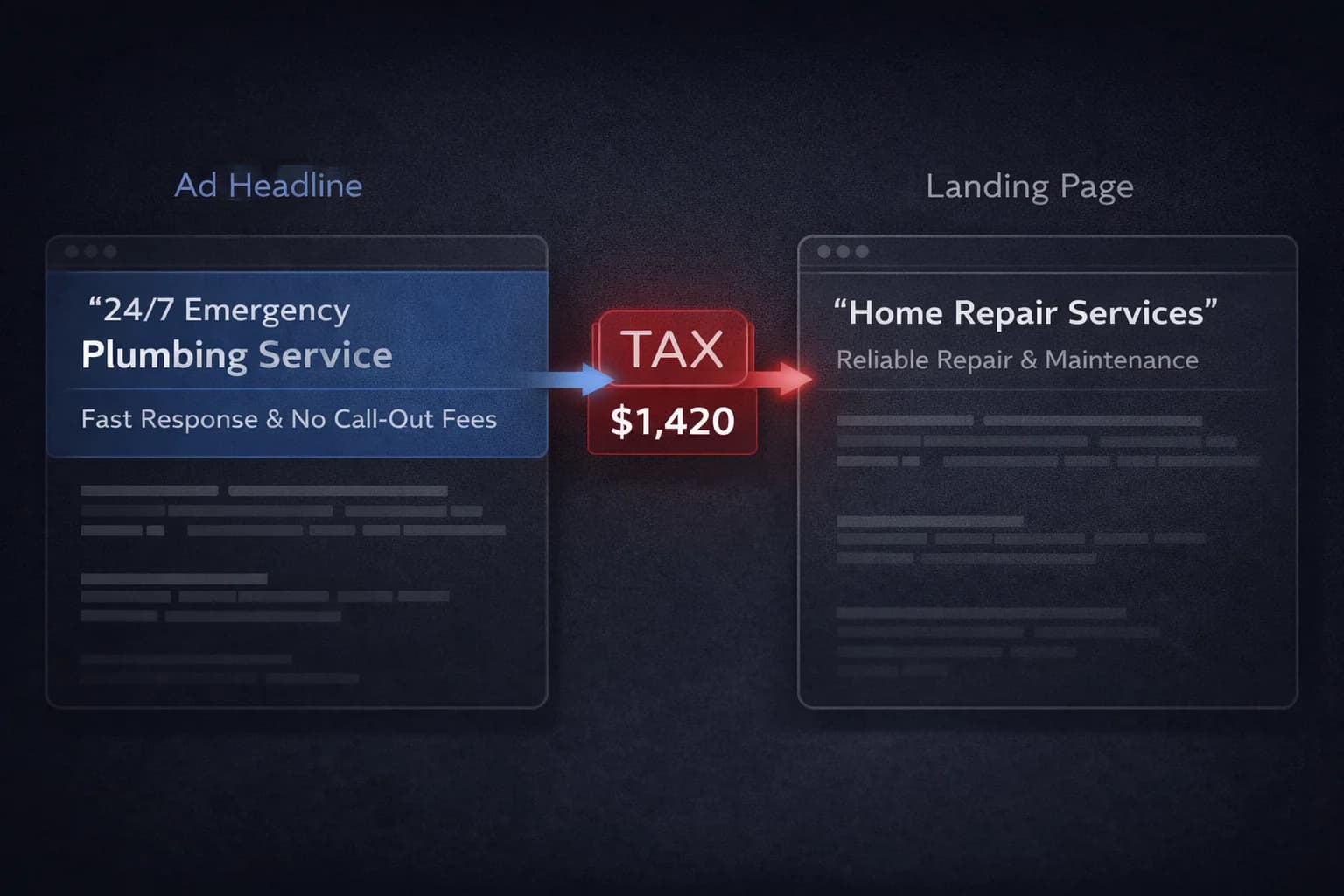
The Alignment Tax: Why High-Spend Google Ads Campaigns Fail at the Post-Click Frontier
Most Google Ads audits start in the wrong place. They open the Campaigns tab, check CTR, look at conversion volume, review the bid strategy, and draw conclusions about what needs to change. Everything they look at is pre-click.
The most expensive inefficiency in high-spend Google Ads accounts is not in the campaign. It is in the six seconds after the click.
When a user clicks your ad, they arrive with a specific expectation formed by your headline and ad copy. If the landing page confirms that expectation immediately, they engage. If it introduces friction, confusion, or a mismatch between what was promised and what is present, they leave. The session is counted as a bounce. The CPC is spent. The Quality Score signal registers the poor landing page experience. The next auction is more expensive.
This is the Alignment Tax: a compounding cost paid in inflated CPCs, degraded Quality Scores, and high bounce rates, caused by structural incongruence between search intent, ad promise, and landing page fulfillment. It is not visible as a line item. It is embedded in every performance metric across the account.
The financial scale of closing this gap is significant. In a documented audit of a dumpster rental operator, transitioning paid traffic from a generic homepage to a dedicated landing page increased conversion rate from 7.16% to 28.94%. A 4x improvement in cost-per-lead with no increase in media spend.
For the account-level signal architecture that determines whether traffic quality is worth optimizing for conversion at all, The $1,127 Algorithmic Tax covers the upstream data problems that make post-click optimization moot if left unaddressed.
The Mathematics of the Alignment Tax
Google Ads operates as a mathematical auction that simultaneously serves advertiser objectives and user experience goals. The mechanism that enforces this dual mandate is Ad Rank:
Ad Rank = f(Bid, Quality Score, Expected Impact of Assets)
Quality Score is the variable that determines how much you pay for your position. A higher Quality Score means paying less per click for the same ad position. A lower Quality Score means paying more. The spread between a Quality Score of 5 and 8 on the same keyword is approximately 30% in CPC. At scale, that differential compounds across every auction the keyword enters.
Quality Score has three components, each evaluating a different stage of the user journey:
| Component | What It Measures | Strategic Implication |
|---|---|---|
| Expected CTR | How effectively creative captures intent relative to competitors | Measures relevance before the click |
| Ad Relevance | Linguistic alignment between query and ad copy | Requires tightly themed ad groups that mirror query language |
| Landing Page Experience | Alignment between ad promise and page fulfillment | Penalties applied for friction, mismatch, or low utility |
Landing Page Experience is where most accounts lose ground because it is the component operators control least consciously. CTR and ad relevance get attention because they live in the campaign interface. The landing page lives somewhere else, managed by a different team, updated on a different schedule, and almost never tested systematically against the specific ad copy driving traffic to it.
The result is an account paying the Landing Page Experience tax on every click while the cause of the tax sits outside the platform where most operators look for problems.
How Google Reads Your Funnel
The technical reality that makes landing page alignment increasingly important is that Google no longer evaluates relevance through keyword matching. It evaluates it through semantic understanding.
Google uses BERT, its bidirectional language model, to evaluate the contextual relationship between what a user searched for, what your ad promised, and what your landing page delivers. BERT understands nuance, word relationships, and intent in a way that keyword-matching algorithms did not. It can identify when your ad copy uses precise industry terminology and your landing page uses generic category language. It registers that mismatch as a relevance failure.
If an ad promises "enterprise SOC 2 compliance software" and the landing page delivers generic "security consulting" copy, BERT identifies the contextual break. The landing page is not irrelevant in a crude keyword-matching sense. It is irrelevant in the way that a knowledgeable reader would find it irrelevant: it does not specifically address what the user came to find.
This means the standard practice of driving paid traffic to product category pages or service overview pages is systematically penalized. Those pages are built for breadth. Paid traffic requires depth on the specific query that generated the click.
The practical audit question is not "is this landing page about the right topic?" It is "does this landing page specifically fulfill the intent expressed in the search query that brought this user here?"

Engineering Continuity: Headline Mirroring
The simplest and highest-impact alignment intervention is headline mirroring: ensuring the H1 on your landing page matches or directly echoes the primary headline of the ad that drove the click.
The psychological mechanism is cognitive continuity. A user who clicks an ad that says "Enterprise Compliance Automation for SOC 2" arrives expecting to see that language on the page. When they see it in the H1, their brain registers "I am in the right place" and they continue. When they see "Security Solutions for Modern Teams," their brain registers a potential mismatch and they slow down or leave.
The performance data on this is consistent. Headline mirroring typically produces a 40 to 60% conversion lift compared to driving the same traffic to pages without matched H1s. This is not a marginal improvement. It is a structural one, driven by reducing the friction between what was promised and what is delivered.
For campaigns scaling across large keyword sets, maintaining headline alignment manually across hundreds of ad variations is not operationally feasible. Dynamic Text Replacement solves this at scale.
Dynamic Text Replacement: Automating Alignment at Scale
Dynamic Text Replacement injects search parameters from the URL string directly into the landing page headline, automatically matching the page copy to whatever query or keyword triggered the ad.
The technical implementation uses URL parameters in your Final URL:
{lpurl}?service={keyword}&utm_content={creative}&geo={_city}
When a user searches "emergency roof repair Chicago," the parameter string passes "emergency roof repair" as the service value and "Chicago" as the geographic value. The landing page H1 dynamically renders as "Emergency Roof Repair in Chicago" without any manual intervention.
A documented A/B test by Campaign Monitor found that dynamically updating a single verb in a headline to match the user's specific search query produced a 31.4% conversion lift over a 77-day test period. One variable. One change. Thirty percent more conversions from the same traffic.
The key requirement for DTR to function correctly is that your landing page platform supports it and that you have mapped your parameter strings to the correct page elements. Verify the implementation with a test query before scaling. A broken DTR implementation that renders a malformed headline is worse than no DTR at all.
Ad Assets: Intent-Match Bridgeheads
Ad assets are not optional enrichments. Google incorporates the expected impact of assets directly into Ad Rank. Their absence is a self-imposed penalty on every auction you enter.
Beyond Ad Rank, assets serve a specific alignment function: they let users self-select into the most relevant part of your offer before they reach the landing page, which improves both conversion rate and traffic quality.
Sitelinks as Precision Navigation
Sitelinks allow users to bypass your primary landing page offer and navigate directly to a high-intent internal destination. A user searching "enterprise compliance software pricing" and seeing a sitelink directly to your pricing page will click that sitelink at dramatically higher intent than a user forced to navigate through a product overview page to find pricing.
A documented sitelink optimization case study for a payment provider produced a 36.33% improvement in sitelink-specific CTR, a 120% increase in total conversions, and a 101.5% year-over-year increase in marketing qualified leads. The sitelinks did not change the product. They reduced the distance between the user's intent and the information they needed.
Build sitelinks around the highest-intent destinations in your funnel: pricing pages, demo request forms, specific product features, and case study pages organized by industry or use case. Each sitelink should fulfill a distinct high-intent query variation that your primary landing page does not address directly.
Callout Assets as Trust Signals
Callouts are non-clickable text assets that appear in the ad and communicate specific, credibility-building USPs. Deploy a minimum of 6 callouts per ad. The critical distinction between effective and ineffective callouts is specificity.
Generic: "Best Service Available" Specific: "Response Time Under 4 Hours"
Generic: "Trusted by Businesses" Specific: "SOC 2 Type II Certified"
Generic: "Easy to Use" Specific: "30-Day Money-Back Guarantee"
The generic versions communicate nothing. Every competitor claims them. The specific versions communicate verifiable claims that a user can evaluate before clicking. That pre-click trust building improves conversion rate on the landing page because the user arrives with higher confidence in what they are about to find.
The Post-Click Audit Checklist
Run this against your highest-traffic landing pages before making any other campaign optimization decisions. Every pre-click improvement you make is capped by the conversion rate ceiling of the post-click environment.
Intent Match
The Rule of One. Does the page fulfill exactly one promise with one primary call-to-action? Multiple competing offers on a single landing page introduce choice overload that increases cognitive friction and reduces conversion. Homepage routing for paid traffic violates this principle structurally.
Headline Mirroring. Does the page H1 match or directly echo the top-performing ad headline for the traffic segment landing on this page? If you are running multiple ad variations, verify the H1 alignment for each headline variant separately.
Linguistic Congruence. Does the page use the specific terminology present in the search queries driving traffic to it? Not category-level language. Query-level language. If users are searching "HIPAA-compliant patient scheduling software," the page should use that exact phrase, not "healthcare software solutions."
Performance Engineering
LCP under 2.5 seconds. Largest Contentful Paint measures how quickly the main content element loads. Above 2.5 seconds, users begin abandoning. Above 4 seconds, mobile abandonment accelerates rapidly. Test with Google's PageSpeed Insights on mobile, not desktop.
INP under 200 milliseconds. Interaction to Next Paint measures how quickly the page responds to user input. A slow INP means users clicking your CTA button experience a lag before anything happens, which destroys conversion confidence at the exact moment of decision.
Mobile performance. Approximately 83% of landing page visits come from mobile devices. Mobile consistently converts at lower rates than desktop due to technical friction: slow load times, forms not optimized for mobile keyboards, CTAs not positioned in thumb-reach zones. Every 0.1-second improvement in mobile load speed produces an 8 to 10% lift in conversions. Fix mobile performance before everything else.
Form field count. Forms with 4 fields convert 120% better than forms with 11 fields. For lead generation landing pages, capture only what is necessary for the next sales step. Additional qualification data can be collected during the sales process. Every additional field you require is a conversion you are choosing not to have.
Trust Signals
Social proof specificity. Replace "thousands of customers" with specific counts and recognizable logos. "7,400 compliance teams trust us" is verifiable. "Thousands of customers" is not. Verifiable specificity converts. Vague claims do not.
Decision-point trust placement. Security badges, privacy policy links, and certifications should appear directly adjacent to the CTA button, not in the footer. Trust signals placed at the decision point reduce anxiety at the exact moment the user is deciding whether to submit. Trust signals in the footer are seen after the decision has already been made, or not at all.
The Mobile Performance Paradox
Mobile drives the majority of paid search traffic. Mobile converts at the lowest rate. The gap between these two facts is where a significant portion of your CPC budget disappears.
The causes are technical, not behavioral. Mobile users do not have lower purchase intent than desktop users. They have less patience for technical friction. A page that loads in 1.5 seconds on desktop may load in 4.5 seconds on a 4G connection. A form optimized for a full keyboard requires frustrating interaction on a mobile keyboard. A CTA button sized for a mouse cursor is difficult to tap accurately on a touchscreen.
None of these are content problems. They are engineering problems. And they are the ones most likely to be overlooked in an account audit that starts and ends in the Google Ads interface.
Audit your top landing pages on an actual mobile device, not a browser emulator. Fill out your own forms on mobile. Tap your own CTA buttons. Experience the friction your users experience. The problems that are obvious to a user on their phone are often invisible to a marketer reviewing analytics on a desktop.
The alignment between what your ads promise and what your landing pages deliver is only part of the equation. The other part is whether the delivery mechanism works for the device the majority of your users are on.
The Compounding Return on Alignment
Closing the alignment gap is not a one-time conversion rate lift. It is a compounding return across every downstream metric in the account.
Higher landing page experience scores reduce your effective CPC through Quality Score improvement. Lower CPCs mean more clicks for the same budget. More relevant traffic on better-aligned pages converts at higher rates. Higher conversion rates improve the quality of your conversion data, which improves the algorithm's ability to find similar users. Better audience targeting produces better-quality traffic, which lands on your aligned landing pages and converts at higher rates.
Every improvement in the post-click environment amplifies every other optimization in the account. This is why the alignment gap, despite being technically outside the Google Ads interface, is often the highest-leverage intervention available to a high-spend account.
The operators who treat landing page alignment as a separate project, managed on a separate timeline, by a separate team, are paying the Alignment Tax continuously. The operators who build systematic alignment between query, ad copy, and landing page as a core component of their campaign architecture are compounding an efficiency advantage that widens with every dollar spent.
For the match type and intent architecture that ensures the right queries reach your aligned landing pages in the first place, Match Type Forensics covers how semantic drift routes the wrong traffic to pages that cannot convert them regardless of alignment quality.
Frequently Asked Questions
What is Ad Rank in Google Ads and how does Quality Score affect it? Ad Rank determines your ad's position in the auction and the CPC you pay for that position. It is calculated from your bid, your Quality Score, and the expected impact of your ad assets. Quality Score has three components: Expected CTR, Ad Relevance, and Landing Page Experience. A higher Quality Score means paying less per click for the same position. The spread between a Quality Score of 5 and 8 on the same keyword is approximately 30% in CPC. Improving landing page experience is often the fastest path to Quality Score improvement because it is the component competitors invest in least.
What is headline mirroring in Google Ads landing pages? Headline mirroring is the practice of matching the H1 on your landing page to the primary headline of the ad that drove the click. It works by creating cognitive continuity: the user sees the same language they responded to in the ad reproduced on the page, confirming they are in the right place. This reduces bounce rate and typically produces a 40 to 60% conversion lift compared to landing pages with generic H1s that do not reflect the specific ad copy. It is the single highest-impact landing page change available to most accounts.
What is Dynamic Text Replacement and how does it work in Google Ads? Dynamic Text Replacement automatically updates the text on your landing page to match the search query or keyword that triggered the ad, using URL parameters passed from your Final URL. A user searching "emergency plumber San Jose" lands on a page that dynamically renders "Emergency Plumber in San Jose" as the H1, without manual intervention. This maintains alignment at scale across large keyword sets where manually creating a unique landing page for every keyword variation is not operationally feasible. The technical implementation requires landing page platform support for DTR and correctly configured URL parameter strings.
Why does routing Google Ads traffic to a homepage hurt conversion rates? Homepages are built for breadth: introducing the company, communicating the full range of products or services, and directing visitors to the section relevant to them. Paid search users arrive with a specific intent formed by their search query. A homepage forces them to navigate from a general overview to the specific information they are looking for, which introduces friction and choice overload. Dedicated landing pages built around a single offer and a single CTA remove that navigation requirement and typically convert at 2 to 4 times the rate of homepage routing for the same paid traffic.
How many form fields should a Google Ads landing page have? Research consistently shows that 4-field forms convert at significantly higher rates than longer forms. Forms with 11 fields convert at roughly half the rate of 4-field forms. Capture only what is necessary for the next sales step: typically name, email, phone, and one qualifying question. Additional qualification data can be gathered during the sales process. Every additional field you require is a measurable conversion reduction. If your current form has more than 4 fields, A/B test a stripped-down version before changing anything else on the page.
What causes the mobile performance paradox in Google Ads? Mobile drives approximately 83% of paid search landing page traffic but consistently converts at lower rates than desktop. The gap is not behavioral. Mobile users do not have less purchase intent. They have less patience for technical friction: slow load times on mobile networks, forms that require awkward interaction on mobile keyboards, and CTA buttons sized for mouse cursors rather than thumbs. The fix is engineering-focused: optimize page load speed specifically for mobile network conditions, simplify forms for mobile input, and verify that CTAs are positioned and sized for touch interaction. Test on an actual device, not a desktop browser emulator.
Sources
- Google Ads Help — About Ad Rank
- Google Ads Help — About Quality Score for Search Campaigns
- Journey Further — BERT Relevance Using AI in Google Ads
- Avid Demand — Paid Media Case Study: Google Ads Sitelink Extensions More Than Double MQLs
- Unbounce — Dynamic Text Replacement for Landing Pages
- Involve.me — 100+ Landing Page Statistics You Should Know (2026)
- SEO Sherpa — Landing Page Statistics 2026
- Instapage — Google Ads Quality Score: How It's Calculated and Tips to Improve It