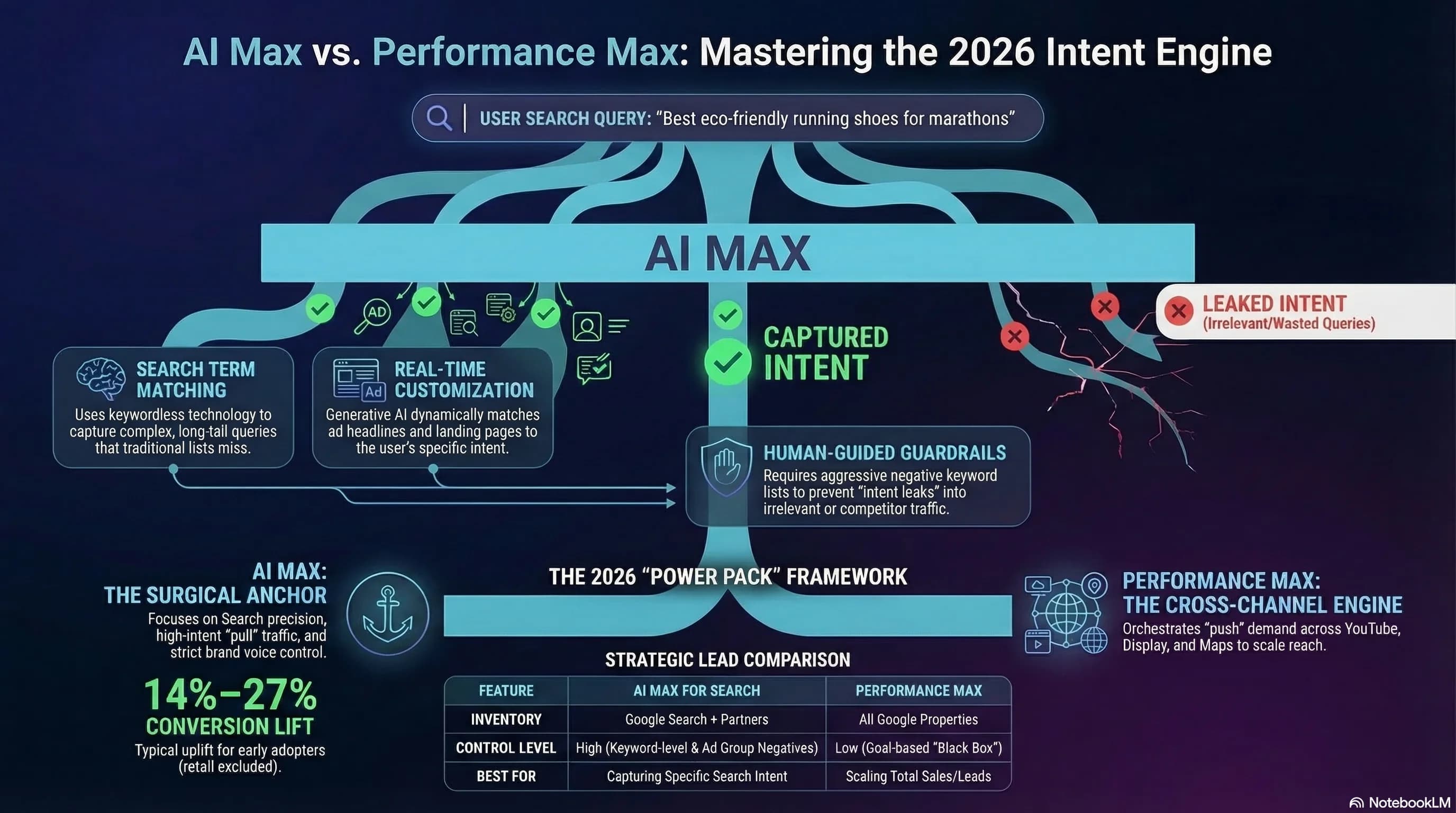
The AI Max Audit: Why Your Search Campaigns Are Leaking Intent and How to Fix Them
For a decade, precision in Google Ads meant manual labor. Hand-picked exact match keywords, granular bid adjustments, meticulous campaign segmentation. The advertiser's job was to find the right keyword and bid the right amount. The machine executed the instruction.
That model ended in September 2025 when Google rolled out AI Max globally. With 87% of total ad spend now flowing through automated bidding, the keyword era is over. Your job is no longer to find the keyword. It is to steer the system.
AI Max is not a set and forget utility. Treated with a traditional manual mindset, it becomes a liability that leaks intent and burns budget on traffic that was never going to convert. Treated as what it actually is, a signal-orchestration layer that requires disciplined human oversight, it outperforms every alternative configuration available in Google Ads today.
In split tests across nearly 900 accounts, AI Max delivered 23% better CPA than Performance Max while maintaining 91% of its reach. Against standard Search campaigns, it produced 31% more conversions at similar CPAs by identifying high-intent query patterns a human manager operating on manual keyword lists would never see.
The gap between those results and what most accounts actually achieve with AI Max is a configuration gap. This audit closes it.
If you have not yet addressed the foundational signal architecture and conversion tracking setup that makes any AI-driven campaign viable, start with The $1,127 Algorithmic Tax, which covers the signal maturity model every account needs before deploying automated bidding at scale.
Why AI Max Sits Between Standard Search and Performance Max
Understanding where AI Max fits in the campaign architecture is the prerequisite to configuring it correctly.
Standard Search gives you full visibility into search terms and complete control over keyword matching. The cost is scale. You are limited to the queries your keyword list explicitly covers or closely matches. High-intent queries you have not thought to include are invisible to the campaign.
Performance Max gives you maximum reach across all Google inventory. The cost is control. The search term report shows categories, not individual queries. You cannot see where your budget is going or why specific auctions are being entered.
AI Max sits between them and resolves the core tension.
| Standard Search | Performance Max | AI Max | |
|---|---|---|---|
| Search term visibility | Full | Categories only | Full |
| Placement | Search Network only | Cross-network | Search and Partners only |
| Control model | Manual keyword control | Black box automation | Guided orchestration |
| Performance | Precision, limited scale | Maximum reach, zero control | 25% conversion lift via signals |
The transparency of standard Search with the intent-discovery capability of automation. That combination is the competitive moat AI Max offers, but only when you provide the guardrails that prevent the algorithm from expanding into low-quality territory.
Broad Match as a Discovery Engine, With a Kill Switch
In AI Max, Broad Match is the default match type. The system has moved from syntax matching, scanning pages for specific words, to intent-based matching, understanding what the user is actually trying to accomplish. A query does not need to contain your keywords for AI Max to serve your ad. It needs to reflect the same underlying intent.
This is a powerful capability. It is also the primary source of waste in misconfigured AI Max campaigns.
An unconstrained broad match system will expand into tangentially related queries that share surface-level intent signals with your target audience but have no purchase intent. The algorithm is not doing something wrong. It is doing exactly what you told it to do. You told it to find conversions. It found queries that statistically correlate with the conversion events in your account. If those conversion events are form fills rather than qualified sales, it will find queries that produce form fills from users who will never become customers.
Four guardrails define the boundary between useful discovery and budget waste:
The 15x Budget Rule. Your daily budget must be at least 15 times your Target CPA. This is not a recommendation. It is a functional requirement. A restrictive budget prevents the algorithm from exploring enough auction variance to find its performance ceiling. It learns on a narrow dataset, optimizes for that narrow dataset, and never discovers the high-value query patterns that justify the AI Max configuration.
The 14-Day No-Touch Zone. Every AI Max campaign runs a 7 to 14 day learning phase after launch or after any significant change to bids, budgets, or assets. Making adjustments during this window resets the learning process and returns the campaign to baseline volatility. Set the campaign up correctly before launch. Then leave it alone for two weeks.
Conversion Quality Guardrails. Optimizing for raw form fills trains the algorithm to find users who submit forms, including bots, accidental submissions, and leads with no purchase intent. Feed the system Qualified Lead or Offline Sales conversion data from your CRM. The signal you provide determines the audience the algorithm finds. If you provide accurate signals of what a real customer looks like, it will find real customers.
Disciplined Negative Keywords. Proactively exclude intent themes that will never convert before the campaign learns to chase them. Standard exclusions include informational intent (free, how to, DIY, tutorial), employment intent (jobs, careers, hiring, internship), and competitor queries where you have no realistic conversion rate. Use the search term report weekly during the first month to identify intent mismatches and add them as negatives before they scale.

The RSA Quality Audit: Avoiding Automated Copy That Sounds Like a Robot
The greatest creative risk in AI Max is what I call the uncanny valley of automated copy. Weak asset combinations that dilute your brand voice and sound like a machine addressing a machine. Users do not click ads that feel generated. They click ads that speak directly to their specific situation.
The minimum viable asset set for AI Max is 15 headlines and 8 descriptions. Volume gives the algorithm the permutations it needs to match specific user intent across the full range of queries broad match will discover. But volume without brand DNA is dangerous. Fifteen generic headlines are worse than five sharp ones because they give the algorithm more low-quality combinations to test and scale.
Two features in AI Max address this directly and most operators are not using either of them.
Term Exclusions allow you to specify up to 25 phrases the algorithm is strictly forbidden from using in generated ad copy. A luxury brand can exclude "cheap," "affordable," and "budget." A B2B SaaS company can exclude "free trial" if that offer is not part of their acquisition model. A professional services firm can exclude "DIY" and "template." This is the difference between writing ads and teaching the system how your brand sounds.
Message Restrictions allow you to implement up to 40 custom rules that ensure mandatory value propositions appear consistently while the AI optimizes secondary hooks. If "Next Day Delivery" is a core differentiator, a message restriction ensures it appears in ad copy across all generated combinations rather than only when the algorithm decides to include it. If your certifications or accreditations are conversion drivers, lock them in as required elements.
Build your asset set with these constraints active from launch. Do not add them after the campaign has learned on unconstrained copy. The algorithm has already built patterns around the unrestricted version and will need to relearn from scratch.
Final URL Expansion: Precision Over Randomness
Final URL Expansion allows AI Max to match the most relevant page on your site to a specific user query rather than always sending traffic to the URL you specified at the ad level. When a user searches for something your site covers on a page other than your primary landing page, the system can route them directly there.
The feature works by having Google's crawler scan your site and identify the value propositions present on each page. This crawl takes approximately 2 to 3 minutes when you enable the feature. The system then builds an internal map of what each page is about and uses that map to make routing decisions in real time.
The problem is that Google's crawler does not distinguish between pages you want traffic on and pages that exist for internal purposes. Without explicit exclusions, AI Max will send paid traffic to your Privacy Policy, your Careers page, your About Us section, and blog posts from three years ago that happen to contain keywords related to your current campaigns.
The audit fix is implementing URL Exclusion Rules before enabling Final URL Expansion. Define the pages and directories you want excluded from paid traffic routing. Review the Website URL analysis in your AI Max campaign to verify that the value propositions Google has identified for each included page actually align with your current marketing positioning. Pages that were accurate in 2023 may reflect offers, pricing tiers, or messaging that you have since changed.
Enable the feature with exclusions active. Do not enable it without them.
The AI Max Operator's Audit Checklist
Run through this weekly. These are not optimization suggestions. They are the minimum oversight requirements for an AI Max campaign to produce results that reflect your actual business goals rather than the algorithm's default behavior.
Search Term Audit Review the search terms report and identify zero-conversion themes. These are query categories that have generated clicks and spend but no conversion events over the past 30 days. Add them as negative keywords at the campaign level. Separately, benchmark your Search Partner Network volume. Search Partners should contribute 8 to 15% of incremental conversion volume. If they exceed this with a CPA significantly above your target, test a network-specific campaign split to isolate Search Partners and evaluate them independently.
Location Setting Check Switch the location targeting setting from the default "Presence or Interest" to "Presence Only." Interest-based targeting serves ads to users who have searched for or shown interest in your target location but are not physically there. For most businesses with geographic service constraints, this is a primary source of spend on users who cannot become customers.
Negative Keyword Sync Verify that your AI Max campaign shares brand-defense negative keywords with your branded search campaign. AI Max running on broad match will match brand-intent queries. Without explicit exclusions at the campaign level, it will cannibalize traffic your branded campaign should be capturing at lower CPC with higher Quality Score.
Bid Cap Review Validate that your Target CPA or Target ROAS reflects your actual margins at current volume. If your account has scaled since you set the initial targets, your margins may have compressed. Adjust targets in increments of 10 to 15%. Dramatic bid strategy changes trigger a new learning phase. Incremental adjustments allow the algorithm to adapt without resetting.
RSA Asset Health Open the Assets report and filter for any headline or description rated Low. Replace Low-rated assets quarterly with new copy hypotheses. Do not pause and reactivate. Replace with genuinely different messaging. The algorithm needs new permutations to test, not the same underperforming copy given another chance. Verify your headline and description counts are at or above the 15 and 8 minimums.
URL Guardrail Verification Confirm your URL exclusion rules are protecting your site structure from informational and non-conversion pages. Check this monthly. New pages added to your site are not automatically excluded and may be incorporated into AI Max's routing decisions without your awareness.
Three Mental Models for AI Max Operators
These are the frames that consistently separate operators who get results from AI Max from those who blame the algorithm for problems they created.
The Guardrail Model. The AI is the horse. Your negative keywords, bid caps, conversion signals, and URL exclusions are the reins. Without reins, the horse goes where it wants, which is wherever the terrain is easiest. With reins that are too tight, the horse cannot run at the pace you need. The goal is controlled velocity: enough constraint to keep the algorithm in productive territory, enough freedom for it to find the query patterns you cannot see manually.
The Signal-In, Signal-Out Model. The algorithm is only as intelligent as the data it is trained on. Feed it form fill events and it will find users who submit forms. Feed it offline sales data representing actual closed revenue and it will find users who become customers. The quality of your output is determined entirely by the quality of your input signal. This is not a nuance of AI Max. It is the fundamental operating principle of every automated bidding system in Google Ads.
The Portfolio Model. Do not evaluate individual broad match keywords in isolation. Evaluate the campaign's capacity to find incremental, long-tail query patterns that your exact match campaigns cannot reach. A keyword that looks expensive at the individual level may be the entry point to a high-value query cluster that produces your best customers. The unit of analysis is the campaign's performance against your revenue targets, not the CPC of any specific term.
The One-Click Experiment: Proving the Lift Before Committing the Budget
You do not need to take a leap of faith on AI Max. Google's experiment framework allows you to run a controlled split test between your current keyword-constrained campaign and an AI Max version simultaneously.
The system automatically calculates the required runtime based on your historical conversion volume and statistical confidence thresholds. It removes the guesswork from experiment design. Run the test for a minimum of 14 days. Let the data demonstrate the lift before migrating budget.
The experiment will show you the actual CPA differential, conversion volume difference, and reach expansion that AI Max produces in your specific account context. Industry benchmarks are useful orientation. Your account data is the only number that matters for your budget decisions.
For the broader picture of how AI-driven search is reshaping the environment your campaigns operate in, including how organic visibility and paid search increasingly share the same signal infrastructure, The SEO Roadmap for 2026 covers what is changing at the search engine level and what it means for paid advertisers.
Frequently Asked Questions
What is AI Max for Search and how is it different from Performance Max? AI Max is a Search-only campaign type that combines broad match intent discovery with full search term transparency and human-configurable guardrails. Performance Max operates across all Google inventory (Search, YouTube, Display, Gmail, Discover, Maps) with limited visibility into where budget is being spent. AI Max gives you the intent-discovery benefits of automation while keeping placements confined to Search and Search Partners, where purchase intent is highest and you can see exactly which queries triggered your ads.
How long does the AI Max learning phase take and what should I avoid during it? The learning phase runs 7 to 14 days from campaign launch or from any significant change to bids, budgets, or creative assets. During this window, avoid changing target CPA or ROAS settings, pausing or adding asset groups, making significant negative keyword additions, or adjusting budget by more than 20%. Any of these actions resets the learning process. Set the campaign up correctly before launch and then leave it alone for two weeks.
What conversion data should I feed AI Max for best results? Qualified lead or offline sales conversion data that reflects actual revenue outcomes. Raw form fills, page views, and micro-conversions train the algorithm to find users who complete those specific actions, which does not necessarily correlate with users who become paying customers. If you have CRM integration and offline conversion tracking set up, import closed-won deal data or qualified sales stages as your primary conversion signal. The algorithm will find users who resemble your actual customers rather than users who resemble your form submitters.
How do I prevent AI Max from cannibalizing my branded search campaigns? Add your brand terms as exact-match negative keywords at the AI Max campaign level. This forces branded queries to your dedicated branded search campaign where they are captured at lower CPC with higher relevance. Verify this is working by checking the search term report for your AI Max campaign and filtering for brand-name queries. Any branded terms appearing there indicate the exclusion list needs updating.
What is Final URL Expansion and should I enable it? Final URL Expansion allows AI Max to route traffic to the most relevant page on your site for a given query rather than always using your specified landing page URL. It can improve conversion rates by matching users to more relevant content. Enable it only after implementing URL exclusion rules that prevent traffic from landing on your Privacy Policy, Careers page, outdated blog posts, or any page that is not designed to convert. Without exclusions, the feature will route paid traffic to pages that were never intended to receive it.
How do I know if AI Max is working better than my previous campaign setup? Run a Google Ads experiment. The experiment framework splits your traffic between your existing campaign and an AI Max version simultaneously and reports the CPA differential, conversion volume, and reach expansion with statistical confidence indicators. Run the experiment for at least 14 days to accumulate sufficient data. Industry benchmarks suggest 23% better CPA than PMax and 31% more conversions than standard Search, but your account data will reflect your specific competitive environment and conversion quality.
Sources
- Google Ads Help — About Final URL Expansion in Search (Beta)
- Google Ads Help — Grow Your Smart Bidding Campaigns with Broad Match
- ALM Corp — Google AI Max for Search: Performance Data from 250+ Real Campaigns
- Search Engine Land — How to Use Broad Match Without Losing Control
- Loud Mouth Media — AI Max vs PMax: Which One Should Lead Your 2026 Strategy
- GROAS — Google AI Max Explained: Complete October 2025 Guide for Search Campaigns
- Search South — Negative Keywords and Broad Match in 2026
- Bullseye Strategy — 2026 PPC Audit Checklist: How to Evaluate Google Ads in the AI Era