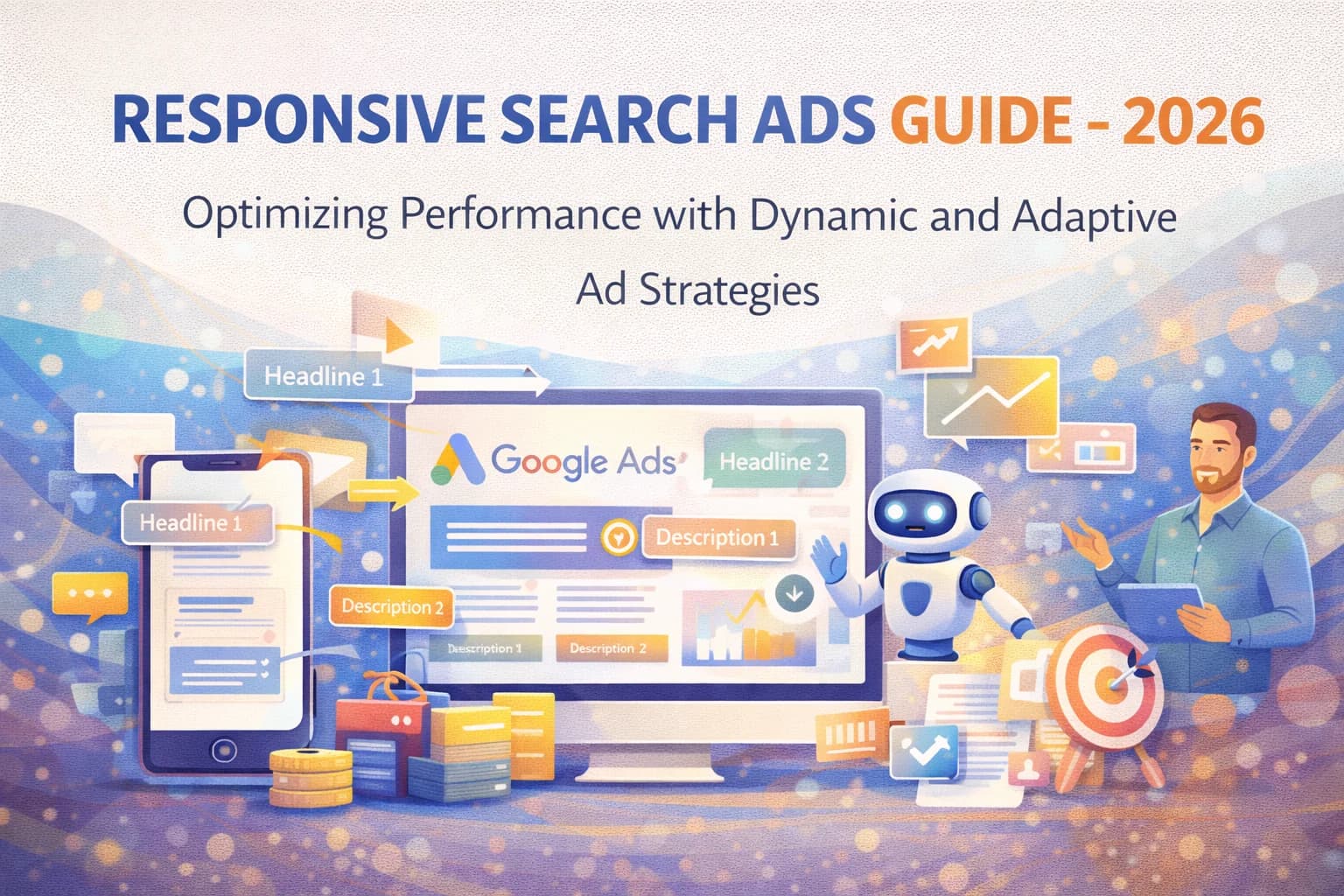
Responsive Search Ads are no longer optional. With Expanded Text Ads retired since June 2022 and call-only ads phased out in February 2026, RSAs are the only Search ad format available to most advertisers. If you are running Search campaigns in 2026, you are running RSAs. The question is whether you are running them well.
The honest answer, for most accounts, is no. The typical RSA has five to seven headlines that partially overlap, descriptions that read like a company tagline repeated twice, and an Ad Strength of "Good" that was chased for its own sake rather than for performance. The algorithm has limited material to work with and produces mediocre results accordingly.
This guide covers how RSAs actually work, why Ad Strength is a distraction, and the specific approach to writing and structuring headlines and descriptions that gives Google's machine learning the best inputs to find your highest-performing combinations.
What RSAs Actually Do (and Do Not Do)
Responsive Search Ads allow you to input up to 15 headlines (each up to 30 characters) and up to 4 descriptions (each up to 90 characters). Google's machine learning then tests combinations of these inputs and — over time — learns which combinations perform best for different users, queries, and contexts.
A displayed RSA shows up to 3 headlines and up to 2 descriptions in any given auction. Critically, Google controls which combination appears. You do not. This means any three headlines in your RSA could theoretically appear together in the same ad. If your headlines are not written to work independently and in any combination, you will produce ads that are incoherent or redundant.
The range of combinations Google can test from 15 headlines and 4 descriptions is mathematically large — over 40,000 potential combinations. In practice, the algorithm tests the most plausible combinations first based on prior performance signals and user context, narrowing down to the highest-performing variants over time. Accounts with more conversion data see this optimization happen faster.
RSAs are also now the asset source for Google's enhanced flexibility features. Up to 2 unused headlines from your RSA can serve as link-based assets (similar to sitelinks) in the same ad, pointing to the same domain. This means your unused headline assets extend the footprint of your ads beyond the three headline slots — another reason to use all 15 if possible.
The Ad Strength Trap
Ad Strength is a rating Google displays when you create or edit an RSA, ranging from "Incomplete" to "Poor," "Average," "Good," and "Excellent." It evaluates the diversity, relevance, and quantity of your headlines and descriptions and suggests improvements.
Here is the important nuance: Ad Strength is confirmed by Google itself to have no effect on Ad Rank. A "Poor" rated RSA can outperform an "Excellent" rated RSA if the copy is more relevant and converts better. Ad Strength evaluates breadth of inputs — how many headlines you have, how diverse they are, whether you included keywords. It does not evaluate whether those headlines are good.
The danger of chasing Ad Strength to "Excellent" is that it pushes you toward adding generic, diversifying headlines that are technically different but not actually useful. "Our Services," "Learn More Today," and "Contact Us Now" will raise your Ad Strength score. They will not improve your campaign performance.
Use Ad Strength as a check that you have given Google enough material to work with. Aim for at least "Good" as a baseline. But do not add headlines for the purpose of raising the score — add them only if they represent genuinely distinct, valuable messages.
The Right Framework for Writing RSA Headlines
The most useful way to think about your 15 headline slots is to categorize them by the type of message they carry. An RSA that performs well across a range of users and queries needs headlines in each of these categories:
Keyword-focused headlines — directly mirror the search query and signal immediate relevance. These are the headlines most likely to get bolded by Google when they closely match the user's search. Include 3 to 4 keyword-focused variants covering the primary terms in your ad group. If your ad group covers "project management software," "project tracking tool," and "team task management," each could have its own keyword headline.
Benefit headlines — articulate what the user gains from your offer. Not features ("Built-in reporting dashboard") but outcomes ("Know Where Every Project Stands"). Benefits speak to the user's goal, not your product's capabilities. Write 3 to 4 benefit headlines that address the primary outcomes your target users care about.
Differentiator headlines — communicate why you over alternatives. What do you offer that competitors do not? Speed, price, specific integrations, industry focus, support quality? These headlines convert users who are comparison-shopping. Write 2 to 3 differentiator headlines that are specific enough to be meaningful. "Industry-Leading Support" is not a differentiator. "24/7 Live Chat — Reply in Under 2 Minutes" is.
CTA headlines — drive action. "Start Your Free Trial," "Book a Live Demo," "Get a Custom Quote Today," "See Pricing." These tend to perform well in the third headline position when paired with keyword and benefit headlines in positions one and two. Write 2 to 3 CTA variants with different action orientations (demo, trial, pricing, consultation).
Social proof headlines — reduce hesitation. "Trusted by 2,000+ Marketing Teams," "Rated 4.8/5 on G2," "Used by Shopify, HubSpot and Stripe." These provide third-party validation at the moment users are deciding whether to click. Write 1 to 2 social proof headlines with specific, verifiable numbers.
Urgency or offer headlines — create reason to act now. "Limited-Time: 3 Months Free," "Free Migration Included," "Setup in One Day." Use these if you genuinely have a time-bound offer or a genuinely compelling hook. Do not manufacture false urgency — sophisticated users recognize it and it damages trust.
The Coherence Requirement
Because Google can combine any three of your headlines, you need to verify that your headlines are coherent in any combination. The practical test: pick three headlines at random from your list and read them as though they were a single ad. Does it make sense? Does any combination produce something misleading, redundant, or contradictory?
The most common coherence failures are:
Redundancy — headlines that say the same thing in slightly different words, producing ads like "Project Management Software / Manage Projects Effectively / Track Your Projects Today." Three slots used, one message delivered.
Contradiction — headlines that communicate incompatible messages together, like a "Budget-Friendly" headline appearing alongside a "Premium Enterprise Solution" headline.
Non-standalone fragments — headlines that complete each other's thoughts, requiring both to appear together to make sense. Each headline must be able to stand alone or pair meaningfully with any other headline in the set.
Writing Descriptions That Do the Heavy Lifting
With only four description slots at 90 characters each, descriptions carry the responsibility that headlines cannot: full sentences, full explanations, and the narrative that converts a click into an action.
Do not use descriptions to repeat your headlines. Headlines get bolded for keyword matching; descriptions are where you expand the value proposition, handle objections, and drive a specific action.
Each description should be able to stand independently alongside any combination of your headlines. This means each description needs a complete thought — not a fragment that relies on another description to make sense.
Write descriptions that speak to the specific intent level of your target users. A description that works for someone in early research ("Our platform consolidates every project, deadline, and team communication in one place — no more spreadsheet chaos") reads differently from one aimed at purchase-ready users ("Start free. Set up in 30 minutes. No credit card required. Cancel anytime."). If your ad group captures both intents, write one description for each and let the algorithm serve the right one for the context.
Include your primary differentiator or most compelling offer in at least one description. This is your chance to answer the question the headline implied: "Why should I click this instead of the other ads?" Be specific. Numbers, timeframes, and concrete outcomes outperform abstract language.
Pinning: When to Use It and When Not To
Pinning locks a specific headline or description to a specific position, overriding Google's ability to move it. Headline 1 is the most prominent position and appears before any other headline in the ad. Pinning your strongest keyword headline to Headline 1 ensures it always appears first.
The debate about pinning among PPC practitioners is real and unresolved. Studies show conflicting results: some find pinning improves CTR for certain messages, others find it reduces ad visibility and conversion rates by limiting the algorithm's flexibility.
The practical guidance is conservative: pin sparingly, and only when the brand or legal consequence of a specific message not appearing outweighs the performance cost of reduced flexibility. If your brand always needs to be mentioned in the first headline, pin your brand headline to Position 1. If you have a time-sensitive offer that must appear, pin it to Position 1 with an expiration plan. Otherwise, let the algorithm optimize.
Avoid pinning multiple headlines to the same position. If you pin five headlines to Position 1, Google randomly rotates between them without applying learning about which performs best — effectively creating a manual rotation you manage yourself, which is worse than RSA optimization.
Account Structure and RSA Performance
RSA performance is inseparable from ad group structure. An RSA can only be as relevant as the keywords in its ad group allow it to be. If an ad group contains 60 keywords spanning several distinct intents, no single RSA — regardless of how well-written — can be relevant to all of them.
The best practice is tightly themed ad groups with 5 to 15 closely related keywords and an RSA specifically written for that theme. Each RSA should be able to speak to every keyword in the ad group with at least moderate relevance.
For high-priority keywords, single keyword ad groups (SKAGs) or very tight two to three keyword groups with dedicated RSAs give you maximum control over relevance. The tradeoff is account management overhead — more ad groups, more RSAs to maintain and update.
Monitoring and Improving RSA Performance Over Time
Unlike Expanded Text Ads, where you could see performance data per individual ad variant, RSA performance data is rolled up. You see performance for the RSA as a whole, not for each headline combination. Google provides an "Asset performance" view that rates individual headlines and descriptions as "Best," "Good," "Low," or "Learning" based on how often they are served and what results they produce.
Use asset performance to prune. Headlines rated "Low" after sufficient impressions (typically 500 to 1,000) are consistently losing in Google's internal testing. Replace them with new variants. This is the RSA equivalent of pausing losing ad copy in an ETA rotation.
Headlines rated "Best" should be protected — do not replace them unless you have evidence that a different message would outperform. These are your account's proven copy assets.
The cadence of optimization for RSAs is different from traditional ad testing. You are not running head-to-head A/B tests. You are periodically pruning underperformers and adding new variants for Google to test, informed by asset performance data and campaign performance trends. Review asset performance monthly. Make two to three changes per RSA per review cycle — enough to give the algorithm new material without disrupting ongoing learning.
The Context Where RSAs Are Not the Answer
RSAs work best when your ad group has clear, high-intent keywords and enough conversion volume for Google's machine learning to optimize effectively. They are less effective in very low-volume, highly specialized campaigns where the algorithm does not have enough data to learn what works.
For brand campaigns where you need guaranteed message control — where the specific combination of brand name, tagline, and CTA is non-negotiable — pinning heavily or using a single RSA that pins all key elements gives you the control ETAs used to provide, at the cost of some optimization flexibility.
For competitor campaigns where messaging must be precise and where a wrong combination could create problems, consider fewer headline variants with more intentional pinning.
What Good RSA Performance Looks Like
A well-structured RSA in a well-managed ad group should, over time, show improving asset performance ratings as the algorithm learns which combinations win, stable or improving CTR as winning combinations serve more often, and headline redundancy elimination as Low-rated variants are replaced with fresh options.
The goal is not perfect Ad Strength. The goal is ads that match what your best potential customers are searching for, speak to their intent, demonstrate your value, and make the next step obvious. RSAs give Google the material to assemble those ads at scale and test them in real time against real user behavior. Your job is to give it the right material to work with.
Writing 15 strong headlines for every ad group in your account is genuinely hard work. ClickCatalyst's Catalyst AI can help you generate RSA headline and description variants aligned with your specific offer, audience, and intent — so you can focus on the strategy decisions only you can make.