If you've spent any time in Google Ads over the past two years, you've probably heard one of two things about Performance Max: either it's the future of paid advertising and you're leaving money on the table by not using it, or it's a black box that burns budget and you should avoid it entirely.
Both camps are wrong. And both camps are also, partially, right.
The truth is that Performance Max is neither a magic campaign type nor a budget incinerator — it's a highly capable system that performs exceptionally well under specific conditions and terribly under others. The difference is almost never the campaign type itself. It's almost always what the advertiser fed it.
This guide cuts through the noise. We're going to cover exactly what Performance Max is, why most advertisers fail with it, what the right conditions for success look like in 2026, and how to structure, signal, and optimise campaigns to actually get results.
What Performance Max Actually Is (And What It Isn't)
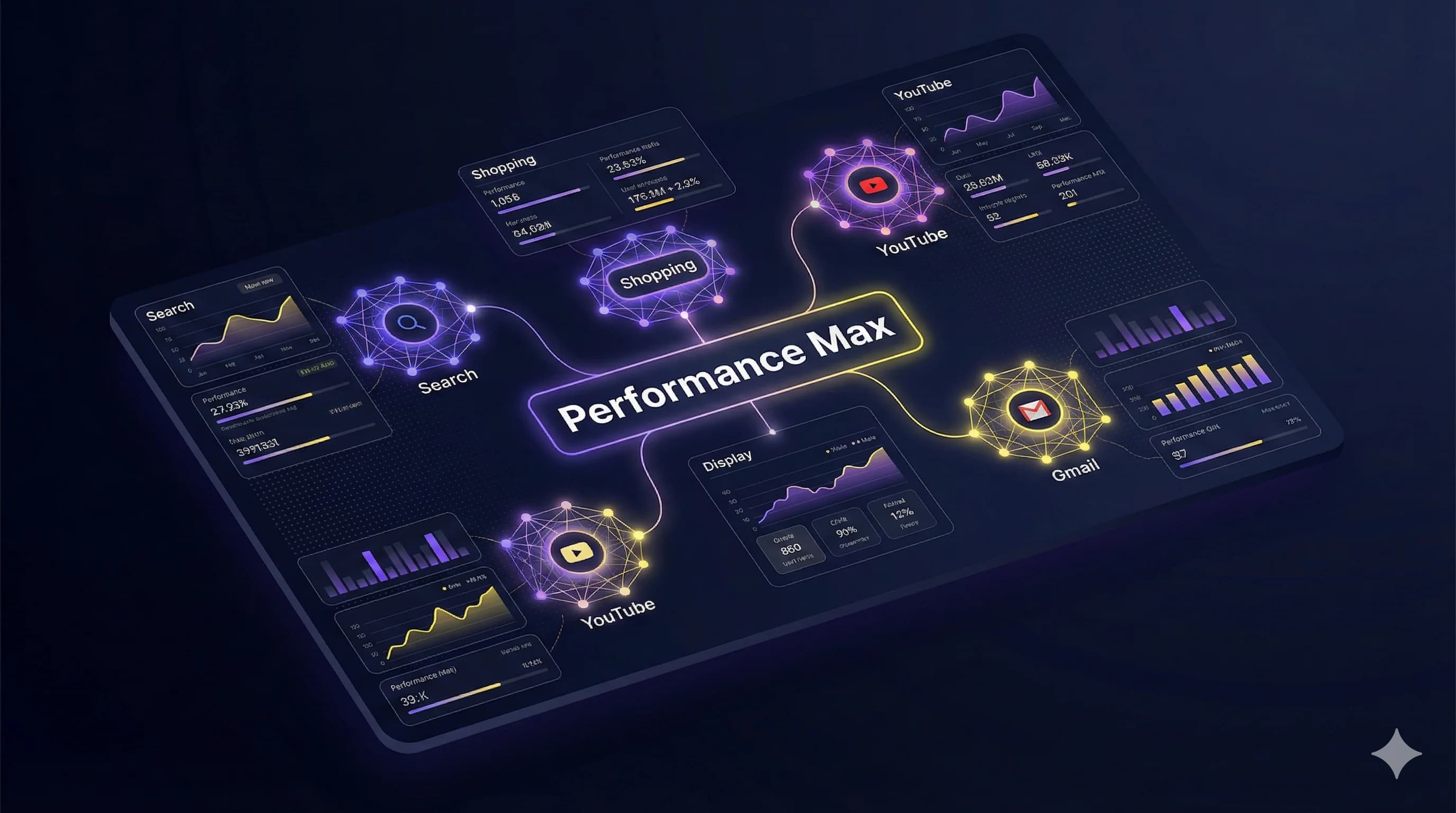
Performance Max is a goal-based campaign type that runs across every Google advertising surface — Search, Shopping, Display, YouTube, Discover, Gmail, and Maps — from a single campaign interface. Rather than you choosing where your ads appear, Google's AI decides in real time based on which surface is most likely to drive a conversion for your specific goal.
At its core, PMax is an automation layer that combines six things:
- Smart Bidding — real-time bid adjustments at auction time
- Audience signals — your data as starting hints, not hard targeting
- Asset groups — headlines, descriptions, images, and videos that the AI mixes and matches
- Final URL expansion — Google can send users to any page it thinks will convert, not just your specified URL
- Automatically created assets — Google can write additional ad copy if you allow it
- Cross-channel optimisation — budget shifts between surfaces automatically
What it is not is a replacement for a well-structured Search campaign. This is the most common misconception. PMax is designed to complement Search, not cannibalise it. The distinction matters enormously when it comes to structuring your account.
Why Most Advertisers Fail With Performance Max
The failure pattern is consistent across thousands of accounts. Advertisers launch PMax expecting automation to do the heavy lifting, then make one or more of these mistakes:
Insufficient conversion volume. PMax's AI needs data to learn. Without at least 30 conversions per month — ideally 50 or more — the algorithm operates on guesswork. Campaigns with fewer than this threshold show wildly inconsistent results not because PMax doesn't work, but because the system literally lacks enough signal to make intelligent decisions. Advertisers see a bad first two weeks and panic.
Launching during the learning period. Every PMax campaign goes through a learning period of roughly two weeks. During this time, performance can be genuinely alarming — high CPAs, low conversion rates, budget going to unexpected places. The temptation to make changes immediately is strong and almost always wrong. Every significant change resets the learning period. Advertisers who intervene too early are essentially trapping their campaigns in a permanent learning loop.
Weak or mismatched assets. PMax's quality is capped by the quality of what you give it. Bland stock photography, generic headlines, and no video assets produce bland results. Google's internal data consistently shows that campaigns with comprehensive video libraries outperform image-only campaigns by 25-40%. If you're not providing video, you're voluntarily handicapping performance.
Poor audience signals. Many advertisers skip audience signals entirely, believing they'll limit reach. This is backwards. Audience signals are not targeting constraints — they are starting hints for the algorithm. They tell PMax where to begin looking, not where it must look. Without them, the system starts cold, tests broadly, and takes far longer to identify your best customer segments.
Allowing Final URL expansion without intent. By default, Final URL expansion is enabled, which means Google can override your specified landing page and send users to any page it thinks will convert better. For some businesses this works well. For others — particularly those with carefully designed landing pages, compliance requirements, or specific funnel stages — this can be disastrous. Know this setting, and decide deliberately whether to leave it on.
Underfunded budgets. A budget of $20-30 per day is insufficient to learn, let alone perform. PMax needs volume. Independent testing has consistently shown that budgets at least 10-15 times your target CPA deliver dramatically faster and more reliable learning. If your target CPA is $50 and you're running $30/day, you're asking the algorithm to learn from fewer than one conversion per day. That's not a test — that's starvation.
The Prerequisites for Performance Max Success in 2026
Before launching a PMax campaign, audit honestly against these requirements. If you don't meet them, PMax will not be the right move yet.
Minimum conversion volume: 30+ conversions per month from existing campaigns. 50+ is significantly better. 100+ is where PMax consistently performs well according to industry data.
Minimum budget: At a bare minimum, $300-500 per day. For anything serious, budget at your target CPA multiplied by 10-15.
Conversion tracking: Accurate, complete, and tracking full-funnel value. This is non-negotiable. If your conversion tracking is broken or incomplete, PMax will optimise toward the wrong signals and you'll never diagnose why.
Established Search campaigns: PMax should complement existing Search campaigns, not replace them. Running PMax without Search is leaving your highest-intent, most controllable traffic channel undefended.
Asset library: Minimum 15 headlines, 4 descriptions, 5+ high-quality images (including landscape, square, and portrait formats), and at least one video. No video means no YouTube inventory. In 2026, that's a meaningful exclusion.
Business age and data: If you've never run Google Ads or have very limited account history, start with Search campaigns. Build 60-90 days of conversion data first, then layer in PMax.
How to Structure Your Performance Max Campaign
Structure is where most of the nuance lives, and where many PMax guides go wrong by oversimplifying.
Asset Groups: Think in Customer Intent, Not Product Categories
The most common structural mistake is organising asset groups by product category. Instead, organise them by customer intent and buying stage.
An asset group should represent a distinct audience with a distinct need and a distinct message. Someone searching for "what is Performance Max" has a different intent to someone searching "Performance Max agency to manage campaigns." Those are different asset groups with different headlines, different descriptions, and ideally different landing pages.
For e-commerce with a large catalogue, segment asset groups by:
- Product performance tier (bestsellers vs. new arrivals vs. clearance)
- Price point (premium vs. mid-range)
- Customer type (new customers vs. existing customers)
For lead generation and B2B, segment by:
- Service type or solution
- Buyer persona (decision-maker vs. practitioner)
- Funnel stage (awareness vs. decision-ready)
Each asset group should only be created if it will realistically generate 30+ conversions per month. Asset groups that are too small to learn effectively are a liability.
Campaign Segmentation: When to Use One Campaign vs. Multiple
One campaign is the right starting point for most advertisers. Spreading conversion volume across multiple campaigns slows learning for all of them. The general rule: only segment into separate PMax campaigns when each campaign will reliably receive 30+ conversions per month independently.
When segmentation makes sense:
- You have fundamentally different target CPAs or ROAS targets for different products or services
- You need to control budget allocation between very different business units
- You have seasonal products that should be isolated to prevent them cannibalising evergreen campaigns
When segmentation doesn't make sense:
- You're just starting out
- You want "more control" without a specific operational reason
- Your total monthly conversions are under 100
Brand Exclusions: Non-Negotiable
PMax will, by default, consume your brand traffic. This looks great on paper — brand conversions are cheap and high-confidence — but it inflates your numbers without generating incremental growth. Always add your brand terms to the brand exclusions list in PMax. Let your dedicated brand Search campaign handle branded queries.
Negative Keywords: The Underused Lever
For a long time, adding negative keywords to PMax campaigns was impossible. That has changed. You can now add negative keywords at the campaign level. Use this. Add irrelevant queries you identify from the Search terms report in your regular Search campaigns. If you're a B2B SaaS company, exclude consumer-intent terms. If you're a premium brand, exclude "cheap" and "free" modifiers.
This is not about over-restricting PMax's reach. It's about removing obvious waste.
Bidding Strategy: Choosing Between Target ROAS and Maximize Conversions
The bidding strategy you choose will define how PMax behaves, and choosing wrong is expensive.
Maximize Conversions is the right starting point when:
- You're launching a new PMax campaign with no learning history
- You have under 50 conversions per month in the account
- Your primary goal is volume over efficiency
Target ROAS (or Target CPA) is appropriate when:
- You have consistent, sufficient conversion volume (50+ per month, ideally 100+)
- Your conversion values are relatively consistent
- You want efficiency over maximum volume
The common mistake is starting with Target ROAS when conversion volume is too low. The algorithm will restrict spend dramatically trying to hit an efficiency target it has insufficient data to achieve. The result looks like PMax "not spending budget" — in reality, it's making a rational decision based on the constraint you gave it.
Set a realistic ROAS target. Start 10-20% lower than your actual goal, let the campaign learn and perform, then gradually tighten the target. Aggressive ROAS targets from day one strangle campaigns before they've had a chance to prove their value.
Audience Signals: The Most Underinvested Element
Audience signals are starting hints for Google's AI. They do not restrict where your ads show — they tell the algorithm where to begin looking for your best customers. Think of them as the initial training data you're providing before the system discovers more patterns on its own.
Prioritise these signal sources in this order:
Customer lists — your existing customers, email subscribers, or CRM data. These are your highest-quality signals because they represent real people who have already demonstrated intent or converted. The algorithm learns to find people who look like this audience.
Website visitors — particularly visitors who have been to your high-intent pages (pricing pages, product pages, contact pages) rather than your homepage or blog.
Custom segments — built from keywords people search for or URLs people visit. Build custom segments around your highest-intent keyword clusters. Someone who searches "Google Ads agency London" and visits competitor websites is a powerful custom segment for a PPC agency.
In-market audiences — Google's built-in intent audiences that group users by recent commercial research behaviour.
Demographic signals — age, gender, household income. Use these carefully and only when you have genuine data suggesting your customer base skews toward specific demographics.
Add multiple signal types to each asset group. The algorithm uses these collectively, not in isolation.
Monitoring Performance Max Without Losing Your Mind
PMax's limited reporting has historically been its biggest criticism. This has improved in 2026, but it still requires a different monitoring mindset than Search campaigns.
What you can now measure:
- Asset-level performance ratings (Learning, Low, Good, Best)
- Channel-level performance breakdown (Search, Shopping, Display, YouTube, etc.)
- Search categories (broad thematic groupings of the searches driving results)
- Audience insights
What you still cannot measure with granularity:
- Individual search query-level data
- Precise budget allocation between channels
- Impression share at the keyword level
The five diagnostic questions to run weekly:
- Is conversion volume on track compared to last month and last week?
- Is CPA or ROAS within 20% of target? If not, which asset groups are outliers?
- Has any single asset group consumed more than 70% of budget? Is that concentration justified by performance?
- Are there any "Low" or "Learning" assets that have had 30+ days to perform? Replace them.
- Are there new search categories appearing in the Insights tab that suggest unintended audiences?
If two or more of these raise concerns simultaneously, immediate optimisation is warranted. If only one raises a concern, monitor for one more week before acting.
The 2026 Campaign Architecture: The Power Pack Approach
Google's current recommendation for mature advertisers is what they call the Power Pack — a three-way portfolio across campaign types:
Performance Max (60-70% of budget for e-commerce, 30-40% for B2B/services) — the broad reach engine covering all channels and capturing demand across the full funnel.
AI Max for Search (30-40% of budget) — Google's newest campaign type, which applies PMax-style AI to standard Search campaigns while maintaining search-specific visibility. It delivers roughly 18% more unique search queries with conversions compared to standard broad match while giving you query-level reporting that PMax doesn't.
Demand Gen (remaining budget) — for awareness and upper-funnel consideration, particularly on YouTube and Discover.
For smaller accounts or those earlier in their PMax journey, the starting point is simpler: one PMax campaign supported by strong brand and non-brand Search campaigns, with PMax responsible for expansion and incremental volume.
When Performance Max Is the Wrong Choice
PMax is not always the answer. There are clear situations where it will consistently underperform traditional campaign types:
You have under $1,000/month in budget. The volume simply isn't there to learn. Standard Search with manual or Target CPA bidding will give you more control and better results at lower spend levels.
You're in a highly regulated industry. Financial services, healthcare, legal — industries where ad copy and landing page accuracy are critical. PMax's automated asset generation and Final URL expansion can create compliance exposure.
You sell a single product with a narrow audience. PMax thrives on variety — multiple products, multiple audience segments, multiple intent levels. A single-product business with one customer type is better served by a focused Search campaign.
You've just launched your business. No conversion history means no signal. Start with Search, generate 60-90 days of data, then consider PMax.
Your brand protection is a priority. PMax can cannibalise branded search volume even with brand exclusions configured. If your branded search drives a significant portion of revenue and you cannot afford any leakage, keep PMax tightly monitored.
What's Changed in 2026 That You Need to Know
Several specific developments from Google in 2025 and early 2026 directly affect how you should approach PMax:
AI Max for Search is now the fastest-growing AI product in Google Ads history. This creates a genuine choice: for high-intent search traffic, AI Max may now be a better option than adding more PMax budget, particularly for lead generation and B2B where query-level visibility matters.
Performance Max channel reporting is now available. The long-awaited channel breakdown is out of beta for most accounts. Use it. Understanding whether your PMax spend is predominantly going to Search, Display, YouTube, or Shopping is critical for diagnosing performance issues and comparing PMax's channel efficiency against standalone campaign types.
Brand exclusions are now more granular. You can now exclude competitor brand terms as well as your own branded terms. This is significant for competitive categories where PMax would previously absorb competitor brand searches that belong in a dedicated competitor campaign.
The 2-week learning period is shorter for accounts with rich conversion history. If you have 500+ conversions per month in the account, PMax campaigns can exit the learning period in as few as 7 days. If you're a high-volume advertiser, your patience threshold can be shorter — but not nonexistent.
Flexible ROAS targets deliver 18% more converting query categories. Google's own data shows that advertisers using ROAS targets with 10-15% flexibility around their target — rather than rigid fixed targets — access significantly more query volume while maintaining efficiency. Build this flexibility into your bidding strategy by setting your target 10% below your actual efficiency floor.
The Bottom Line
Performance Max is not magic and it's not a trap. It's a sophisticated automation system that performs proportionally to the quality of what you give it. Feed it rich signals, sufficient budget, quality creative assets, and accurate conversion data — then give it time to learn — and it will find customers you never would have reached with keyword targeting alone.
Starve it of signals, underfund it, panic during the learning period, or launch it without the foundational account infrastructure to support it, and it will fail predictably.
The shift that 2026 demands from PPC professionals is a shift in identity: from keyword-level tacticians to signal architects. Your job is no longer to control every auction. Your job is to design the systems, signals, and creative assets that let automation work intelligently toward your actual business goals.
Master that shift and Performance Max becomes one of the most powerful tools in paid media.
Looking to get Performance Max working properly in your Google Ads account? ClickCatalyst specialises in PPC strategy and management. Explore how our Level 8 Optimization Framework can transform your campaign performance.