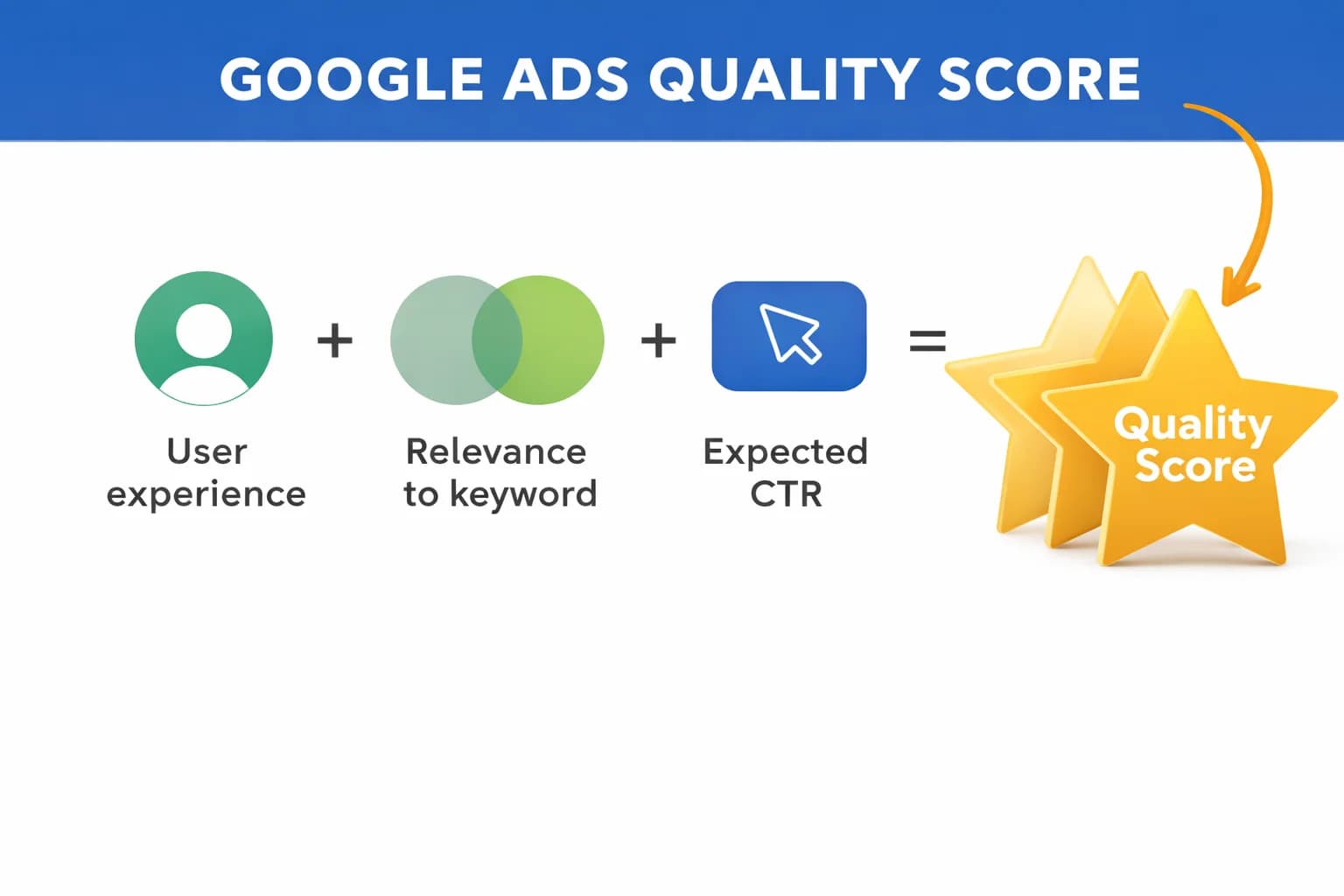
There is a number sitting quietly behind every keyword in your Google Ads account. It does not announce itself. It does not send alerts. But it determines whether you pay $1.20 per click or $4.80 for the exact same position on the exact same search. That number is your Quality Score, and understanding it might be the highest-leverage move available to most advertisers in 2026.
This guide breaks down what Quality Score actually is, how each of its three components works in practice, what the data says about its real impact on your campaigns, and a clear priority list for improvement. No filler. No vague advice. Just the mechanics.
What Quality Score Actually Is — And What It Isn't
Quality Score is a diagnostic metric assigned to each keyword in your Search campaigns on a scale of 1 to 10. A score of 7 or above is generally considered healthy. Below 5 and you are likely paying a significant premium on every click.
Here is something Google itself now emphasizes, and it is worth internalizing: Quality Score is a diagnostic tool, not a bidding input. It does not directly enter the ad auction. What enters the auction is Ad Rank, and Ad Rank is calculated differently.
The formula that actually matters is this:
Ad Rank = Max CPC × Quality Score × Expected impact of ad assets
This means Quality Score acts as a multiplier. An advertiser with a $2.00 max CPC and a Quality Score of 8 can outrank a competitor with a $4.00 max CPC and a Quality Score of 3. The math: 2.00 × 8 = 16 versus 4.00 × 3 = 12. Lower bid, higher placement.
And because ad auction pricing works in reverse — you pay just enough to beat the advertiser below you, adjusted for their quality — a higher Quality Score directly reduces your actual cost per click. Accounts with Quality Scores of 8 to 10 consistently pay 30 to 50 percent less per click than accounts stuck at 4 to 6, according to 2026 benchmark data across thousands of campaigns.
That is not a rounding error. That is the difference between a profitable campaign and one that bleeds budget.
The Three Components That Determine Your Score
Quality Score is built from three sub-metrics, each rated as Below Average, Average, or Above Average. Understanding which one is dragging you down is the first step to meaningful improvement.
1. Expected Click-Through Rate
Expected CTR measures how likely users are to click your ad when it appears for a given keyword — relative to every other advertiser competing for that same keyword. This is important. It is not your absolute CTR. It is your CTR compared to the competition.
This means you can have a technically decent 7 percent CTR and still receive a "Below Average" rating, because your competitors are averaging 12 percent on the same keyword. Google wants to show ads that users find compelling, because Google only makes money when ads get clicked.
The counterintuitive implication is that adding negative keywords can improve your expected CTR — not by making your ad copy better, but by eliminating the queries where your ad was appearing irrelevantly and getting no clicks, dragging down your historical rate.
To improve expected CTR directly, review the Google Ads Transparency Center and search your target keywords to see exactly what competitors are saying. Look for patterns: urgency phrases, free offers, specific numbers, benefit-driven language. Then test variations that genuinely differentiate your offer. Headlines with specific numbers consistently outperform generic claims. "Cut ad spend by 31%" outperforms "Save money on ads."
2. Ad Relevance
Ad relevance measures how closely your ad copy matches the intent behind the search query triggering it. This is the one component you have the most direct control over, because unlike CTR (which depends on competition) and landing page experience (which often requires developer support), ad copy is something you can change today.
The most common cause of poor ad relevance is an overstuffed ad group. When one ad group contains 40 keywords spanning different intents — "Google Ads management," "PPC agency pricing," "how to set up Google Ads" — no single ad can be relevant to all of them. Each ad speaks to some keywords and ignores others.
The solution is tighter ad group structure. Group keywords by intent, not just theme. "Google Ads management" and "hire Google Ads manager" share intent and belong together. "How to set up Google Ads" is informational and belongs in a separate group with different messaging — or as a negative keyword if you are only targeting buyers.
Dynamic Keyword Insertion (DKI) can raise ad relevance quickly, because it automatically places the search term in your headline. Use it carefully. DKI works well when your keyword list is clean and tightly themed. It breaks down when your match types are broad and your search terms vary wildly, producing headlines that make no sense.
3. Landing Page Experience
Landing page experience is the one component that most advertisers neglect most expensively. Google evaluates your landing page using a combination of automated systems and human review, looking at relevance to the search query, page load speed, mobile usability, transparency of business information, and ease of navigation.
Data from a multi-account analysis comparing "Above Average" to "Below Average" ratings across both landing page experience and ad relevance showed that CTR improved by 87 percent and conversion rates improved by 750 percent when both metrics were Above Average. CPCs were 36 percent below average. The numbers are striking enough to be worth repeating.
The most common landing page failures are not exotic. They are: sending all traffic to the homepage when specific product or service pages exist, pages that load in over three seconds on mobile (a one-second delay in mobile load time can reduce conversions by up to 20 percent), and pages where the promise in the ad copy is not reflected in the page headline or content.
The fix for homepage routing is straightforward — build or designate dedicated landing pages for each major ad group. The fix for load speed is PageSpeed Insights, which gives specific, actionable recommendations. The fix for content mismatch is reading your own ad, then immediately reading your landing page headline, and asking honestly: does this page deliver what the ad promised?
One thing Google makes clear is that exact keyword matching on the landing page is not required. A search for "best digital marketing agency for SaaS startups" does not need to land on a page with that exact phrase in the H1. What Google is evaluating is whether the page genuinely helps the user accomplish what they were searching for.
The CPC Discount (and Premium) Math
Here is a concrete illustration of what Quality Score means for your actual cost per click, using the simplified pricing model. If the keyword "Google Ads management" has an average market CPC of $3.00:
A Quality Score of 10 gives you a 50 percent discount — effective CPC around $1.50. A Quality Score of 7 is roughly break-even — effective CPC near $3.00. A Quality Score of 4 carries a 25 percent premium — effective CPC around $3.75. A Quality Score of 1 carries an 80 percent premium — effective CPC around $5.40.
Across a $5,000 monthly budget, the difference between operating at a Quality Score of 4 versus 8 is not incremental. It can represent hundreds of additional clicks per month for the same spend, or the same number of clicks at dramatically lower cost.
Where to Start: Priority Order for Improvement
Chasing a perfect 10 across every keyword is a trap. Quality Score only updates when your keywords generate impressions, and obsessing over it can distract from actual business outcomes. The smart approach is a periodic audit — every one to two months — focused on finding ad groups where the score is below 5 and identifying which component is the weak link.
Here is the priority order that makes practical sense:
Start with ad relevance, because it is the only component you fully control and can change today. Review every ad group where ad relevance shows Below Average. Ask whether the keywords in that group are genuinely served by the current ad copy, and whether the group needs to be split.
Move to landing page experience next. Run your destination URLs through PageSpeed Insights. If mobile scores are below 50, that is your biggest lever. If speed is fine, read the page against the ad copy and look for promise-delivery gaps.
Address expected CTR last, because it responds to the other two improvements naturally, and because direct intervention requires competitive research and creative testing that takes longer to produce results.
One tactical point worth knowing: pausing keywords with high impressions and zero clicks improves your account's historical CTR signal over time. Dead-weight keywords that rack up impressions without clicks are silently dragging your expected CTR down.
Quality Score and Smart Bidding: The Hidden Relationship
In 2026, most advertisers running Search campaigns are using Target CPA or Target ROAS bidding. Smart Bidding uses real-time signals — device, location, time of day, audience membership, and dozens of others — to set bids at each auction. Quality Score, in the traditional diagnostic sense, becomes less central when Smart Bidding has clean conversion data to optimize toward.
But landing page experience and ad relevance still matter enormously under Smart Bidding, because they affect whether Google enters you in auctions at all and at what position. A poor landing page experience score does not just mean you pay more per click — it means Google's system learns that your ads produce poor user outcomes and begins limiting your auction participation.
This is the subtler cost of a low Quality Score in an AI-driven campaign environment: it is not just about CPC anymore. It affects the breadth of auctions your campaigns can win.
The relationship also runs the other direction. Improving ad relevance and landing page experience gives Smart Bidding better signals to work with. Users who click relevant ads and land on good pages convert more often. That conversion signal is what Smart Bidding uses to identify and target similar users. The quality improvement compounds.
Quality Score by Match Type
Broad match keywords almost always generate lower Quality Scores than exact or phrase match, because they trigger a wider range of searches, many of which are peripheral to your ad copy. This is expected behavior, not a problem to solve.
The practical implication is to not treat broad match keywords with Quality Scores of 5 or 6 as failures requiring urgent intervention. Instead, ensure broad match is paired with comprehensive negative keyword lists and Smart Bidding, and monitor the search terms report to catch irrelevant triggers before they accumulate enough history to depress scores.
Exact match keywords that have low Quality Scores deserve immediate attention, because those keywords are triggering your ad for searches that precisely match your bid — and users still are not clicking, or the landing page is failing them. That combination signals a genuine relevance problem.
The One Metric to Watch Instead
Here is the honest conclusion about Quality Score: it is a useful diagnostic, not a KPI. Accounts with great business results sometimes have mediocre Quality Scores because they are running competitor campaigns or broad-intent keywords where relevance is inherently lower.
The metric that actually matters is conversion value per impression — how much revenue or pipeline does each time your ad appears generate. Quality Score improvements that do not move this number are academic. Quality Score improvements that do — through better CTR, lower CPC, or higher conversion rates from better landing pages — are compound investments that pay off every month your campaigns run.
Treat Quality Score as a map for finding where relevance is broken. Fix what the map points to. Then go back to watching the metrics that reflect real business performance.
Managing multiple campaigns and struggling to keep Quality Scores healthy across the account? ClickCatalyst's ClickHub gives you a unified view of keyword health, landing page performance, and cost efficiency — so you can find and fix the expensive problems fast.