The Invisible Drain: Master Device Bid Optimization for Advanced Google Ads Operators
Treating all traffic as equal is a reliable way to lose money at scale. Mobile traffic accounts for approximately 82% of all visitors in 2026. High volume is consistently mistaken for uniform intent. It is not.
Mobile and desktop represent fundamentally different behavioral contexts with different conversion economics. A flat bid strategy that applies the same auction pressure to both is systematically overpaying for one and underpaying for the other. The overpayment is the invisible drain: money leaving the account on every auction with no corresponding return because the traffic's intent profile does not match the bid you placed for it.
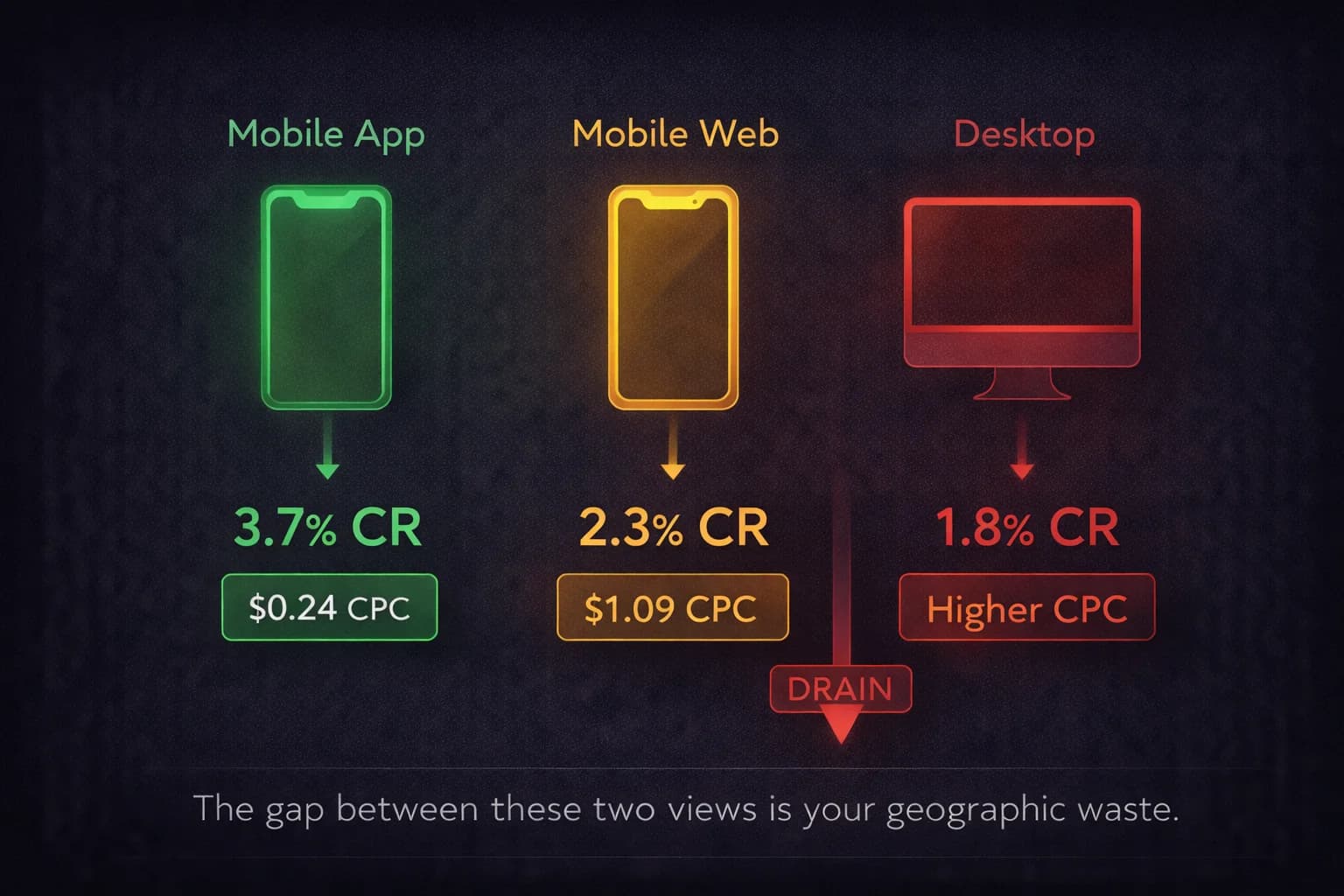
The conversion rate hierarchy by device type confirms this: mobile apps convert at 3.7%, mobile web at 2.3%, and desktop at 1.8%. These are not small differences. They reflect completely distinct user behavioral states that require different bidding logic.
Understanding how to segment, diagnose, and rebalance device performance is one of the highest-leverage optimizations available to high-spend account operators, precisely because most accounts are not doing it with the rigor the differential warrants.
For the signal architecture foundation that makes device-level optimization meaningful, The $1,127 Algorithmic Tax covers how conversion signal quality at the account level determines whether device-level bid adjustments are training the algorithm on accurate data or noise.
The Behavioral Framework: Why Device Matters More Than You Think
The conversion rate differential between devices is not primarily a technical problem. It is a behavioral one.
Mobile intent operates in micro-moments. Mobile users are making decisions in the cracks of their day: between meetings, during commutes, waiting in line. Purchase decisions on mobile are typically convenience-driven and proximity-dependent. They favor one-tap actions, immediate availability, and minimal friction. When the intent and the offer align, mobile converts quickly and efficiently. When they do not align, mobile users bounce immediately. They will not fight a poor experience. They have no patience for friction when there are five competing options one tap away.
Desktop intent is research-heavy. Desktop sessions are longer, involve side-by-side comparisons, and reflect a more deliberate decision-making mode. Desktop is the domain of complex B2B procurement, high-consideration purchases, and configuration-heavy products. Users in a desktop session have allocated time to the decision. They are in a different psychological state than a mobile user in a micro-moment.
The B2B cross-device complexity. In B2B accounts, these behavioral differences create attribution challenges that flat bidding cannot handle. B2B sales cycles average 11.5 months and involve 6 to 10 stakeholders. A prospect may discover your solution on mobile, research it on desktop over several sessions, and finalize a purchase or contact request on desktop weeks later. If you are not accounting for this cross-device journey in your attribution model, you will systematically underbid for mobile because you cannot see the downstream desktop conversions that the mobile sessions generated.
A flat bid strategy optimizes for none of these realities. It applies the same cost assumption to a mobile micro-moment conversion and a desktop research-to-purchase journey, which will consistently misprice at least one of them.
How Device Adjustments Work Differently in Smart Bidding vs. Manual
The mechanics of device bid adjustments changed fundamentally with the deprecation of Enhanced CPC on March 15, 2025. Understanding the distinction between how adjustments function in Smart Bidding versus Manual CPC is essential before applying any device-level changes.
| Smart Bidding (tCPA / tROAS) | Manual CPC | |
|---|---|---|
| Optimization | Real-time auction-level adjustments | Static adjustments requiring manual review |
| Device control | Adjustments modify the target, not the bid | Bid changes from -90% to +900% |
| Signal depth | Multi-signal: OS, browser, time, location, intent | Limited to manually set parameters |
| Agility | Instantaneous reaction to auction shifts | Requires human intervention |
The critical distinction: in Smart Bidding, a +20% device adjustment on a tCPA campaign does not increase your bid by 20%. It tells Google you are willing to pay a 20% higher acquisition cost for that device type. The algorithm then adjusts its real-time bids accordingly across all auctions for that device.
This is a fundamental difference from manual bidding that operators frequently misunderstand. In a tCPA campaign, you are setting a cost constraint signal, not a bid multiplier. The algorithm interprets that signal and adjusts auction behavior accordingly. Getting this wrong does not just produce suboptimal results. It trains the algorithm on a false cost signal that can distort performance across the entire campaign.
The Audit: Finding the Device-Level Drain
Device-level performance data requires a specific report path. The standard campaign view does not surface this granularity automatically.
Navigate to Campaigns, then Insights and Reports. In the report view, segment by device type to surface CPC, conversion rate, cost per conversion, and ROAS broken down by mobile, desktop, and tablet. Compare each device's metrics against the campaign average.
The pattern that indicates the invisible drain is a combination of higher CPCs on mobile web with lower conversion rates than desktop. A common configuration: average CPC of $4.00 for mobile versus $3.75 for desktop, with mobile web converting at 2.3% against desktop's 1.8%. This creates a situation where you are paying a CPC premium for a device that converts less efficiently. The higher CPC for lower conversion rate is the drain.
The manual bid adjustment formula for recalibrating this in manual or hybrid setups:
((Device metric / Campaign average metric) - 1) × 100 = Device bid adjustment
For example: if mobile ROAS is 180% of campaign average, the adjustment is ((1.80) - 1) × 100 = +80%.
One calculation error that invalidates device adjustments is treating existing adjustments as additive rather than multiplicative:
- Existing adjustment: +40%
- Formula output: +20%
- Wrong calculation: 40 + 20 = 60%
- Correct calculation: 40 + (40 × 0.20) = 48%
Adding percentages directly instead of applying the multiplier produces a gross over-adjustment that disrupts auction efficiency. The correct approach is multiplicative: apply the new adjustment as a percentage of the current adjusted bid, not as an addition to the percentage figure.
The weekly audit cadence for device performance is: compare each device's ROAS against the account average. If deviation exceeds 15% in either direction, rebalance using the formula. This threshold prevents constant micro-adjustments while catching material performance gaps before they compound.

Why Mobile Landing Pages Are Failing Your Device Optimization
Device bid optimization is worthless if the landing page experience eliminates the conversion probability you are bidding for. Every second of mobile page load time costs 20% in conversions. The performance gap between mobile and desktop conversion rates is largely a landing page engineering problem, not a device intent problem.
Three specific friction points are responsible for the majority of mobile conversion failure:
Forced account creation. Requiring users to create an account before purchasing or submitting a lead form kills 23% of potential mobile conversions instantly. Mobile users in micro-moment intent are not willing to create credentials under time pressure. Implement guest checkout and one-tap form fills (Google Autofill, Apple Pay) as alternatives.
Cluttered UI. A 26% bounce rate is the documented consequence of cluttered mobile interfaces. Mobile users who encounter a UI that requires navigation effort in a micro-moment context will leave to a competitor who makes the action easier. The mobile UX standard in 2026 is one primary action per screen, thumb-reach placement for the CTA, and minimal cognitive load between arrival and conversion.
Absence of biometric payment options. More than half of mobile checkouts now rely on Face ID or Google Pay. An e-commerce or service business that does not support these frictionless payment methods is intentionally inflating its cart abandonment rate. The user has made the purchase decision. The checkout friction is preventing the execution. Every cart abandonment from a payment UI that is not optimized for mobile represents a conversion your device bid adjustment bought but your landing page failed to close.
These are not aspirational UX improvements. They are direct conversion rate multipliers that determine whether the device-level bid optimization you are implementing produces revenue or just more expensive non-converting clicks.
Proximity Bidding: Layering Geographic Intent on Device
Device optimization does not operate in isolation. The highest-value bid configurations combine device signals with geographic intent.
For local service businesses and any account where physical proximity to the user matters, proximity bidding applied at the device level concentrates spend on the highest-conversion scenario: a mobile user in close physical proximity to your location or service area, in a micro-moment intent state.
Set bid modifier tiers:
- Mobile users within 3 miles: +75% combined device and proximity modifier
- Mobile users within 5 miles: +50% combined modifier
- Desktop users in primary market: standard bid, no negative modifier
This configuration reflects the behavioral reality. A mobile user 2 miles from your location, actively searching for your service category, is your highest-probability conversion. Your bid should reflect that.
For B2B accounts where physical proximity matters less than professional context, the geographic dimension shifts to office district targeting rather than radius distance. A mobile user in a commercial district searching for B2B software is in a different intent context than the same user searching from a residential area at 10 PM.
Advanced Tactics: Smart Bidding Exploration and PMax Device Control
For accounts that have plateaued on standard device optimization, two advanced configurations extend the efficiency gains.
Smart Bidding Exploration allows the algorithm to temporarily lower ROAS targets to discover new query categories and audience segments. Data shows this produces an 18% increase in unique search queries generating conversions for eligible accounts. The device dimension here is important: exploration at the account level will surface different query patterns on mobile versus desktop, which may reveal device-specific intent categories you are not currently capturing.
The eligibility requirement is at least 50 monthly conversions per campaign before enabling exploration. Below this threshold, exploration does not discover new opportunities. It spends budget on uncertain auctions without enough conversion history to evaluate the results.
Performance Max device governance has improved significantly from earlier iterations. PMax now supports up to 10,000 account-level negative keyword exclusions. For device-level control, the primary levers are:
Brand exclusion lists prevent PMax from capturing branded mobile queries, which convert cheaply but represent demand you had already earned. High-Value Mode prioritizes bids for users predicted to have high LTV based on existing customer data, which interacts with device signals because LTV profiles often correlate with device usage patterns.
The learning phase discipline that applies to all PMax changes applies particularly to device-level adjustments. The system requires 50 conversion events or three complete conversion cycles to recalibrate after any significant bid strategy change. Making device adjustments to a PMax campaign before the previous adjustment's learning phase is complete compounds the instability and wastes spend on an account that is effectively starting its learning process over repeatedly.
The Weekly Device Audit Protocol
Device optimization is not a launch configuration. It is a recurring performance discipline.
Weekly: Export device performance segmented by campaign. Filter for device-level ROAS deviating more than 15% from campaign average in either direction. Apply the bid adjustment formula to bring outliers back toward equilibrium. Document the adjustments made and the rationale.
Monthly: Review cross-device conversion paths in your attribution reports. Identify whether mobile sessions are initiating journeys that convert on desktop. If they are, and your current attribution model is not capturing those assists, your mobile device performance is being systematically undervalued. The fix is either attribution model adjustment or applying a positive mobile bid modifier to account for the offline and cross-device contribution.
Quarterly: Review mobile landing page performance against the technical benchmarks: LCP under 2.5 seconds, form fields at four or fewer, biometric payment options active. Device bid adjustments that are optimally configured but landing on technically underperforming pages are producing less return than they could. Landing page technical performance is the ceiling on device bid optimization returns.
Frequently Asked Questions
What are device bid adjustments in Google Ads and how do they work? Device bid adjustments modify how aggressively your campaigns bid for specific device types: mobile, desktop, and tablet. In Manual CPC campaigns, they directly increase or decrease the bid by a percentage. In Smart Bidding campaigns (tCPA or tROAS), they tell the algorithm the relative cost you are willing to accept for conversions from each device type, which influences real-time auction behavior without directly setting a bid. The range is -90% to +900% for manual campaigns. For Smart Bidding, adjustments are interpreted as target modifications rather than bid multipliers.
Why do mobile and desktop convert at different rates in Google Ads? The difference is primarily behavioral, not technical. Mobile users are typically in micro-moment intent states: making convenience-driven decisions quickly with low tolerance for friction. Desktop users are typically in research-heavy states: comparing options, reviewing details, and making considered decisions. These behavioral differences produce different conversion rates for the same offer. Additionally, mobile landing page technical quality (load speed, form design, payment options) often creates friction that further suppresses mobile conversion rates relative to desktop.
How do I calculate the correct device bid adjustment in Google Ads? Use the formula: ((Device metric / Campaign average metric) - 1) × 100 = device bid adjustment. For example, if mobile ROAS is 180% of your campaign average, the adjustment is ((1.80) - 1) × 100 = +80%. When applying a new adjustment to an existing adjustment, use multiplicative math: if your current adjustment is +40% and your formula output is +20%, the correct new adjustment is 40 + (40 × 0.20) = 48%, not 60%. Adding percentages directly produces a significant over-adjustment.
How does the deprecation of Enhanced CPC affect device bid optimization? Enhanced CPC was deprecated on March 15, 2025. Campaigns that were using eCPC as a hybrid between manual and automated bidding were transitioned to Manual CPC. This means those campaigns now lack automatic real-time bid adjustments and require manual device bid management to maintain competitive auction performance. If you are running any campaigns that were on eCPC before the deprecation, verify they have been actively managed for device-level adjustments since the transition.
Should I use device bid adjustments with Smart Bidding campaigns? Yes, but understand what they do. In Smart Bidding, device adjustments modify the cost target rather than the bid directly. A +20% device adjustment on a tCPA campaign tells the algorithm you are willing to pay 20% more per acquisition for that device type. The algorithm then adjusts its real-time auction behavior to reflect that cost tolerance. This is different from manual bidding where the adjustment directly changes the bid. Misunderstanding this distinction and applying device adjustments as if they were manual bid multipliers in Smart Bidding campaigns produces incorrect cost signals.
What mobile landing page elements most directly affect conversion rate? The three highest-impact elements are page load speed (every one-second delay costs 20% in conversions), form friction (forced account creation kills 23% of potential conversions, four-field forms convert 120% better than eleven-field forms), and payment method options (more than half of mobile checkouts rely on Face ID or Google Pay). Optimizing these three elements produces the largest conversion rate improvements for mobile traffic before any changes to ad copy, bidding, or targeting.
Sources
- Google Ads Help — About Bid Adjustments
- Google Ads Help — Set Device Bid Adjustments for Ad Groups or Campaigns
- Nils Rooijmans — Does It Make Sense to Add Bid Adjustments to Smart Bidding Campaigns?
- Tapcart — Why Ecommerce Mobile Conversion Rates Are Lagging and How Apps Fix It
- Rocket Clicks — How to Manually Calculate Device Bid Adjustments
- Search Engine Land — PPC Budgeting: When to Adjust, Scale, and Optimize with Data
- ALM Corp — Google Ads Advanced Tactics to Maximize ROAS for 2026
- WordStream — 11 Biggest Google Ads Updates of 2025