The Silent 15%: Why Your Google Ads AI Is Addicted to Your Existing Customers
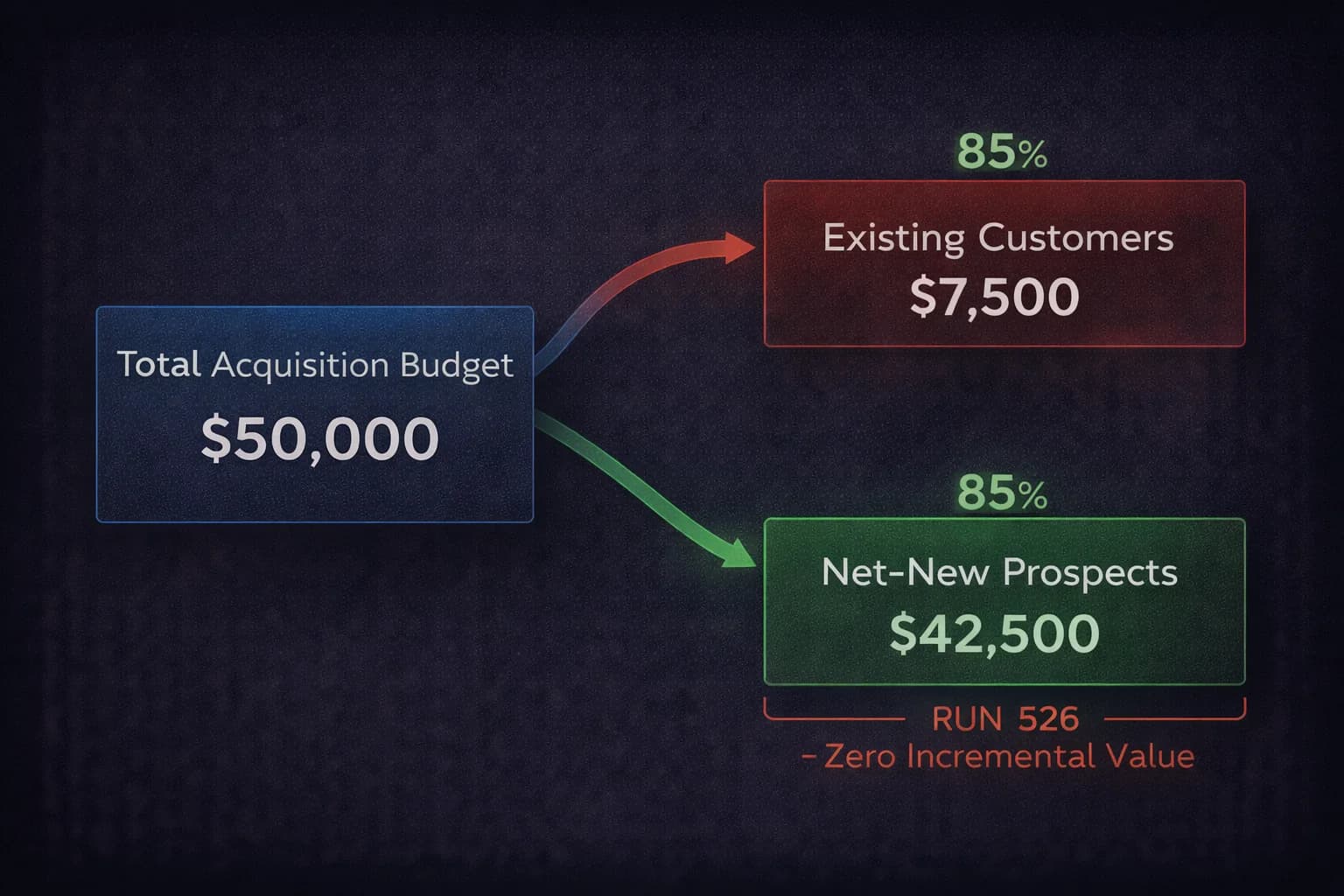
Your dashboard shows excellent ROAS. Your conversion volume is healthy. Your optimization score is green. And 8 to 15% of your ad spend is going to people who already bought from you.
This is the Silent 15%. Not a single obvious error. A systemic behavioral tendency of Google's machine learning system that surfaces in every high-spend account without aggressive exclusion architecture in place.
The mechanism is straightforward. Google's AI is incentivized to find the path of least resistance to a conversion event. Your existing customers are the easiest conversions available: they already know your brand, they have already purchased, and their behavioral signals strongly predict that they will convert again. The algorithm bids aggressively for them. Your acquisition budget reaches people you already own. The ROAS looks excellent. The incremental growth is near zero.
With CPCs rising 13% year over year, this waste is not static. Every dollar misallocated to existing customers in one quarter costs more in the next as the same inventory gets more expensive. The operators closing the gap between attributed ROAS and incremental ROAS through systematic exclusion architecture are compounding an efficiency advantage that pure bid management cannot replicate.
For the signal architecture foundation that makes exclusion strategy coherent, Beyond the Pixel covers the first-party data infrastructure that powers high-quality suppression lists.
Why the Algorithm Defaults to Familiarity
The technical reason for this waste is embedded in how Smart Bidding, Broad Match, and Responsive Search Ads interact in the current environment.
Smart Bidding optimizes for conversion probability at auction time. A user who has previously purchased from you has a high predicted conversion probability. They recognize your brand, they have trusted you with a transaction before, and their recent site behavior signals ongoing interest. From the algorithm's mathematical perspective, bidding for that user is a high-confidence bet.
This creates three specific system behaviors that produce the familiar customers problem:
Ad Position Bias. Google fights for Position 1 on branded terms, which carry a 2.1% CTR. Position 1 on your own brand name, where an organic result would have captured the click for free. Your paid budget is intercepting demand you had already earned, paying for traffic that would have converted organically, and attributing the conversion to the paid campaign.
Broad Match Brand Cannibalization. Broad Match in the AI Max era expands your non-branded keywords into branded query territory when the algorithm predicts the user is likely to convert. A campaign targeting "marketing automation software" may serve ads to users searching your brand name specifically. The attributed conversion looks like a generic keyword win. It is a branded search capture that cost acquisition budget on a user who was already finding you.
Attributed vs. Incremental ROAS. Most dashboards reward the algorithm for any touchpoint before a conversion. The question attribution cannot answer is whether the conversion would have happened without the ad. A user who was going to buy regardless is credited to the campaign that served the last impression. Incremental ROAS measures the revenue that would not have existed without the specific ad intervention. The gap between attributed ROAS and incremental ROAS is where the Silent 15% lives.
Exclusion Tier 1: The Recent Converter Wall
The most immediate suppression implementation is the recent buyer exclusion. Serving a product acquisition ad to a user who purchased 48 hours ago is a pure waste of impressions. The purchase objective has been fulfilled. The correct response is a post-purchase nurture sequence, not a repetitive acquisition loop.
Build a 30-day recent purchaser list from your CRM or e-commerce platform and apply it as a negative audience to every acquisition campaign. This single exclusion typically recovers 5 to 8% of acquisition budget and reallocates it to users who have not yet converted.
The window length should reflect your product's repurchase cycle. A consumable product with a 30-day replenishment pattern warrants a shorter exclusion window and a restock campaign, not a blanket suppression. A considered purchase product with a 12 to 24-month repurchase cycle warrants a 180-day or longer suppression window. Match your exclusion windows to your actual customer behavior, not to default platform settings.
For Performance Max specifically, the recent converter exclusion is the mechanism that prevents PMax from inflating its reported ROAS with retargeting conversions that required no advertising to generate. Without this exclusion, PMax will systematically find your highest-probability converters, serve them an ad, and claim credit for conversions they were generating organically.
Exclusion Tier 2: CRM Syncing and the 540-Day Standard
Browser-level pixel suppression has a coverage problem. With 48% of users running ad blockers and iOS privacy restrictions degrading pixel-based audience matching, a suppression strategy built entirely on site visitor cookies is missing a significant portion of your existing customer base.
Server-to-server Customer Match is the solution. Upload your customer records via Google's Customer Match API or a connected CDP. The matching happens server-side using hashed first-party identifiers, which bypasses browser restrictions and ad blockers. Your suppression list covers customers you know, regardless of whether their browser allows pixel tracking.
The comparison between manual list uploads and real-time first-party data operations is stark:
| Manual Uploads | Real-Time 1PD Operations | |
|---|---|---|
| Data freshness | Outdated; periodic CSV uploads | Real-time; synced via CDP or server-side GTM |
| Identity resolution | Siloed; prone to data decay | 360-degree view; resolves across devices |
| Suppression logic | Static 30/90-day windows | Dynamic; up to 540-day exclusion lists |
| AI signal quality | Weak; AI may chase stale converters | Strong; forbids AI from chasing existing value |
The 540-day exclusion list is the operational standard for mature acquisition programs. A customer who purchased 18 months ago is not a prospect. They are a retention opportunity that should be in a separate retention campaign, not in your acquisition budget. The 540-day window covers most considered-purchase repurchase cycles and prevents your acquisition campaigns from reaching anyone in your existing customer database.
Automated CRM syncing that updates these lists every 24 to 48 hours ensures the suppression is current. A new purchaser should enter the exclusion list within 24 hours of their first purchase. A manually updated monthly CSV allows weeks of acquisition spend to reach existing customers before the list is refreshed.

Diagnosing Cannibalization: Demand Gen vs. Shopping
Demand Gen campaigns are positioned as top-of-funnel prospecting tools. In practice, the overlap problem means they frequently target users already deep in your conversion funnel, claiming credit for Shopping or Search conversions rather than generating incremental demand.
An audit of 12 e-commerce accounts showed that 8 of 12 had flat total conversions when Demand Gen was added to accounts already running Shopping campaigns. The AI shifted attribution credit from Shopping to Demand Gen. The total revenue was unchanged. The budget allocation and reported channel ROAS were dramatically different.
In the 3 accounts where genuine lift occurred, the effective CPA on incrementally generated conversions was 3 to 5 times higher than the dashboard reported, because the dashboard attribution did not distinguish between cannibalized and incremental conversions.
Three tests diagnose whether Demand Gen is generating incremental revenue or redistributing attribution credit:
Geographic holdout test. Run Demand Gen in defined test regions while excluding it from matched control regions. Measure total revenue across all channels, not Demand Gen-reported conversions. If total revenue does not lift in test regions relative to control, Demand Gen is cannibalizing existing conversion pathways.
On/Off test. Toggle Demand Gen off for a 4-week period. Monitor total account conversion volume, not campaign-specific metrics. If total conversions hold or increase during the off period, Demand Gen was not generating incremental demand.
New customer analysis. Pull the customer list from Demand Gen converters and cross-reference against your CRM. If more than 60% have prior site visits, prior search interactions, or existing purchase history, your prospecting campaign is delivering expensive remarketing to people already in your funnel.
These tests replace attribution-reported performance with incrementality-measured performance. The distinction is the difference between a campaign that looks like it is working and a campaign that is actually working.
Technical Infrastructure: Beyond the Browser Pixel
The suppression architecture described above requires a data infrastructure that most accounts are not running. Client-side tracking alone cannot support comprehensive suppression.
Server-side Google Tag Manager moves conversion tracking and audience list management from the user's browser to your own cloud server. This bypasses ad blockers, iOS restrictions, and browser privacy settings that degrade client-side pixel coverage. Server-side tracking has documented improvements in audience match rates of 30 to 50% compared to browser-only implementations.
Enhanced Conversions supplements server-side tracking by hashing first-party user data (email, phone) at the point of conversion and sending it directly to Google's matching infrastructure. This improves identity resolution across devices and browsers, which makes your suppression lists more comprehensive. A customer who purchases on mobile and later browses on desktop can be suppressed on desktop if Enhanced Conversions has resolved both sessions to the same customer identity.
The quantifiable impact of this infrastructure upgrade is documented in case studies: one migration to server-side tracking produced a 39% reduction in Google Ads CPA and a 53% increase in measured revenue by recovering lost conversion signals and tightening suppression coverage. The AI is only as effective as the data it is forbidden from pursuing.
The 2026 Audience Audit Framework
Run this audit quarterly against every acquisition campaign in your account. Suppression architecture is not a one-time configuration. Customer lists age, new segments emerge, and PMax continuously probes for the path of least resistance as the exclusion landscape changes.
RLSA threshold validation. Remarketing Lists for Search Ads require a minimum of 1,000 active visitors to remain operational. Lists that fall below this threshold become inactive. Verify monthly that your key RLSA lists maintain sufficient size. If a list drops below threshold, investigate whether the corresponding audience segment is being adequately captured by your tracking infrastructure.
RSA asset integrity. Every Responsive Search Ad should have at least 15 unique headlines and 4 descriptions with an Excellent Ad Strength rating. Below this threshold, the algorithm has insufficient creative combinations to effectively serve the audiences your exclusions are funneling it toward. Tight exclusions combined with limited creative variety produces high-frequency exposure to the remaining audience, which accelerates creative fatigue.
Branded CPC monitoring. Competitors bidding on your brand terms can dramatically inflate branded search CPCs. Cases where brand CPCs rose 16 times during aggressive competitor bidding have been documented in retail categories. Monitor your branded search CPC weekly. When spikes appear, investigate whether competitors are running conquest campaigns on your brand terms and whether additional brand protection measures are warranted.
Search terms review for lazy clicks. Review the search terms report for Broad Match queries that are bleeding into branded terms or low-intent informational searches. These are the lazy clicks: high-probability low-value conversions that your suppression of existing customers has forced the algorithm to find as a substitute. If branded cannibalization appears in your search terms after suppressing existing customers, add explicit brand term exclusions at the acquisition campaign level.
Customer Match presence verification. Confirm that your PMax audience signals are fueled by real-time CRM data, not general interest categories. PMax with CRM-seeded audience signals performs significantly differently from PMax operating on Google's generic interest audiences. The first-party seed is what forces the algorithm toward new customers who resemble your best existing ones, rather than toward existing customers who are the easiest conversions.
The Profit on Ad Spend Reframe
The reason the Silent 15% persists in most accounts is that ROAS measurement does not expose it. A campaign reaching existing customers at high conversion rates and low CPAs reports excellent ROAS. The attributed revenue looks real. The incremental contribution is near zero.
Profit on Ad Spend (POAS) is a more accurate metric because it accounts for the actual business value of each conversion. Excluding taxes, shipping costs, and return rates from the revenue calculation, and factoring in margin by product category, produces a metric that better represents whether advertising spend is generating net-new profit.
Combined with incrementality testing, POAS measurement forces the question that ROAS obscures: not "did this campaign produce conversions?" but "would this revenue have existed without this campaign?"
The operators who have built suppression architecture that forces their acquisition campaigns to reach genuinely new customers, combined with incrementality measurement that distinguishes real from attributed growth, are running a fundamentally different business model than operators chasing ROAS on campaigns that are partially serving as expensive delivery mechanisms for organic demand.
That difference compounds. The suppression architecture recovers 8 to 15% of acquisition budget. That budget funds genuine prospecting. Genuine prospecting grows the customer base. A larger customer base generates more organic demand. More organic demand creates more opportunities for the suppression architecture to identify and protect. The virtuous cycle is the opposite of the algorithmic addiction cycle that the Silent 15% creates.
Frequently Asked Questions
What is the Silent 15% in Google Ads and why does it happen? The Silent 15% refers to the 8 to 15% of acquisition budget that typically goes to existing customers or recent converters in accounts without active suppression architecture. It happens because Google's Smart Bidding optimizes for conversion probability at auction time. Existing customers have high predicted conversion probability because they have already demonstrated purchase intent. The algorithm bids aggressively for them regardless of whether reaching them represents new business value. The fix is explicit audience exclusions that remove existing customers from acquisition campaign eligibility.
What is the difference between attributed ROAS and incremental ROAS? Attributed ROAS credits any touchpoint before a conversion, regardless of whether the ad caused the conversion. If a user was going to buy regardless of your ad and your ad happened to appear before they converted, attributed ROAS credits the campaign. Incremental ROAS measures only the revenue that would not have existed without the specific ad intervention. The gap between them is the portion of your attributed revenue that was organic demand intercepted by paid advertising. Incrementality testing via geographic holdouts or on/off tests measures this gap.
How do I build a 540-day customer suppression list for Google Ads? Export your full customer database from your CRM as a CSV containing email addresses and phone numbers. Hash the data using SHA256 before uploading. Upload to Google Ads via the Audience Manager using the Customer Match feature. Set the membership duration to 540 days. Apply the list as a negative audience to all acquisition campaigns. Automate the refresh cycle so the list updates every 24 to 48 hours as new customers are added to your CRM. This ensures new purchasers enter the suppression list within 24 hours of their first transaction.
Should I suppress existing customers from Performance Max campaigns? Yes. PMax without existing customer suppression will systematically find your highest-probability converters, serve them ads, and claim credit for conversions that were generating organically. Apply your recent purchaser list (30 days) and your full customer database (540 days) as negative Customer Match audiences at the PMax campaign level. Separately, add brand exclusion lists to prevent PMax from capturing branded search queries that your branded search campaign should handle. These two exclusion layers are the minimum viable suppression architecture for PMax.
How do I know if my Demand Gen campaign is cannibalizing Shopping conversions? Run a geographic holdout test: enable Demand Gen in defined test regions while keeping it paused in matched control regions. Measure total revenue across all channels, not Demand Gen-specific reported conversions. If total revenue does not lift in test regions relative to control regions, Demand Gen is redistributing attribution credit rather than generating incremental demand. Additionally, audit your Demand Gen converter list against your CRM. If more than 60% have prior purchase history or site interactions, your prospecting campaign is serving existing customers.
What is server-side tracking and why does it improve audience suppression? Server-side tracking moves conversion event recording from the user's browser to your own cloud server. Browser-based tracking misses 30 to 50% of events due to ad blockers, iOS privacy restrictions, and browser cookie limitations. Server-side tracking bypasses these restrictions, recording conversion events and audience list membership updates regardless of browser settings. For suppression specifically, this means your Customer Match lists and remarketing audiences are more complete, which reduces the probability that an existing customer slips through your exclusion architecture because their browser blocked the pixel that would have added them to the suppression list.
Sources
- Google Ads Help — About Customer Match
- Google Ads Help — Customer Match Best Practices
- Google Ads Help — About Exclusions: Exclude Specific Audience Segments
- Seer Interactive — Unlocking the Power of Customer Match: Guide to Maximizing Google Ads
- Lunio — Audience Exclusions: 11 Targeting Tips for Google Ads and Meta
- Lifesight — Audience Suppression: How and When to Use It
- JudeLuxe — Demand Gen Is Cannibalising Your Shopping Campaigns: Here's Proof
- KlientBoost — RLSA: The Ultimate 12-Point Guide to Bring Back Conversions