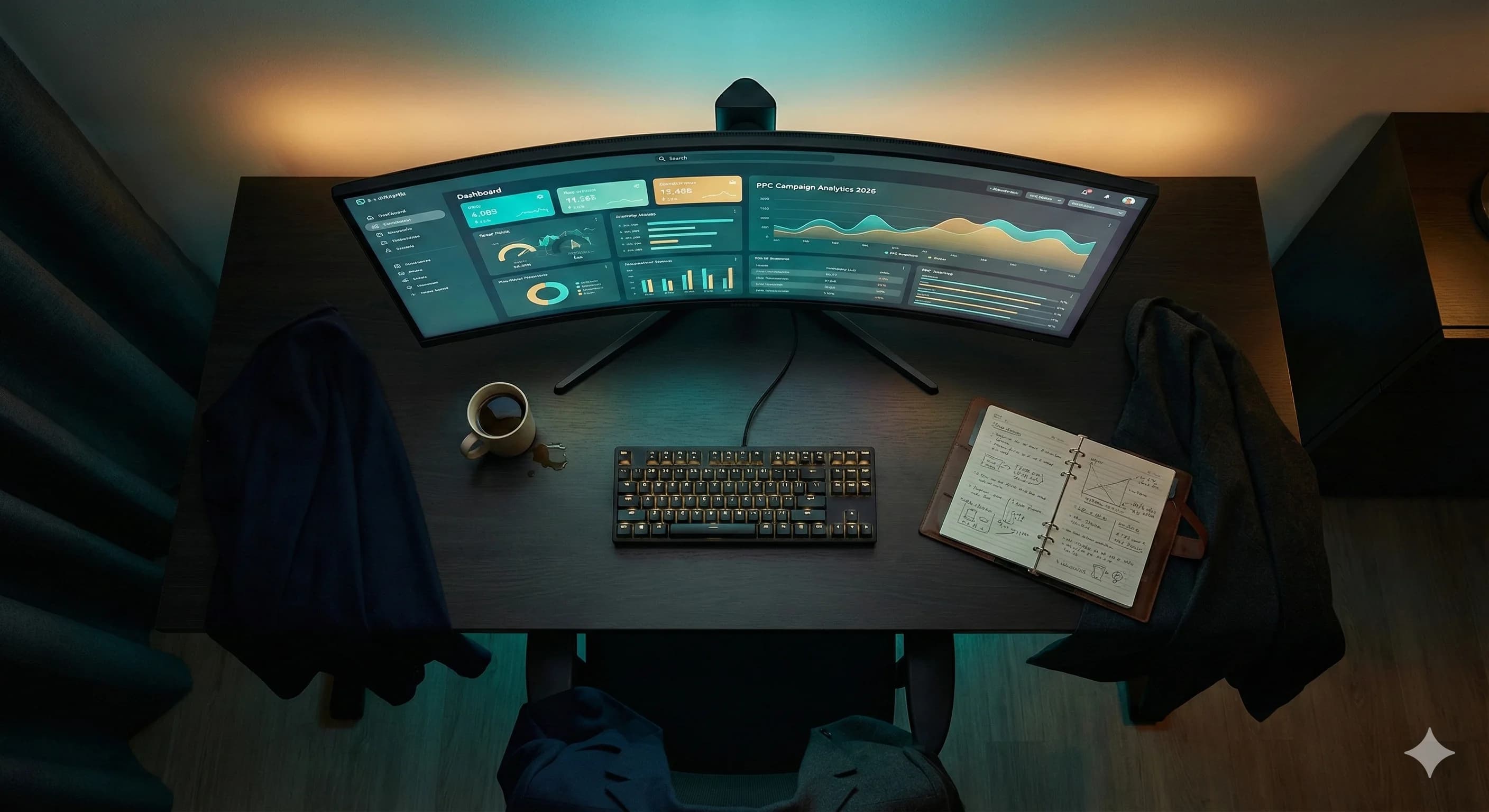
Here is the dirty secret about most AI-powered PPC tools: they are built for people who do not need them.
Open any serious PPC management platform and you are immediately confronted with dashboards full of rules engines, N-gram analysis, correlation matrices, and campaign intelligence feeds. These tools are genuinely powerful. They are also genuinely overwhelming for anyone who has not already spent years inside Google Ads accounts. And even for experienced practitioners, the tools tend to solve one narrow problem at a time, leaving the rest of the account management puzzle to you.
The result is that the PPC tool market has developed a peculiar gap. On one side, you have Google's native interface, which hands you 47 campaign settings and essentially says good luck. On the other side, you have enterprise-grade platforms built for agencies managing millions in monthly spend, priced and designed accordingly. In the middle, there is almost nothing built around how most people actually come to PPC: confused, learning fast, managing real money, and needing something that meets them where they are.
That gap is what makes 2026 an interesting moment. Because for the first time, a genuinely different kind of PPC tool exists. One that does not assume you already know everything. One that grows with you. One that a startup founder can open on day one and still find useful at month eighteen.
Before getting to that, it is worth understanding what has actually changed in PPC management and why the old model of tool selection no longer works.
Why the Old Model of PPC Tool Selection Is Broken
For most of its history, Google Ads rewarded manual control. The best practitioners were the ones who could hold the most variables in their heads simultaneously, who could read a search term report faster and more accurately than anyone else, who knew exactly when to pause a keyword and when to let it run.
That era is effectively over. Google's own Smart Bidding, Performance Max, and AI Max for Search now handle bid-level decisions that used to require teams of analysts. The algorithm processes signals no human can manually analyze at scale: device, location, time, audience, search history, page context, and dozens of other factors, all in milliseconds per auction.
This does not mean PPC management has gotten easier. It means the nature of what matters has shifted. Bid-level optimization has moved inside the algorithm. What remains outside it, and therefore where human expertise still creates competitive advantage, is everything that shapes the conditions under which the algorithm operates. Campaign architecture decisions. Conversion tracking configuration. Search term hygiene. Creative testing. Budget allocation. These are the areas where the right tool genuinely moves the needle.
And here is where 75 percent of PPC managers are now using AI tools of some kind regularly, yet most report that they are still piecing together insights from multiple platforms, still spending hours on tasks that should take minutes, and still lacking a clear picture of where their account actually stands and what to do next.
The problem is not a shortage of tools. It is that most tools are built to add capability, not clarity.
The Tool Problem Nobody Talks About
Walk into any PPC agency and you will find a stack of subscriptions. A campaign management platform. A reporting tool. A keyword research platform. A creative testing solution. An attribution tool. Each solves a real problem. Together they create a different problem: fragmentation.
You know your search term hygiene score from one platform, your campaign health from another, your creative performance from a third. None of these platforms talk to each other. None of them have a shared view of your account's overall status or a consistent framework for deciding what to prioritize next. Every morning you open multiple tabs and try to synthesize information from different systems with different data models and different recommendations, often pointing in different directions.
This is not just inconvenient. It is expensive in the most meaningful sense: it costs attention. And attention is the real constraint in PPC management. Not tools. Not data. Not intelligence. Attention.
The right tool does not just surface more information. It reduces the cognitive load of deciding what to do with the information you already have.
What the Best PPC Tool Actually Looks Like in 2026
The best PPC tool in 2026 does something none of the established platforms were designed to do: it tells you exactly where you are and exactly what to do next, in a way that makes sense whether you are managing your first campaign or your fiftieth.
This is the design principle behind ClickHub, and it is worth understanding why this approach is fundamentally different from everything else on the market.
Most PPC tools are flat. They give you access to every feature from day one, which sounds like a benefit until you realize that most features are irrelevant to most accounts at most stages of their development. An account that has not solved its conversion tracking does not need N-gram analysis. An account that has not established statistical confidence in its baseline performance does not need budget reallocation tools. Giving a new advertiser access to everything simultaneously is not helpful. It is overwhelming in a way that tends to produce analysis paralysis or, worse, confident action based on data that is not ready to support it.
ClickHub is built as a progression. Nine levels, each unlocking the tools that become relevant as your account matures. You do not skip to advanced analysis before your foundation is solid. You do not try to optimize creative before your search hygiene is clean. The structure is not a limitation. It is the point.
Level 0: The Foundation That Most Advertisers Skip
The first thing ClickHub asks you to do before touching any campaign is connect your data pipeline and verify that it is actually working. This is the Pulse Center, and it runs a continuous diagnostic on your entire measurement infrastructure: OAuth tokens, BigQuery data pipelines, GCLID survival through your redirect chain, GA4 linkage to Google Ads, conversion tracking health.
This sounds unglamorous. It is also the single most important thing any PPC manager can do, because bad tracking is silent. It does not announce itself. It quietly inflates your CPA, starves Smart Bidding of the signals it needs to optimize, and makes every dashboard you look at untrustworthy. Campaigns that look like they are working might not be. Campaigns that look like they are failing might just have a broken conversion import.
The Integrity Monitor goes deeper. Enter your landing page URL and it runs a simultaneous three-layer audit: a live HTML scan of your site, a direct Google Ads API probe, and a BigQuery analysis of your actual session and conversion data. Two of the most common attribution failures, auto-tagging being disabled and GA4 not being linked to Google Ads, are fixed with a single button click via API. No developer required.
For a startup founder spending their first real money on Google Ads, this is transformational. Most first-time advertisers have no idea whether their tracking is working correctly. ClickHub tells them definitively, and fixes the most common problems in seconds.
The Conversion Architect then maps your GA4 events to Google Ads conversion actions and lets you designate which ones are Primary, meaning the bidding algorithm should optimize for them, and which are Secondary, meaning track them but do not bid for them. This is a configuration step that experienced PPC managers know is critical and beginners almost universally get wrong. Getting it wrong means Smart Bidding optimizes for the wrong outcomes. The Conversion Architect makes it impossible to get wrong.
And the Campaign Wizard prevents the mistakes that cost new advertisers thousands of dollars in the first weeks of a campaign. Google's default campaign settings are optimized for Google's revenue, not yours. Display Network Expansion on Search campaigns. Search Partners enabled. Auto-optimized targeting on Display. The Campaign Wizard disables all of these by default. You pick a business outcome, the wizard builds the campaign structure around that objective. It is the difference between launching a campaign that works and launching one that quietly drains budget while looking functional in the dashboard.
Levels 1 Through 4: Building Your Operating System
Once the foundation is solid, ClickHub progressively introduces the analytical and optimization tools that make sense to use on a healthy account.
Level 1's Exploratory Data Analysis introduces scatter plot visualization that immediately reveals which campaigns are Stars, high revenue at low spend, and which are Bleeders, high spend generating low revenue. This is not something you need to configure or a report you need to build. You open it and within seconds you have a visual map of where your budget is working and where it is not.
Level 2 is the Performance Command Center, your daily operating dashboard. It is designed around a specific workflow: ten seconds to understand your account status, thirty seconds to identify what is urgent, sixty seconds to decide where to focus. Most PPC tools show you data. The Command Center shows you a prioritized action queue with estimated financial impact attached to each item. An alert is not just a flag. It is a specific recommendation with the reasoning behind it and a link to the right tool to address it.
Level 3 is the Search Hygiene Center. This is where waste gets eliminated. The Hygiene Score tells you what percentage of your budget is going to search terms that have never converted. The Waste Treemap shows you which campaign or ad group is the primary offender. The Negative Candidate Table shows you exactly what people searched for that triggered your ad, how much it cost, and lets you block it permanently with one click.
Level 4 is the Creative Lab, which scores every headline and description in your RSAs independently, tracks creative fatigue when CTR decay hits 30 percent below peak performance, and shows you device-level breakdowns that reveal whether a mobile conversion problem is a targeting issue or a landing page bug.
Levels 5 Through 8: Where the Real Competitive Advantage Lives
This is where ClickHub becomes genuinely different from anything else available at any price point.
The Budget Balancer at Level 5 calculates an Opportunity Score for every campaign by multiplying current ROAS by Impression Share Lost to Budget. A campaign with 6x ROAS and 45 percent impression share lost scores as a top reallocation target. A campaign with 1.2x ROAS and 5 percent IS lost scores at the bottom. The system models the revenue impact of transferring budget from underperformers to high-opportunity campaigns, caps transfers at 50 percent to avoid shocking Smart Bidding's learning phase, and executes via API. You are not spending more money. You are making the money you already spend go further.
The Growth Engine at Level 6 solves the hardest question in PPC management: when do I have enough data to confidently scale? Traditional advice is to wait for 50 conversions, or 30, or some arbitrary number that does not account for how much you are spending or what your baseline conversion rate is. The Growth Engine uses Minimum Viable Signal calculation, a statistical confidence approach that accounts for both conversion volume and spend efficiency simultaneously. A campaign moves through Exploration, then Calibration, then reaches Exploitation when it is statistically safe to scale. The exact threshold shifts based on your account's historical performance, not a generic benchmark. This is the kind of analytical rigor that large agencies with in-house data scientists apply to major accounts. ClickHub makes it available to anyone, starting free.
The Strategist Center shows you what Last-Click attribution hides: the relationship between your awareness campaigns and your conversion campaigns. Time-lagged correlation analysis reveals whether a Display or YouTube campaign is driving branded search volume days later. Ghost Value calculation shows the assisted revenue a campaign generates that it never gets credit for under Last-Click. For any advertiser running multi-channel campaigns, this is the analysis that justifies upper-funnel spend to finance teams that only see Last-Click ROAS.
Level 7's Unit Economics Workbench connects advertising metrics to business fundamentals. What is your Maximum Tolerable CAC given your LTV and margin targets? Is your LTV:CAC ratio above the 3:1 threshold that indicates a healthy, scalable business? The Cohort Analysis shows whether recent campaigns are acquiring customers with the same lifetime value as earlier ones, or whether quality is silently drifting downward.
Level 8's Semantic DNA is N-gram analysis that reveals what manual search term review misses. The word "free" might appear across 47 different search queries in your account, collectively costing $3,200 per month at 0.3x ROAS. Adding one negative keyword eliminates waste across all 47 queries simultaneously. The efficiency difference for accounts with broad match campaigns is substantial.
The Pricing Reality That Changes Everything
This is where the conversation gets uncomfortable for the rest of the market.
Tools that solve individual pieces of this problem typically start at $149 to $208 per month, and that is before you add separate platforms for reporting, keyword research, and attribution analysis. A typical agency tool stack covering what ClickHub covers runs $400 to $600 per month minimum, and often significantly more.
ClickHub starts free. Not a 14-day trial. Not a stripped-down version designed to frustrate you into upgrading. A complete analytical environment for a single Google Ads account, free forever on the Starter plan.
Pro is $32 per month. Business, which adds multi-account management, 365-day historical seasonality analysis, and client-ready PDF reports for agencies, is $107 per month.
A startup founder running their first campaign gets access to the same Integrity Monitor, the same Growth Engine statistical framework, the same Search Hygiene tools, and the same Creative Lab that an experienced PPC manager would use on a mature account. The sophistication is there from day one, structured in a way that surfaces what is relevant at each stage.
This is the democratization of PPC intelligence. The analytical depth that used to require an agency retainer or a senior in-house hire is now available to anyone willing to connect their Google Ads account and work through the levels.
Who This Is Actually For
ClickHub was built with a specific conviction: that a startup founder running their first Google Ads campaign and an experienced PPC manager handling a multi-account portfolio should both be able to open the same platform and immediately find exactly what they need.
For the founder, Level 0 does the technical heavy lifting that would otherwise require a PPC agency to audit. The Campaign Wizard prevents the expensive mistakes that kill first campaigns. The Hygiene Center makes search term management approachable rather than overwhelming. The Growth Engine tells them definitively when they have enough data to scale rather than forcing them to guess.
For the experienced practitioner, the Growth Engine provides statistical rigor for scaling decisions that used to require spreadsheet models. The Strategist Center makes cross-channel attribution analysis available without a data engineering team. The Unit Economics Workbench connects campaign performance to the business metrics that matter to founders and finance teams.
The level structure means neither user sees what they do not need yet. The platform grows with you, revealing complexity as your account matures and your questions get more sophisticated.
And critically: ClickHub never touches your campaigns. The entire platform operates on read-only OAuth access. It can see everything. It cannot change anything. For a founder trusting a tool with their ad account for the first time, or an agency trusting a platform with a client account, that is a meaningful promise. ClickHub advises. You decide. You execute.
The One Thing Worth Saying About AI Hype
Every PPC tool on the market currently claims to be AI-powered. The phrase has been diluted to the point where it communicates almost nothing.
What actually matters is not whether a tool uses AI. It is whether the intelligence it provides reduces your uncertainty about what to do next, and whether the action it recommends is one you can execute without becoming an expert in the tool itself first.
ClickHub's answer to this is the level framework. Every recommendation connects to a specific workbench. Every workbench connects to a specific stage of account development. You never face a recommendation without understanding where it fits in the larger picture of what your account needs. That is a more useful kind of intelligence than a dashboard that surfaces 200 alerts and leaves the prioritization entirely to you.
The PPC managers who will win in 2026 are not the ones with access to the most tools. They are the ones with clarity about what their account actually needs at this specific moment, and the right tools to address exactly that. The level system is how ClickHub delivers that clarity, to everyone from a founder on their first campaign to an agency managing ten accounts, starting at zero cost.
Start free at ClickHub and connect your Google Ads account in under five minutes. The Pulse Center will tell you immediately whether your tracking is working. Most accounts find their first fixable issue within the first session.